Lohman Egan J, Gardner Robert D, Pedersen Todd, Peyton Brent M, Cooksey Keith E, Gerlach Robin
Center for Biofilm Engineering and Department of Chemical and Biological Engineering, Montana State University, Bozeman, MT 59717 USA.
Department of Bioproducts and Biosystems Engineering and West Central Research and Outreach Center, University of Minnesota, St. Paul, MN 55108 USA.
Biotechnol Biofuels. 2015 Jun 11;8:82. doi: 10.1186/s13068-015-0265-4. eCollection 2015.
Large-scale algal biofuel production has been limited, among other factors, by the availability of inorganic carbon in the culture medium at concentrations higher than achievable with atmospheric CO2. Life cycle analyses have concluded that costs associated with supplying CO2 to algal cultures are significant contributors to the overall energy consumption.
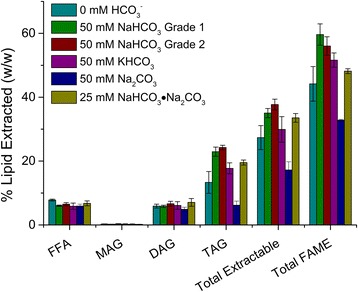
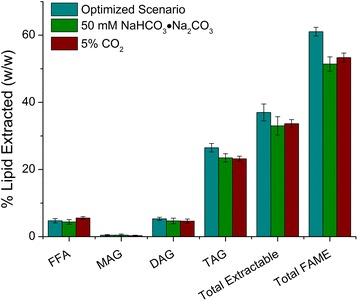
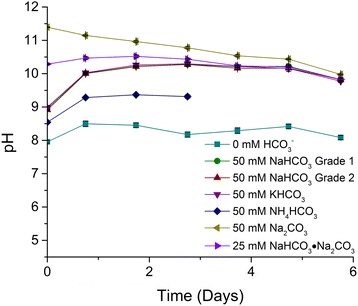
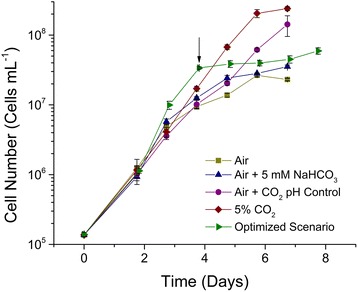
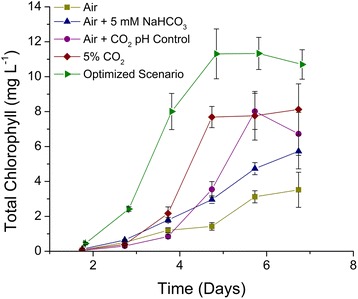
A two-phase optimal growth and lipid accumulation scenario is presented, which (1) enhances the growth rate and (2) the triacylglyceride (TAG) accumulation rate in the oleaginous Chlorophyte Chlorella vulgaris strain UTEX 395, by growing the organism in the presence of low concentrations of NaHCO3 (5 mM) and controlling the pH of the system with a periodic gas sparge of 5 % CO2 (v/v). Once cultures reached the desired cell densities, which can be "fine-tuned" based on initial nutrient concentrations, cultures were switched to a lipid accumulation metabolism through the addition of 50 mM NaHCO3. This two-phase approach increased the specific growth rate of C. vulgaris by 69 % compared to cultures sparged continuously with 5 % CO2 (v/v); further, biomass productivity (g L(-1) day(-1)) was increased by 27 %. Total biodiesel potential [assessed as total fatty acid methyl ester (FAME) produced] was increased from 53.3 to 61 % (FAME biomass(-1)) under the optimized conditions; biodiesel productivity (g FAME L(-1) day(-1)) was increased by 7.7 %. A bicarbonate salt screen revealed that American Chemical Society (ACS) and industrial grade NaHCO3 induced the highest TAG accumulation (% w/w), whereas Na2CO3 did not induce significant TAG accumulation. NH4HCO3 had a negative effect on cell health presumably due to ammonia toxicity. The raw, unrefined form of trona, NaHCO3∙Na2CO3 (sodium sesquicarbonate) induced TAG accumulation, albeit to a slightly lower extent than the more refined forms of sodium bicarbonate.
The strategic addition of sodium bicarbonate was found to enhance growth and lipid accumulation rates in cultures of C. vulgaris, when compared to traditional culturing strategies, which rely on continuously sparging algal cultures with elevated concentrations of CO2(g). This work presents a two-phased, improved photoautotrophic growth and lipid accumulation approach, which may result in an overall increase in algal biofuel productivity.
大规模藻类生物燃料生产受到多种因素限制,其中包括培养基中无机碳的可用性,其浓度高于大气二氧化碳所能达到的浓度。生命周期分析得出结论,向藻类培养物供应二氧化碳的相关成本是总体能源消耗的重要组成部分。
提出了一种两阶段的最佳生长和脂质积累方案,该方案通过在低浓度碳酸氢钠(5 mM)存在下培养普通小球藻(Chlorella vulgaris)菌株UTEX 395,并通过定期通入5%二氧化碳(v/v)气体来控制系统pH值,从而(1)提高生长速率,(2)提高产油绿藻普通小球藻中三酰甘油(TAG)的积累速率。一旦培养物达到所需的细胞密度(可根据初始营养浓度进行“微调”),通过添加50 mM碳酸氢钠将培养物切换至脂质积累代谢阶段。与持续通入5%二氧化碳(v/v)的培养物相比,这种两阶段方法使普通小球藻的比生长速率提高了69%;此外,生物量生产力(g L⁻¹ 天⁻¹)提高了27%。在优化条件下,总生物柴油潜力(以产生的总脂肪酸甲酯(FAME)评估)从53.3%提高到61%(FAME生物量⁻¹);生物柴油生产力(g FAME L⁻¹ 天⁻¹)提高了7.7%。碳酸氢盐筛选表明,美国化学学会(ACS)级和工业级碳酸氢钠诱导的TAG积累最高(% w/w),而碳酸钠未诱导显著的TAG积累。碳酸氢铵对细胞健康有负面影响,可能是由于氨毒性。天然未精制的天然碱,即碳酸氢钠∙碳酸钠(倍半碳酸钠)诱导了TAG积累,尽管程度略低于更精制的碳酸氢钠形式。
与传统培养策略相比,传统策略依赖于向藻类培养物持续通入高浓度二氧化碳(g),研究发现战略性添加碳酸氢钠可提高普通小球藻培养物的生长和脂质积累速率。这项工作提出了一种两阶段的、改进的光合自养生长和脂质积累方法,这可能会导致藻类生物燃料生产力的总体提高。