Kang H J, Trang N H, Baik M
Department of Agricultural Biotechnology and Research Institute of Agriculture and Life Sciences, College of Agriculture and Life Sciences, Seoul National University, Seoul 151-921, Korea ; Institute of Green Bio Science Technology, Pyeungchang 232-916, Korea .
Asian-Australas J Anim Sci. 2015 Aug;28(8):1187-93. doi: 10.5713/ajas.15.0056.
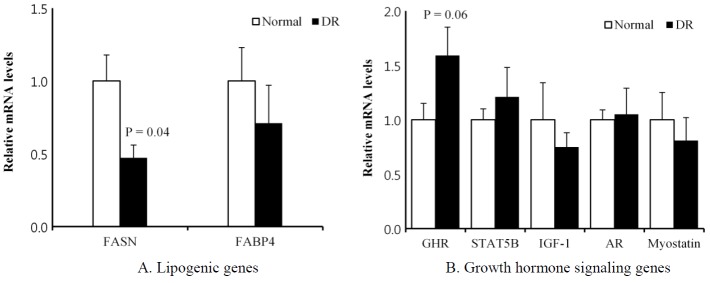
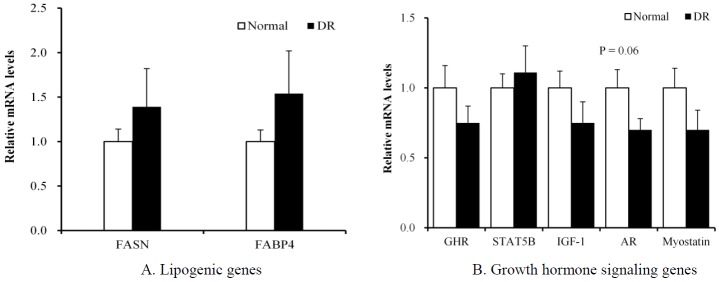
This study determined the effects of dietary restriction on growth and the expression of lipid metabolism and growth hormone signaling genes in the longissimus dorsi muscle (LM) of Korean cattle. Thirty-one Korean cattle steers (average age 10.5 months) were allocated to normal (N; n = 16) or dietary restriction (DR; n = 15) groups. The feeding trial consisted of two stages: for the 8-month growing period, the DR group was fed 80% of the food intake of the normal diet, and for the 6-month growth-finishing period, the DR group was fed a DR total mixed ration with 78.4% of the crude protein and 64% of the net energy for gain of the normal diet. The LM was biopsied 5 months (period 1 [P1] at 15.5 months of age) and 14 months (period 2 [P2] at 24.5 months of age) after the start of feeding. The mRNA levels were determined using real-time polymerase chain reaction. Body weight, daily feed intake, average daily gain, and feed efficiency were lower in the DR group compared with the normal group at both P1 and P2. At P1, the lipogenic fatty acid synthase (FASN) mRNA levels were lower (p<0.05) in the DR group compared with the normal group. The DR group tended (p = 0.06) to have higher of levels of growth hormone receptor (GHR) mRNA than the normal group. At P2, the DR group tended to have lower (p = 0.06) androgen receptor (AR) mRNA levels than the normal group. In conclusion, our results demonstrate that dietary restriction partially decreases the transcription of lipogenic FASN and growth hormone signaling AR genes, but increases transcription of the GHR gene. These changes in gene transcription might affect body fat accumulation and the growth of the animals.
本研究确定了限饲对韩牛背最长肌(LM)生长以及脂质代谢和生长激素信号基因表达的影响。31头韩牛阉牛(平均年龄10.5个月)被分配到正常(N;n = 16)或限饲(DR;n = 15)组。饲养试验包括两个阶段:在8个月的生长期,DR组的采食量为正常日粮的80%,在6个月的生长育肥期,DR组饲喂一种限饲全混合日粮,其粗蛋白含量为正常日粮的78.4%,净能为正常日粮的64%。在开始饲喂后5个月(15.5月龄时的第1阶段[P1])和14个月(24.5月龄时的第2阶段[P2])对LM进行活检。使用实时聚合酶链反应测定mRNA水平。在P1和P2时,DR组的体重、日采食量、平均日增重和饲料效率均低于正常组。在P1时,DR组的生脂脂肪酸合酶(FASN)mRNA水平低于正常组(p<0.05)。DR组的生长激素受体(GHR)mRNA水平倾向于高于正常组(p = 0.06)。在P2时,DR组的雄激素受体(AR)mRNA水平倾向于低于正常组(p = 0.06)。总之,我们的结果表明,限饲部分降低了生脂FASN和生长激素信号AR基因的转录,但增加了GHR基因的转录。这些基因转录的变化可能会影响动物的体脂积累和生长。