Ferlatte Olivier, Dulai Joshun, Hottes Travis Salway, Trussler Terry, Marchand Rick
Faculty of Health Sciences, Simon Fraser University, Blusson Hall Room 11300, 8888 University Drive, Burnaby, BC, V5A 1S6, Canada.
Community-Based Research Centre for Gay Men's Health, Vancouver, Canada.
BMC Public Health. 2015 Jul 2;15:597. doi: 10.1186/s12889-015-1961-5.
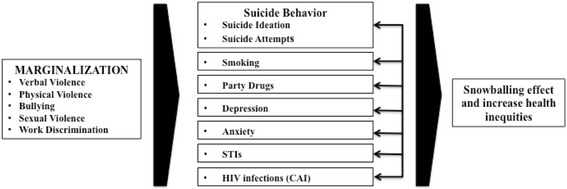
While several studies have demonstrated that gay and bisexual men are at increased risk of suicide less attention has been given to the processes that generate the inherent inequity with the mainstream population. This study tested whether syndemic theory can explain the excess suicide burden in a sample of Canadian gay and bisexual men. Syndemic theory accounts for co-occurring and mutually reinforcing epidemics suffered by vulnerable groups due to the effects of social marginalization.
This study used data from Sex Now 2011, a cross-sectional survey of Canadian gay and bisexual men (n = 8382). The analysis measured the extent to which anti-gay marginalization and several psychosocial health problems are associated with suicide related ideation and attempts. Since psychosocial health problems were hypothesized to have an additive effect on suicide related ideation and attempts, the analysis calculated the effect of accumulated psychosocial health problems on suicide behavior.
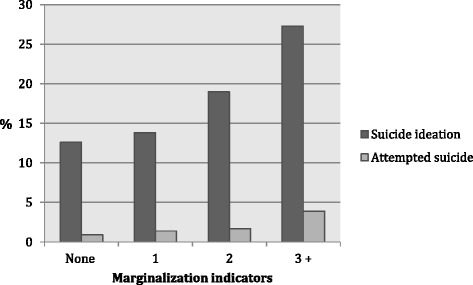
Suicide ideation and attempts were positively associated with each individual marginalization indicator (verbal violence, physical violence, bullying, sexual violence and work discrimination) and psychosocial health problems (smoking, party drugs, depression, anxiety, STIs, HIV risk and HIV). Furthermore, prevalence of suicide ideation and attempts increased with each added psychosocial health problem. Those who reported 3 or more had 6.90 (5.47-8.70) times the odds of experiencing suicide ideation and 16.29 (9.82-27.02) times the odds of a suicide attempt compared to those with no psychosocial health problems.
This investigation suggests that syndemics is a useful theory for studying suicide behavior among gay and bisexual men. Moreover, the findings highlight a need to address gay and bisexual men's health problems holistically and the urgent need to reduce this population's experience with marginalization and violence.
虽然多项研究表明男同性恋者和双性恋男性自杀风险增加,但对于导致他们与主流人群存在固有不平等现象的过程,人们关注较少。本研究检验了综合征理论能否解释加拿大男同性恋者和双性恋男性样本中过高的自杀负担。综合征理论解释了弱势群体因社会边缘化影响而同时出现且相互强化的流行病情况。
本研究使用了“当下的性”2011年的数据,这是一项对加拿大男同性恋者和双性恋男性(n = 8382)的横断面调查。分析测量了反同性恋边缘化和若干心理社会健康问题与自杀相关意念及行为的关联程度。由于假设心理社会健康问题对自杀相关意念和行为有累加效应,分析计算了累积心理社会健康问题对自杀行为的影响。
自杀意念和行为与每个个体边缘化指标(言语暴力、身体暴力、欺凌、性暴力和工作歧视)以及心理社会健康问题(吸烟、消遣性药物、抑郁、焦虑、性传播感染、感染艾滋病毒风险和感染艾滋病毒)呈正相关。此外,自杀意念和行为的患病率随着每增加一个心理社会健康问题而上升。报告有3个或更多心理社会健康问题的人出现自杀意念的几率是没有此类问题者的6.90(5.47 - 8.70)倍,自杀行为的几率是其16.29(9.82 - 27.02)倍。
本调查表明,综合征理论对于研究男同性恋者和双性恋男性的自杀行为是一个有用的理论。此外,研究结果凸显了全面解决男同性恋者和双性恋男性健康问题的必要性,以及迫切需要减少这一群体遭受边缘化和暴力的经历。