Park Joonmo, Lee Jae Won, Ye Byeong Uk, Chun Sung Hee, Joo Sang Hoon, Park Hyunwoong, Lee Heon, Jeong Hu Young, Kim Myung Hwa, Baik Jeong Min
School of Materials Science and Engineering, KIST-UNIST-Ulsan Center for Convergent Materials, Ulsan National Institute of Science and Technology (UNIST), Ulsan 689-798, Republic of Korea.
Department of Chemistry &Nano Science, Global Top 5 Program, Ewha Womans University, Seoul 120-745, Republic of Korea.
Sci Rep. 2015 Jul 7;5:11933. doi: 10.1038/srep11933.
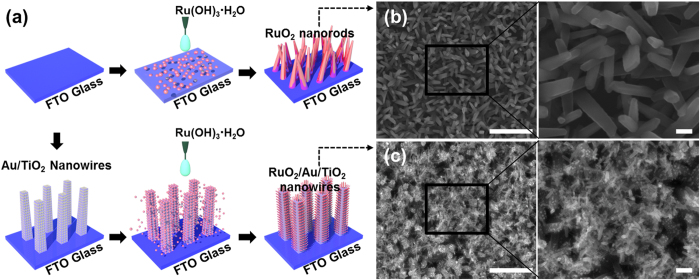
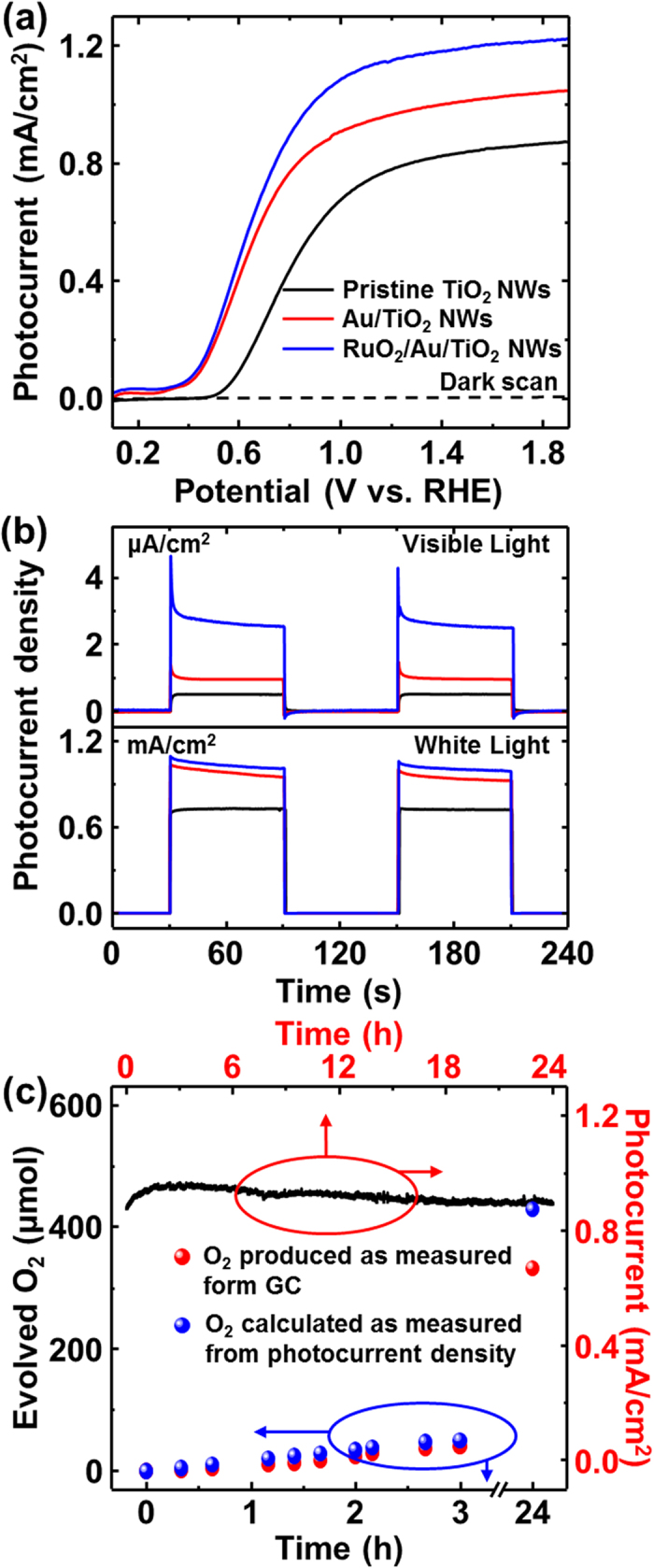
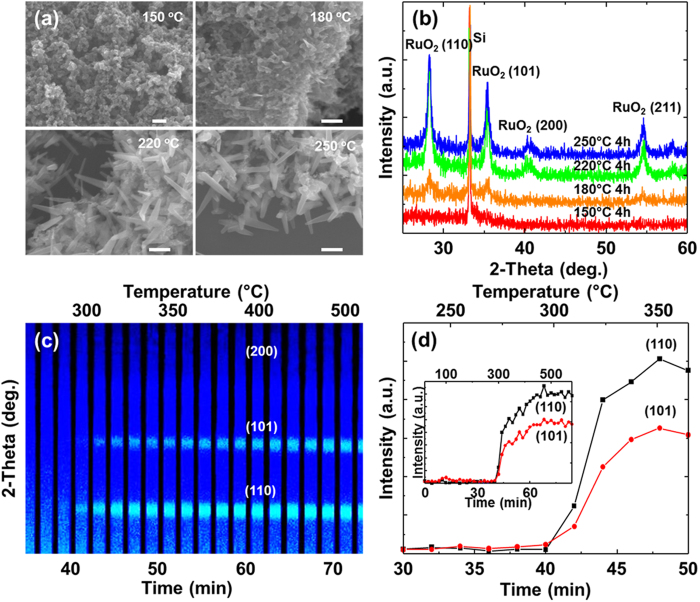
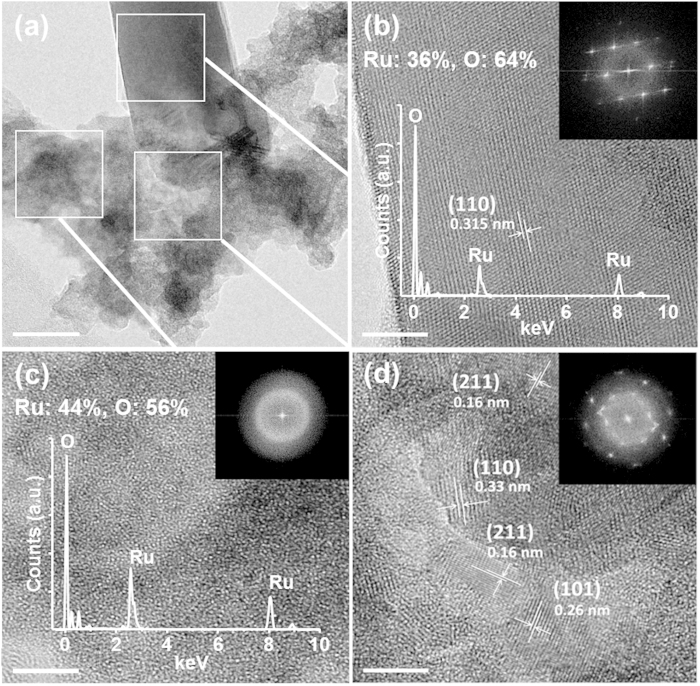
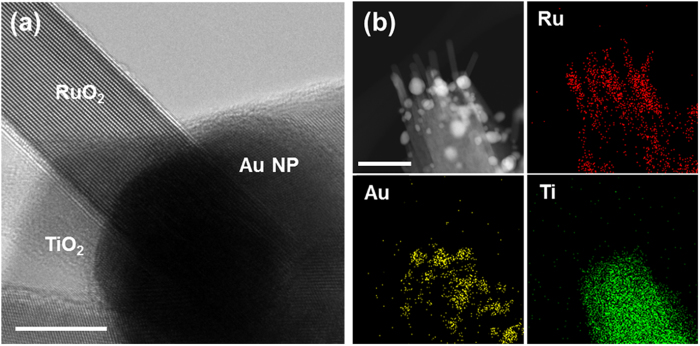
Growth mechanism of chemically-driven RuO2 nanowires is explored and used to fabricate three-dimensional RuO2 branched Au-TiO2 nanowire electrodes for the photostable solar water oxidation. For the real time structural evolution during the nanowire growth, the amorphous RuO2 precursors (Ru(OH)3 · H2O) are heated at 180 (°)C, producing the RuO2 nanoparticles with the tetragonal crystallographic structure and Ru enriched amorphous phases, observed through the in-situ synchrotron x-ray diffraction and the high-resolution transmission electron microscope images. Growth then proceeds by Ru diffusion to the nanoparticles, followed by the diffusion to the growing surface of the nanowire in oxygen ambient, supported by the nucleation theory. The RuO2 branched Au-TiO2 nanowire arrays shows a remarkable enhancement in the photocurrent density by approximately 60% and 200%, in the UV-visible and Visible region, respectively, compared with pristine TiO2 nanowires. Furthermore, there is no significant decrease in the device's photoconductance with UV-visible illumination during 1 day, making it possible to produce oxygen gas without the loss of the photoactvity.
探索了化学驱动的RuO₂纳米线的生长机制,并将其用于制备用于光稳定太阳能水氧化的三维RuO₂分支Au-TiO₂纳米线电极。对于纳米线生长过程中的实时结构演变,将非晶态RuO₂前驱体(Ru(OH)₃·H₂O)在180℃下加热,通过原位同步加速器X射线衍射和高分辨率透射电子显微镜图像观察到,生成具有四方晶体结构和富Ru非晶相的RuO₂纳米颗粒。然后,根据成核理论,通过Ru扩散到纳米颗粒,随后在氧气环境中扩散到纳米线的生长表面来继续生长。与原始TiO₂纳米线相比,RuO₂分支Au-TiO₂纳米线阵列在紫外可见和可见光区域的光电流密度分别显著提高了约60%和200%。此外,在1天的紫外可见光照下,该器件的光电导没有显著下降,从而有可能在不损失光活性的情况下产生氧气。