Mombelli Sarah, Cochaud Stéphanie, Merrouche Yacine, Garbar Christian, Antonicelli Frank, Laprevotte Emilie, Alberici Gilles, Bonnefoy Nathalie, Eliaou Jean-François, Bastid Jérémy, Bensussan Armand, Giustiniani Jérôme
1] Institut National de la Santé et de la Recherche Médicale (INSERM) U976, Hôpital Saint Louis, 75010 Paris, France [2] Université Paris Diderot, Sorbonne Paris Cité, Laboratoire Immunologie Dermatologie &Oncologie, UMR-S 976, F-75475, Paris, France [3] Institut Jean Godinot, Unicancer, F- 51726 Reims, France [4] Université Reims-Champagne-Ardenne, DERM-I-C, EA7319, 51 rue Cognacq-Jay, 51095 Reims Cedex, France.
1] Institut National de la Santé et de la Recherche Médicale (INSERM) U976, Hôpital Saint Louis, 75010 Paris, France [2] Université Paris Diderot, Sorbonne Paris Cité, Laboratoire Immunologie Dermatologie &Oncologie, UMR-S 976, F-75475, Paris, France [3] OREGA Biotech, F-69130 Ecully, France.
Sci Rep. 2015 Jul 8;5:11874. doi: 10.1038/srep11874.
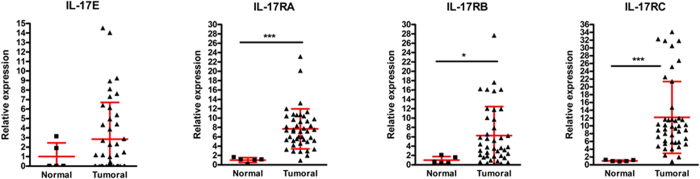
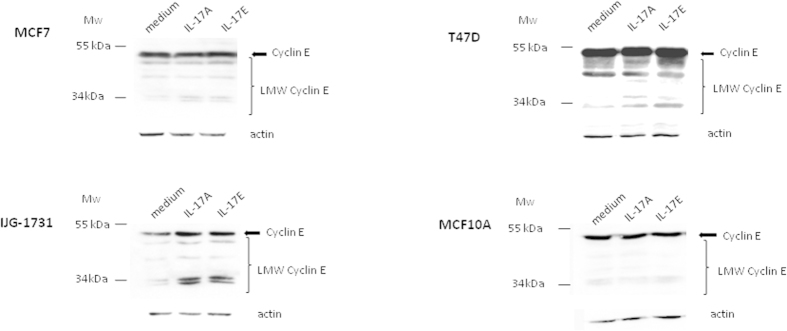
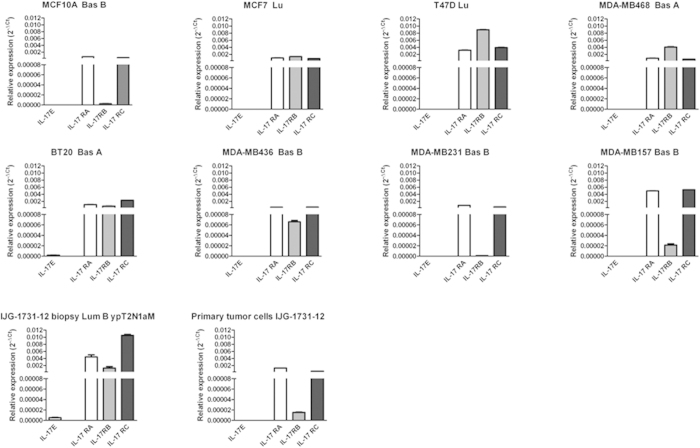
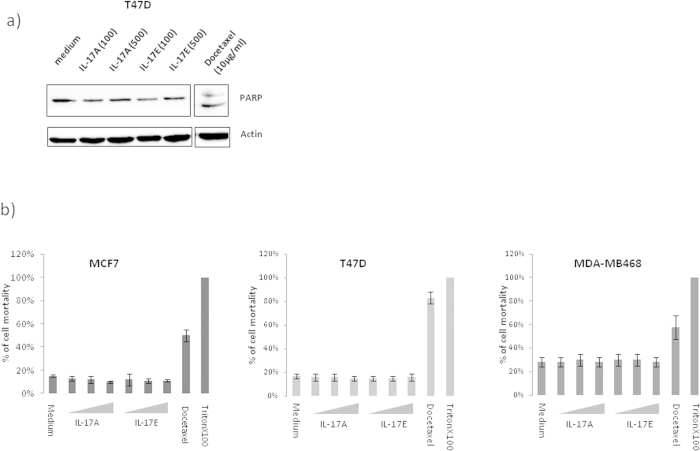
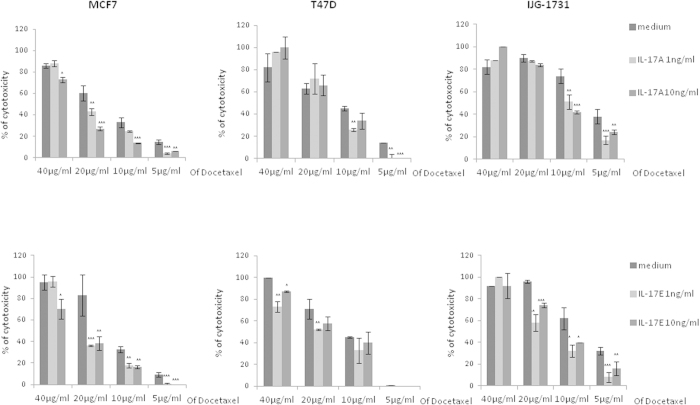
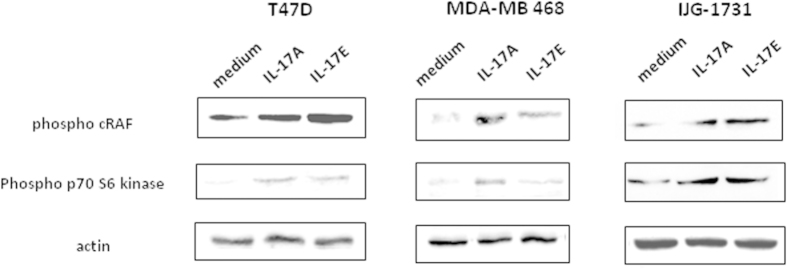
Pro-inflammatory IL-17 cytokines were initially described for their pathogenic role in chronic inflammatory diseases and subsequent accumulating evidence indicated their involvement in carcinogenesis. In the present study we report that IL-17A and IL-17E receptors subunits mRNA expressions are upregulated in breast cancers versus normal samples. IL-17E, which is undetectable in most normal breast tissues tested, seems more expressed in some tumors. Investigation of the molecular signaling following stimulation of human breast cancer cell lines with IL-17A and IL-17E showed that both cytokines induced the phosphorylation of c-RAF, ERK1/2 and p70 S6 Kinase were involved in the proliferation and survival of tumor cells. Accordingly, IL-17A and IL-17E promoted resistance to Docetaxel and failed to induce apoptosis as previously reported for IL-17E. Interestingly, we also revealed that both cytokines induced the generation of tumorogenic low molecular weight forms of cyclin E (LMW-E), which high levels correlated strongly with a poor survival in breast cancer patients. These results show for the first time some of the molecular pathways activated by IL-17A and IL-17E that may participate to their pro-oncogenic activity in breast cancers.
促炎细胞因子IL-17最初因其在慢性炎症性疾病中的致病作用而被描述,随后越来越多的证据表明它们参与致癌过程。在本研究中,我们报告与正常样本相比,乳腺癌中IL-17A和IL-17E受体亚基的mRNA表达上调。在大多数测试的正常乳腺组织中无法检测到的IL-17E,在一些肿瘤中似乎表达更多。用IL-17A和IL-17E刺激人乳腺癌细胞系后对分子信号的研究表明,这两种细胞因子均诱导c-RAF、ERK1/2和p70 S6激酶磷酸化,这些激酶参与肿瘤细胞的增殖和存活。因此,IL-17A和IL-17E促进了对多西他赛的耐药性,并且未能如先前报道的IL-17E那样诱导细胞凋亡。有趣的是,我们还发现这两种细胞因子均诱导产生致癌性低分子量形式的细胞周期蛋白E(LMW-E),其高水平与乳腺癌患者的不良生存率密切相关。这些结果首次显示了IL-17A和IL-17E激活的一些分子途径,这些途径可能参与它们在乳腺癌中的促癌活性。