
巨自噬内质网自噬在内质网质量控制中的作用
A Role for Macro-ER-Phagy in ER Quality Control.
作者信息
Lipatova Zhanna, Segev Nava
机构信息
Department of Biochemistry and Molecular Genetics, University of Illinois at Chicago, Chicago, Illinois, United States of America.
出版信息
PLoS Genet. 2015 Jul 16;11(7):e1005390. doi: 10.1371/journal.pgen.1005390. eCollection 2015 Jul.
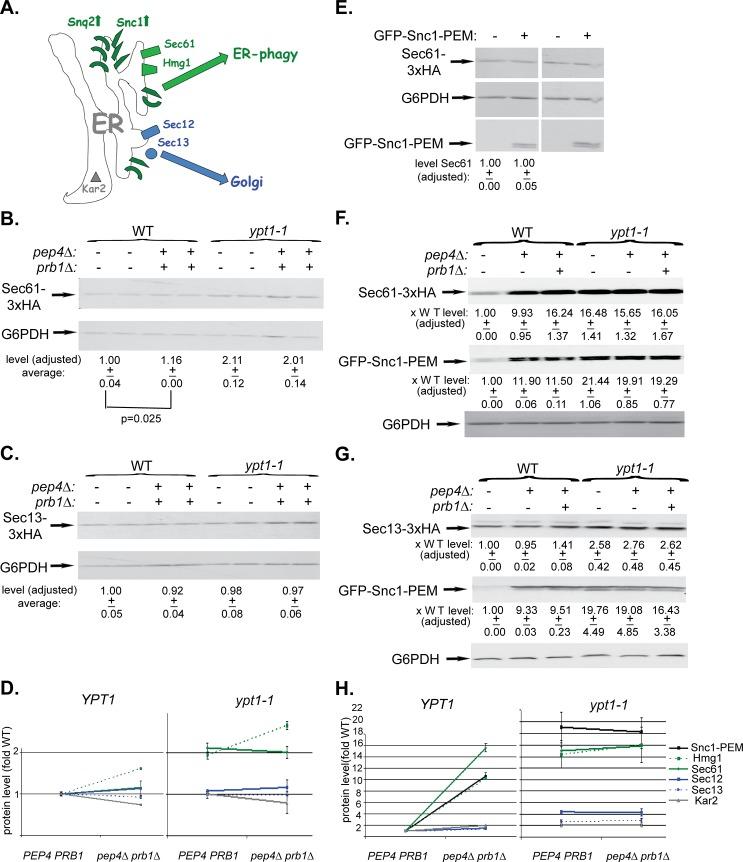
The endoplasmic-reticulum quality-control (ERQC) system shuttles misfolded proteins for degradation by the proteasome through the well-defined ER-associated degradation (ERAD) pathway. In contrast, very little is known about the role of autophagy in ERQC. Macro-autophagy, a collection of pathways that deliver proteins through autophagosomes (APs) for degradation in the lysosome (vacuole in yeast), is mediated by autophagy-specific proteins, Atgs, and regulated by Ypt/Rab GTPases. Until recently, the term ER-phagy was used to describe degradation of ER membrane and proteins in the lysosome under stress: either ER stress induced by drugs or whole-cell stress induced by starvation. These two types of stresses induce micro-ER-phagy, which does not use autophagic organelles and machinery, and non-selective autophagy. Here, we characterize the macro-ER-phagy pathway and uncover its role in ERQC. This pathway delivers 20-50% of certain ER-resident membrane proteins to the vacuole and is further induced to >90% by overexpression of a single integral-membrane protein. Even though such overexpression in cells defective in macro-ER-phagy induces the unfolded-protein response (UPR), UPR is not needed for macro-ER-phagy. We show that macro-ER-phagy is dependent on Atgs and Ypt GTPases and its cargo passes through APs. Moreover, for the first time the role of Atg9, the only integral-membrane core Atg, is uncoupled from that of other core Atgs. Finally, three sequential steps of this pathway are delineated: Atg9-dependent exit from the ER en route to autophagy, Ypt1- and core Atgs-mediated pre-autophagsomal-structure organization, and Ypt51-mediated delivery of APs to the vacuole.
内质网质量控制系统(ERQC)通过明确的内质网相关降解(ERAD)途径,将错误折叠的蛋白质转运至蛋白酶体进行降解。相比之下,自噬在内质网质量控制中的作用却鲜为人知。巨自噬是一系列通过自噬体(APs)将蛋白质转运至溶酶体(酵母中的液泡)进行降解的途径,由自噬特异性蛋白Atgs介导,并受Ypt/Rab GTP酶调控。直到最近,“内质网自噬”一词仍用于描述在应激状态下内质网的膜和蛋白质在溶酶体中的降解:药物诱导的内质网应激或饥饿诱导的全细胞应激。这两种应激会诱导微内质网自噬,其不使用自噬细胞器和机制,以及非选择性自噬。在此,我们描述了巨内质网自噬途径,并揭示了其在内质网质量控制中的作用。该途径将20%-50%的某些内质网驻留膜蛋白转运至液泡,通过过表达单个整合膜蛋白可进一步诱导至>90%。尽管在巨内质网自噬缺陷的细胞中这种过表达会诱导未折叠蛋白反应(UPR),但巨内质网自噬并不需要UPR。我们表明巨内质网自噬依赖于Atgs和Ypt GTP酶,其货物通过自噬体。此外,首次将唯一的整合膜核心Atg即Atg9的作用与其他核心Atgs的作用区分开来。最后,描绘了该途径三个连续的步骤:Atg9依赖的从内质网出发并前往自噬、Ypt1和核心Atgs介导的自噬前体结构组织,以及Ypt51介导的自噬体向液泡的转运。



 Zotero 插件