School of Life Science and Technology, Tokyo Institute of Technology, Yokohama, Japan.
EMBO Rep. 2022 Aug 3;23(8):e55192. doi: 10.15252/embr.202255192. Epub 2022 Jun 27.
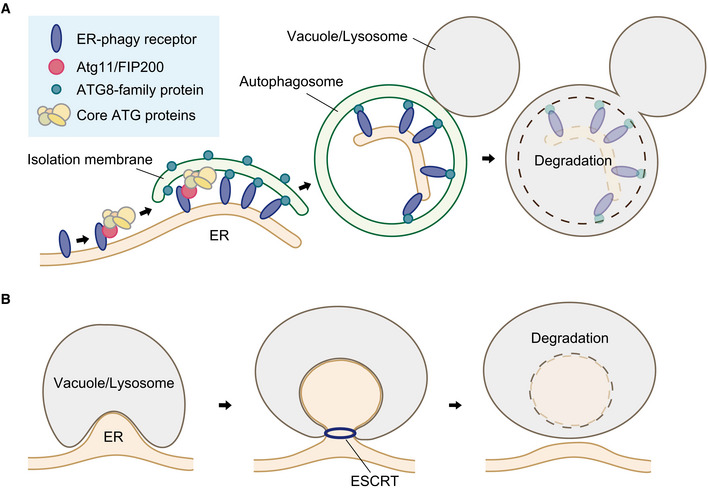
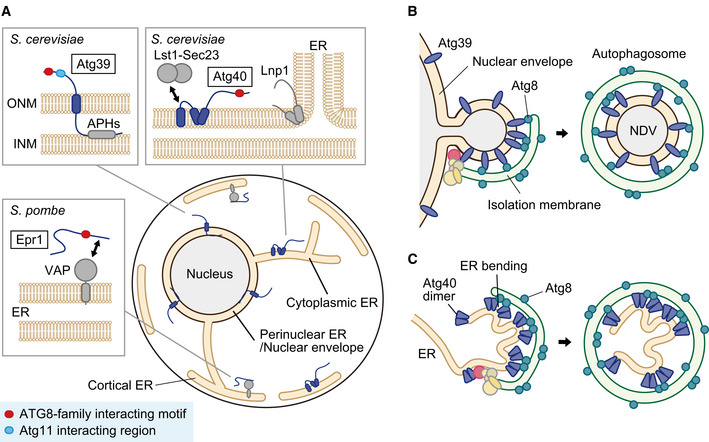
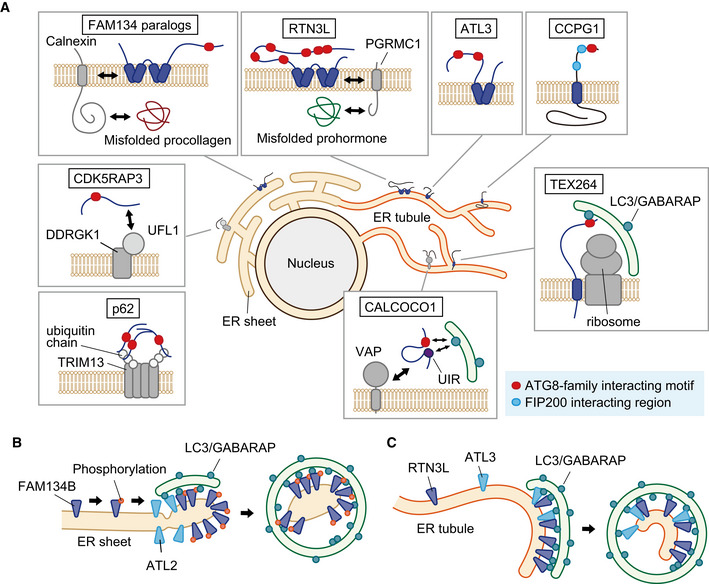
Eukaryotic cells adequately control the mass and functions of organelles in various situations. Autophagy, an intracellular degradation system, largely contributes to this organelle control by degrading the excess or defective portions of organelles. The endoplasmic reticulum (ER) is an organelle with distinct structural domains associated with specific functions. The ER dynamically changes its mass, components, and shape in response to metabolic, developmental, or proteotoxic cues to maintain or regulate its functions. Therefore, elaborate mechanisms are required for proper degradation of the ER. Here, we review our current knowledge on diverse mechanisms underlying selective autophagy of the ER, which enable efficient degradation of specific ER subdomains according to different demands of cells.
真核细胞在各种情况下都能很好地控制细胞器的质量和功能。自噬是一种细胞内降解系统,它通过降解细胞器的多余或有缺陷部分,对细胞器的控制起了重要作用。内质网(ER)是一种具有独特结构域的细胞器,与特定功能相关。内质网的质量、成分和形状会根据代谢、发育或蛋白毒性等信号发生动态变化,以维持或调节其功能。因此,需要精细的机制来实现内质网的正确降解。在这里,我们综述了目前关于内质网选择性自噬的多种机制的认识,这些机制能够根据细胞的不同需求,有效地降解特定的内质网亚区。