Cheng Yi, Gao Junyi, Wang Jiong, Wang Shuang, Peng Jianjun
From the Department of Diagnostic Ultrasound, Beijing An Zhen Hospital (YC, JW); and Department of Cardiology, Beijing Shi Ji Tan Hospital, Affiliated of Capital University of Medical Sciences, Beijing, China (JYG, SW, JJP). *Yi Cheng and Junyi Gao contributed equally to this article as the co-first author.
Medicine (Baltimore). 2015 Jul;94(28):e1119. doi: 10.1097/MD.0000000000001119.
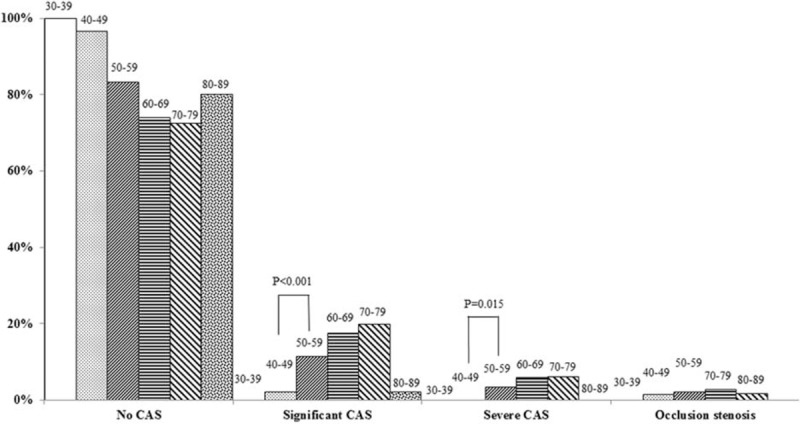
Current guidelines established in the USA and Europe for coronary artery bypass graft (CABG) suggest that patients ≥65 and ≥70 years of age, or with certain atherosclerotic-risk factors, should be screened preoperatively for extracranial carotid artery stenosis (CAS) to assess their risk of perioperative stoke. We sought factors that should be taken into consideration when treating Chinese CABG patients using CABG guidelines based on an analysis of CAS in a large cohort of Chinese CABG patients. We analyzed data for 1558 Chinese CABG patients who were screened preoperatively for CAS using duplex ultrasonography at a single institution. We defined significant and severe CAS as ≥50% and ≥70% stenosis, respectively, in one or more common or internal carotid arteries. We investigated the prevalence of CAS, the incidence of perioperative stroke, and the risk factors for CAS in the CABG cohort. The prevalence of CAS in the CABG cohort was 21.2%. Multivariate stepwise logistic regression analysis showed that an age ≥50 years and a history of smoking (odds ratios = 8.36 and 1.83, respectively) were independent risk factors for CAS (P < 0.05 for both). The incidence of perioperative stroke among CABG patients with significant or severe CAS was significantly higher (2.4% and 2.9%, respectively) than in CABG patients with <50% stenosis (0.5%; P = 0.004 and 0.029, respectively). Chinese CABG patients with a history of smoking or ≥50 years of age should undergo preoperative screening for CAS to assess their risk of perioperative stroke.
美国和欧洲制定的现行冠状动脉旁路移植术(CABG)指南表明,年龄≥65岁和≥70岁的患者,或有某些动脉粥样硬化风险因素的患者,应在术前筛查颅外颈动脉狭窄(CAS),以评估其围手术期卒中风险。我们基于对一大群中国CABG患者的CAS分析,寻找在使用CABG指南治疗中国CABG患者时应考虑的因素。我们分析了在一家机构对1558例中国CABG患者术前使用双功超声筛查CAS的数据。我们将一条或多条颈总动脉或颈内动脉中≥50%和≥70%的狭窄分别定义为显著和严重CAS。我们调查了CABG队列中CAS的患病率、围手术期卒中的发生率以及CAS的风险因素。CABG队列中CAS的患病率为21.2%。多因素逐步逻辑回归分析显示,年龄≥50岁和吸烟史(比值比分别为8.36和1.83)是CAS的独立危险因素(两者P均<0.05)。有显著或严重CAS的CABG患者围手术期卒中的发生率显著高于狭窄<50%的CABG患者(分别为2.4%和2.9%比0.5%;P分别为0.004和0.029)。有吸烟史或年龄≥50岁的中国CABG患者应接受术前CAS筛查,以评估其围手术期卒中风险。