Park Vivian Y, Kim Eun-Kyung, Lee Hye Sun, Moon Hee Jung, Yoon Jung Hyun, Kwak Jin Young
From the Department of Radiology, Research Institute of Radiological Science, Severance Hospital (VYP, E-KK, HJM, JHY, JYK); and Biostatistics Collaboration Unit, Medical Research Center, Yonsei University, College of Medicine, Seoul, Korea (HSL).
Medicine (Baltimore). 2015 Jul;94(28):e1149. doi: 10.1097/MD.0000000000001149.
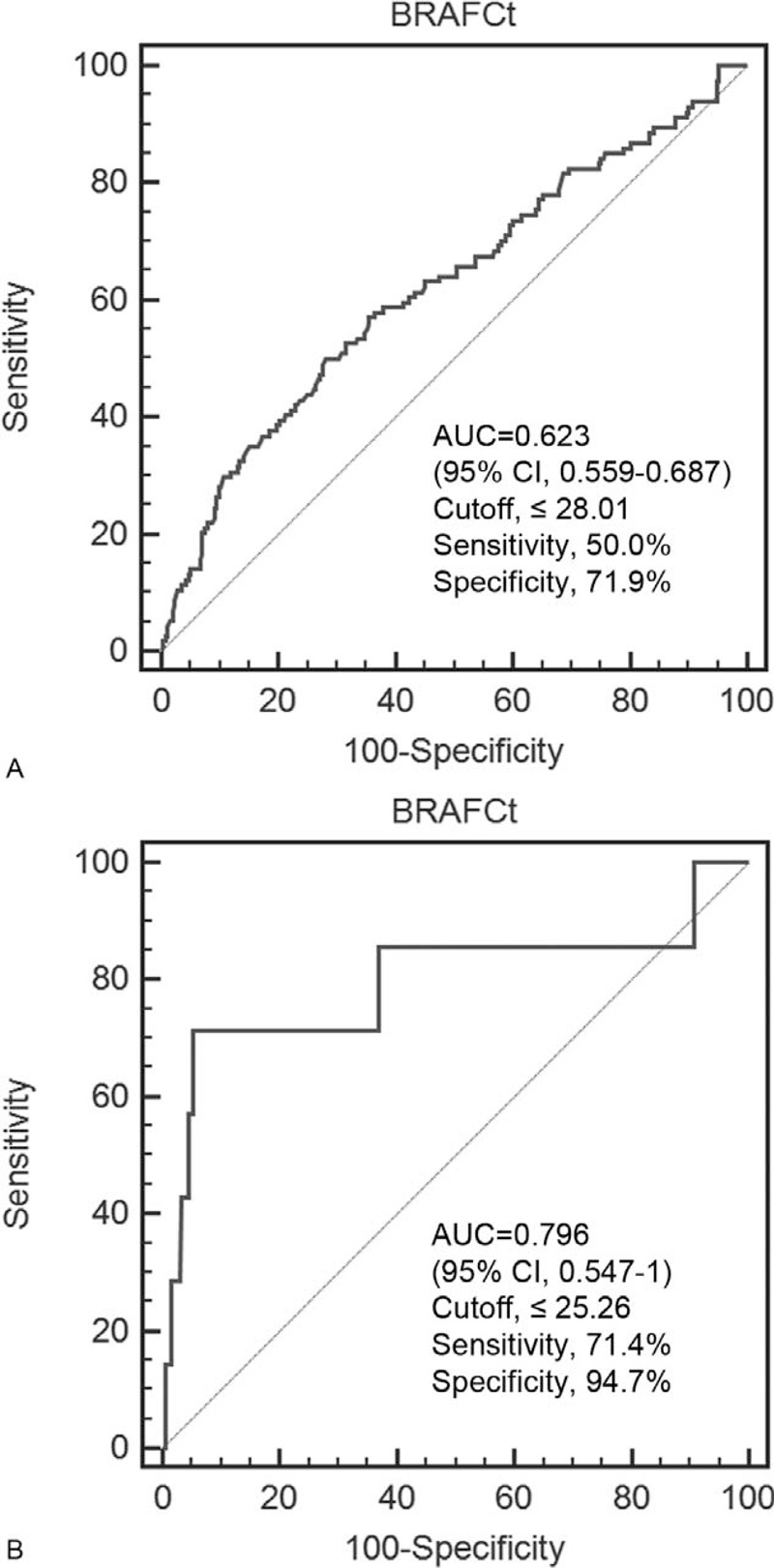
Papillary thyroid microcarcinoma (PTMC) usually has excellent prognosis, but a small subset shows aggressive behavior. Although the B-Raf proto-oncogene, serine/threonine kinase (BRAF)V600E mutation is the most common oncogenic alteration in PTMCs, it is frequently heterogeneously distributed within tumors. The aim of this study was to investigate the association of the BRAFV600E mutation found in fine needle aspirates from PTMCs with known clinicopathologic prognostic factors, based on both its presence and a quantitative approach that uses cycle threshold (Ct) values obtained by a real-time PCR technique. The 460 PTMC patients were included, with 367 patients having the BRAFV600E mutation. Clinicopathologic variables were compared between patients with and without the BRAFV600E mutation. BRAFV600E Ct values were compared according to clinicopathologic prognostic factors. Multivariate analyses were performed to evaluate factors predicting extrathyroidal extension and central and lateral lymph node metastasis (LNM). Each analysis used either the BRAFV600E mutation status or the Ct value as an independent variable for all the study patients and the 367 BRAFV600E-positive patients. Receiver-operating characteristic (ROC) curve analysis was performed to evaluate the diagnostic performance of BRAFV600E Ct values in predicting central and lateral LNM. The BRAFV600E mutation status was not associated with clinicopathologic prognostic factors among the 460 PTMC patients. Of the 367 BRAFV600E-positive patients, Ct values were significantly lower in patients with central and lateral LNM (P < 0.001, P = 0.007). The Ct value was the only independent factor to predict central LNM (OR 0.918, P = 0.025). The area under the ROC curve (AUC) for diagnosing central LNM was 0.623 (sensitivity, 50.0%; specificity, 71.9%) and for diagnosing lateral LNM, it was 0.796 (sensitivity, 71.4%; specificity, 94.7%). In conclusion, real-time PCR Ct values for the BRAFV600E mutation obtained from fine needle aspirates can be associated with central LNM in PTMC patients. Although BRAFV600E Ct values did not reach statistical significance for predicting lateral LNM in our study, further validation through larger studies can be used to overcome any possible type-II errors. With further studies, Ct values for the BRAFV600E mutation obtained from fine needle aspirates may have important implications for predicting both central and lateral LNM in patients with PTMCs.
甲状腺微小乳头状癌(PTMC)通常预后良好,但一小部分表现出侵袭性行为。尽管B-Raf原癌基因丝氨酸/苏氨酸激酶(BRAF)V600E突变是PTMC中最常见的致癌改变,但它在肿瘤内常呈异质性分布。本研究的目的是基于PTMC细针穿刺抽吸物中发现的BRAFV600E突变的存在情况及其通过实时PCR技术获得的循环阈值(Ct)值的定量方法,研究其与已知临床病理预后因素的关联。纳入了460例PTMC患者,其中367例患者存在BRAFV600E突变。比较了有和没有BRAFV600E突变患者的临床病理变量。根据临床病理预后因素比较BRAFV600E Ct值。进行多因素分析以评估预测甲状腺外侵犯以及中央和侧方淋巴结转移(LNM)的因素。每项分析都将BRAFV600E突变状态或Ct值作为所有研究患者以及367例BRAFV600E阳性患者的自变量。进行了受试者操作特征(ROC)曲线分析,以评估BRAFV600E Ct值在预测中央和侧方LNM方面的诊断性能。在460例PTMC患者中,BRAFV600E突变状态与临床病理预后因素无关。在367例BRAFV600E阳性患者中,中央和侧方LNM患者的Ct值显著更低(P<0.001,P=0.007)。Ct值是预测中央LNM的唯一独立因素(OR 0.918,P=0.025)。诊断中央LNM的ROC曲线下面积(AUC)为0.623(敏感性50.0%;特异性71.9%),诊断侧方LNM的AUC为0.796(敏感性71.4%;特异性94.7%)。总之,从细针穿刺抽吸物中获得的BRAFV600E突变的实时PCR Ct值可能与PTMC患者的中央LNM相关。尽管在我们的研究中BRAFV600E Ct值在预测侧方LNM方面未达到统计学意义,但通过更大规模研究的进一步验证可用于克服任何可能的II类错误。随着进一步研究,从细针穿刺抽吸物中获得的BRAFV600E突变的Ct值可能对预测PTMC患者的中央和侧方LNM具有重要意义。