Kapaya Martha, Tong Van, Ding Helen
DB Consulting Group Inc., Silver Spring, MD, United States.
Division of Reproductive Health, National Center for Chronic Disease Prevention and Health Promotion, Centers for Disease Control and Prevention, Atlanta, GA, United States.
Prev Med. 2015 Sep;78:92-100. doi: 10.1016/j.ypmed.2015.07.008. Epub 2015 Jul 16.
Current U.S. guidelines recommend consideration of nicotine replacement therapy (NRT) for pregnant smokers if behavioral therapies fail, only under close supervision of a provider, and after discussion of known risks of continued smoking and possible risks of NRT. The percentage of pregnant smokers offered NRT by their prenatal care providers is unknown.
The study aims to calculate the percentage of pregnant smokers offered cessation intervention and NRT and assess independent associations between selected maternal characteristics and being offered NRT.
Data were analyzed from the 2009-2010 Pregnancy Risk Assessment Monitoring System from four states that asked about provider practices for prenatal smoking cessation. Adjusted prevalence ratios were calculated to examine associations between being offered NRT, selected maternal characteristics, and smoking level. Variables used in adjusted models were based on factors associated with smoking cessation during pregnancy from prior literature and included race, age, education, insurance type, and stress.
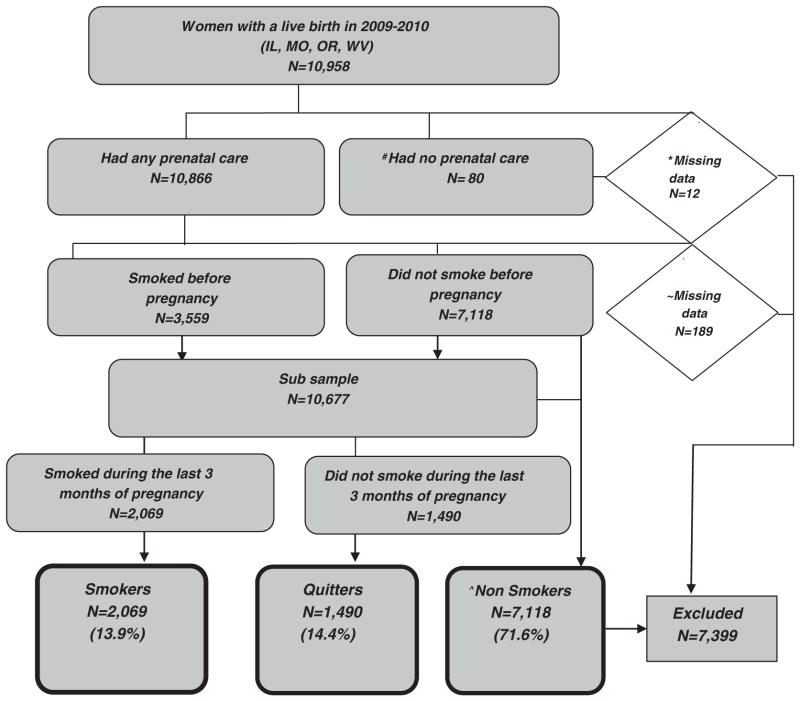
Of 3559 women who smoked 3months before pregnancy, 77.4% (95% CI: 74.2, 80.3) of 3rd trimester smokers and 42% (95% CI: 38.5, 46.4) of women who quit smoking during pregnancy were offered at least one cessation method. Among smokers, 19.1% (95% CI: 16.5, 22.1) were offered NRT and of these, almost all (94%) were offered another cessation method.
One in five pregnant smokers was offered NRT. About a quarter of pregnant smokers did not receive any interventions to stop smoking. There may still be reluctance to provide NRT to pregnant women, despite known harms of continued smoking during pregnancy.
美国现行指南建议,如果行为疗法无效,只有在医疗服务提供者的密切监督下,并且在讨论了持续吸烟的已知风险和尼古丁替代疗法(NRT)的可能风险之后,才考虑对怀孕吸烟者使用NRT。产前护理提供者为怀孕吸烟者提供NRT的比例尚不清楚。
本研究旨在计算接受戒烟干预和NRT的怀孕吸烟者的比例,并评估选定的母亲特征与接受NRT之间的独立关联。
分析了来自四个州的2009 - 2010年妊娠风险评估监测系统的数据,该系统询问了产前戒烟的医疗服务提供者的做法。计算调整后的患病率比,以检查接受NRT、选定的母亲特征和吸烟水平之间的关联。调整模型中使用的变量基于先前文献中与孕期戒烟相关的因素,包括种族、年龄、教育程度、保险类型和压力。
在怀孕前3个月吸烟的3559名女性中,孕晚期吸烟者中有77.4%(95%可信区间:74.2, 80.3),孕期戒烟的女性中有42%(95%可信区间:38.5, 46.4)至少接受了一种戒烟方法。在吸烟者中,19.1%(95%可信区间:16.5, 22.1)接受了NRT,其中几乎所有(94%)还接受了另一种戒烟方法。
五分之一的怀孕吸烟者接受了NRT。约四分之一的怀孕吸烟者没有接受任何戒烟干预。尽管已知孕期持续吸烟有害,但可能仍有人不愿意为孕妇提供NRT。