
1HchS和6HchS染色体对不同环境条件下小麦msH1细胞质雄性不育系统育性恢复的贡献
Contribution of Chromosomes 1HchS and 6HchS to Fertility Restoration in the Wheat msH1 CMS System under Different Environmental Conditions.
作者信息
Castillo Almudena, Rodríguez-Suárez Cristina, Martín Azahara C, Pistón Fernando
机构信息
Departamento de Mejora Genética Vegetal, Instituto de Agricultura Sostenible-Consejo Superior de Investigaciones Científicas, (IAS-CSIC), Córdoba, Spain.
Crop Genetics, John Innes Centre, Norwich, United Kingdom.
出版信息
PLoS One. 2015 Jul 20;10(7):e0121479. doi: 10.1371/journal.pone.0121479. eCollection 2015.
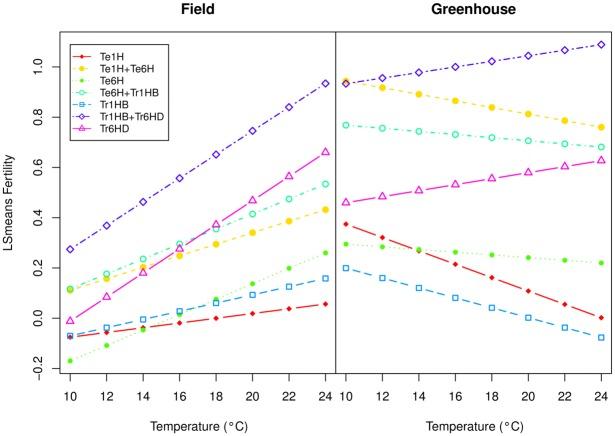
Exploiting hybrid wheat heterosis has been long pursued to increase crop yield, stability and uniformity. Cytoplasmic male sterility (CMS) systems based in the nuclear-cytoplasmic incompatible interactions are a classic way for hybrid seed production, but to date, no definitive system is available in wheat. The msH1 CMS system results from the incompatibility between the nuclear genome of wheat and the cytoplasmic genome of the wild barley Hordeum chilense. Fertility restoration of the CMS phenotype was first associated with the disomic addition of the short arm of chromosome 6H from H. chilense. In further studies it was observed that chromosome arm 1HchS was also implicated, and the combination of genes in both chromosome arms restored fertility more efficiently. In this work we aim to dissect the effect of each chromosome in fertility restoration when combined in different genomic backgrounds and under different environmental conditions. We propose a model to explain how restoration behaves in the msH1 system and generate valuable information necessary to develop an efficient system for hybrid wheat production.
长期以来,人们一直在探索利用杂交小麦杂种优势来提高作物产量、稳定性和一致性。基于核质不相容相互作用的细胞质雄性不育(CMS)系统是杂交种子生产的经典方法,但迄今为止,小麦中尚无确定的系统。msH1 CMS系统是由小麦核基因组与野生大麦智利大麦(Hordeum chilense)的细胞质基因组不相容导致的。CMS表型的育性恢复最初与添加来自智利大麦的6H染色体短臂的二体附加系有关。在进一步的研究中发现,1HchS染色体臂也与之有关,并且两个染色体臂中的基因组合能更有效地恢复育性。在这项工作中,我们旨在剖析在不同基因组背景和不同环境条件下,每条染色体在育性恢复中的作用。我们提出了一个模型来解释msH1系统中恢复作用的表现方式,并生成开发高效杂交小麦生产系统所需的有价值信息。


 Zotero 插件