Nimrouzi Majid, Sadeghpour Omid, Imanieh Mohammad Hadi, Shams Ardekani Mohammadreza, Salehi Alireza, Minaei Mohamad Bagher, Zarshenas Mohammad M
Research Institute for Islamic and Complementary Medicine, Iran University of Medical Sciences, Tehran, IR Iran ; Research Center for Traditional Medicine and History of Medicine, Shiraz University of Medical Sciences, Shiraz, IR Iran.
Research Institute for Islamic and Complementary Medicine, Iran University of Medical Sciences, Tehran, IR Iran.
Iran J Pediatr. 2015 Apr;25(2):e425. doi: 10.5812/ijp.425. Epub 2015 Apr 18.
Polyethylene glycol (PEG) is often considered as the first-line treatment for functional constipation in children. Descurainia sophia (L.) Webb et Berth (D. sophia) is a safe recommended medicine in Iranian folk and Traditional Persian Medicine for the treatment of constipation.
To clinically compare D. sophia with PEG 4000 (without electrolyte) in pediatric constipation and to assess its efficacy and side effects.
120 patients aged 2 - 12 years with constipation for at least 3 months were included in an 8 weeks lasting randomized controlled trial within two parallel-groups. Children received either PEG, 0.4 g/kg/day, or D. sophia seeds, 2 grams (for children aged 2 - 4 years) and 3 grams (for those aged > 4 years) per day.
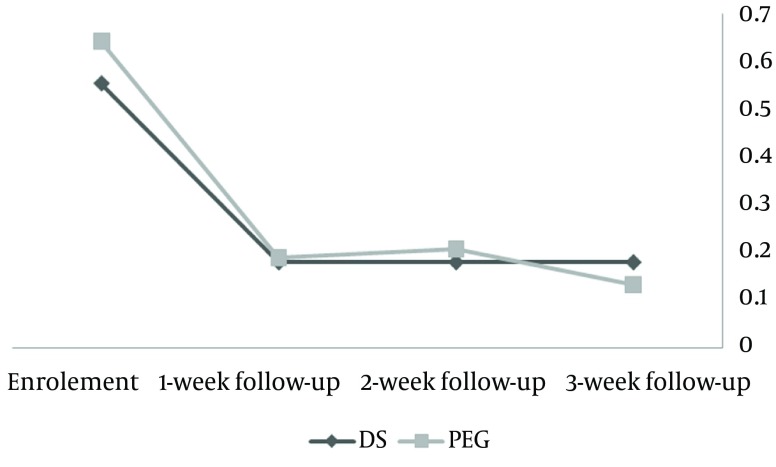
A total of 109 patients completed the study (56 in D. sophia and 53 in PEG group). At the end of the study, 36 (64.3%) patients in D. sophia group and 29 (54.7%) in PEG group were out of Rome III criteria (P = 0.205). Median weekly stool frequency in 0, 1, 2, 3 weeks of the treatment was found to be 2, 5, 5, 5 in D. sophia and 3, 4, 4, 5 in PEG group (P = 0.139, 0.076, 0.844, 0.294), respectively. The number of patients who suffered flatulence was less (5, 8.9%) in D. sophia group as compared to PEG group (6, 11.3%) at the end of the trial (P = 0.461). D. sophia taste was less tolerated.
D. sophia is introduced as a cheap and available medication which can be applied as a safe alternative to conventional PEG in the management of pediatric chronic functional constipation.
聚乙二醇(PEG)常被视为儿童功能性便秘的一线治疗药物。播娘蒿是伊朗民间医学和传统波斯医学中推荐用于治疗便秘的一种安全药物。
在儿科便秘患者中对播娘蒿与聚乙二醇4000(无电解质)进行临床比较,并评估其疗效和副作用。
120名年龄在2至12岁、便秘至少3个月的患者被纳入一项为期8周的随机对照试验,分为两个平行组。儿童分别接受每日0.4 g/kg的PEG或播娘蒿种子,2克(2至4岁儿童)和3克(4岁以上儿童)。
共有109名患者完成研究(播娘蒿组56名,PEG组53名)。研究结束时,播娘蒿组36名(64.3%)患者和PEG组29名(54.7%)患者符合罗马III标准(P = 0.205)。治疗第0、1、2、3周时,播娘蒿组每周排便次数中位数分别为2、5、5、5,PEG组分别为3、4、4、5(P分别为0.139、0.076、0.844、0.294)。试验结束时,播娘蒿组出现肠胃胀气的患者人数(5名,8.9%)少于PEG组(6名,11.3%)(P = 0.461)。播娘蒿的味道较难被接受。
播娘蒿是一种廉价且可得药物,可作为传统PEG的安全替代品用于小儿慢性功能性便秘的治疗。