Downs Shauna M, Singh Archna, Gupta Vidhu, Lock Karen, Ghosh-Jerath Suparna
Menzies Centre for Health Policy, University of Sydney, Sydney, Australia.
Indian Institute for Public Health, Public Health Foundation of India and All India Institute of Medical Sciences, Delhi, India.
BMC Public Health. 2015 Jul 22;15:693. doi: 10.1186/s12889-015-1988-7.
The World Health Organization (WHO) recommends virtually eliminating trans fat from the global food supply. Although several high-income countries have successfully reduced trans fat levels in foods, low- and middle-income countries such as India face additional challenges to its removal from the food supply. This study provides a systems analysis of the Indian food chain to assess intervention options for reducing trans fat intake in low-income consumers.
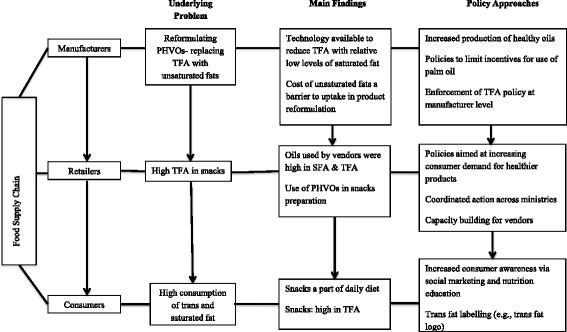
Data were collected at the manufacturer, retailer and consumer levels. Qualitative interviews were conducted with vanaspati manufacturers (n = 13) and local food vendors (n = 44). Laboratory analyses (n = 39) of street foods/snacks sold by the vendors were also conducted. Trans fat and snack intakes were also examined in low-income consumers in two rural villages (n = 260) and an urban slum (n = 261).
Manufacturers of vanaspati described reducing trans fat levels as feasible but identified challenges in using healthier oils. The fat content of sampled oils from street vendors contained high levels of saturated fat (24.7-69.3 % of total fat) and trans fat (0.1-29.9 % of total fat). Households were consuming snacks high in trans fat as part of daily diets (31 % village and 84.3 % of slum households) and 4 % of rural and 13 % of urban households exceeded WHO recommendations for trans fat intakes.
A multisectoral food chain approach to reducing trans fat is needed in India and likely in other low- and middle-income countries worldwide. This will require investment in development of competitively priced bakery shortenings and economic incentives for manufacturing foods using healthier oils. Increased production of healthier oils will also be required alongside these investments, which will become increasingly important as more and more countries begin investing in palm oil production.
世界卫生组织(WHO)建议在全球食品供应中几乎消除反式脂肪。尽管一些高收入国家已成功降低了食品中的反式脂肪含量,但印度等低收入和中等收入国家在从食品供应中去除反式脂肪方面面临额外挑战。本研究对印度食物链进行了系统分析,以评估降低低收入消费者反式脂肪摄入量的干预方案。
在制造商、零售商和消费者层面收集数据。对氢化植物油制造商(n = 13)和当地食品摊贩(n = 44)进行了定性访谈。还对摊贩出售的街头食品/小吃进行了实验室分析(n = 39)。在两个农村村庄(n = 260)和一个城市贫民窟(n = 261)的低收入消费者中也调查了反式脂肪和小吃摄入量。
氢化植物油制造商称降低反式脂肪含量可行,但指出在使用更健康的油方面存在挑战。街头摊贩采样油的脂肪含量含有高水平的饱和脂肪(占总脂肪的24.7 - 69.3%)和反式脂肪(占总脂肪的0.1 - 29.9%)。家庭将富含反式脂肪的小吃作为日常饮食的一部分(31%的农村家庭和84.3%的贫民窟家庭),4%的农村家庭和13%的城市家庭超过了WHO的反式脂肪摄入量建议。
印度以及全球其他低收入和中等收入国家需要采取多部门食物链方法来降低反式脂肪。这将需要投资开发价格具有竞争力的烘焙起酥油,并为使用更健康的油制造食品提供经济激励。随着越来越多的国家开始投资棕榈油生产,除了这些投资外,还需要增加更健康油的产量,这将变得越来越重要。