Khankhanian Pouya, Matsushita Takuya, Madireddy Lohith, Lizée Antoine, Din Lennox, Moré Jayaji M, Gourraud Pierre-Antoine, Hauser Stephen L, Baranzini Sergio E, Oksenberg Jorge R
Department of Neurology, University of California, San Francisco, 675 Nelson Rising Lane, San Francisco, CA, 94158, USA.
Current address: Graduate School of Medical Sciences, Kyushu University School of Medicine, 3-1-1, Maidashi, Higashi-ku, Fukuoka City, 812-8582, Japan.
BMC Med Genet. 2015 Jul 28;16:55. doi: 10.1186/s12881-015-0201-2.
Multiple sclerosis (MS) is an autoimmune disease of the central nervous system, with a strong genetic component. Over 100 genetic loci have been implicated in susceptibility to MS in European populations, the most prominent being the 15:01 allele of the HLA-DRB1 gene. The prevalence of MS is high in European populations including those of Ashkenazi origin, and low in African and Asian populations including those of Jewish origin.
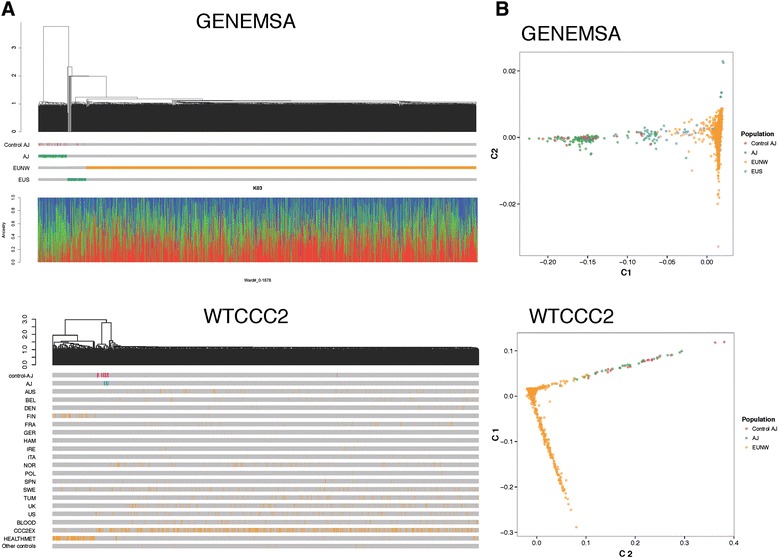
Here we identified and extracted a total of 213 Ashkenazi MS cases and 546 ethnically matched healthy control individuals from two previous genome-wide case-control association analyses, and 72 trios (affected proband and two unaffected parents) from a previous genome-wide transmission disequilibrium association study, using genetic data to define Ashkenazi. We compared the pattern of genetic risk between Ashkenazi and non-Ashkenazi Europeans. We also sought to identify novel Ashkenazi-specific risk loci by performing association tests on the subset of Ashkenazi cases, controls, probands, and parents from each study.
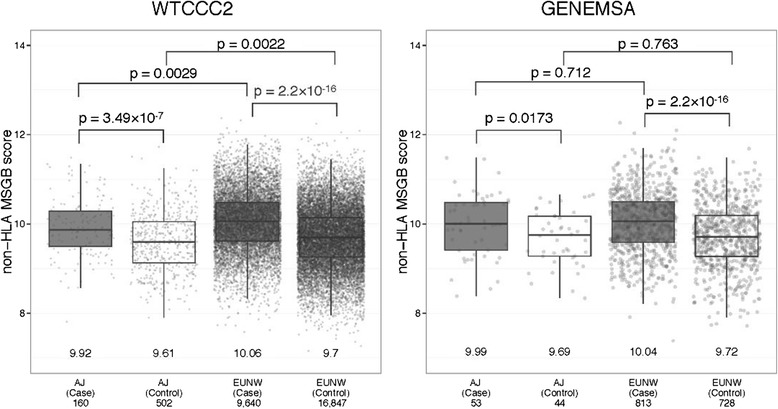
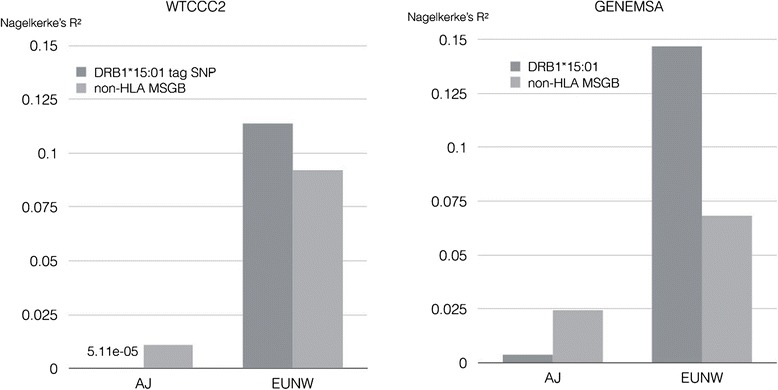
The HLA-DRB115:01 allele and the non-HLA risk alleles were present at relatively low frequencies among Ashkenazi and explained a smaller fraction of the population-level risk when compared to non-Ashkenazi Europeans. Alternative HLA susceptibility alleles were identified in an Ashkenazi-only association study, including HLA-A68:02 and one or both genes in the HLA-B38:01-HLA-C12:03 haplotype. The genome-wide screen in Ashkenazi did not reveal any loci associated with MS risk.
These results suggest that genetic susceptibility to MS in Ashkenazi Jews has not been as well established as that of non-Ashkenazi Europeans. This implies value in studying large well-characterized Ashkenazi populations to accelerate gene discovery in complex genetic diseases.
多发性硬化症(MS)是一种中枢神经系统的自身免疫性疾病,具有很强的遗传因素。在欧洲人群中,超过100个基因位点与MS易感性有关,其中最突出的是HLA - DRB1基因的15:01等位基因。MS在包括阿什肯纳兹裔在内的欧洲人群中患病率较高,而在包括犹太裔在内的非洲和亚洲人群中患病率较低。
在此,我们从之前的两项全基因组病例对照关联分析中识别并提取了总共213例阿什肯纳兹MS病例和546名种族匹配的健康对照个体,以及从之前的一项全基因组传递不平衡关联研究中提取了72个三联体(患病先证者和两名未患病的父母),使用遗传数据来定义阿什肯纳兹人。我们比较了阿什肯纳兹人和非阿什肯纳兹欧洲人之间的遗传风险模式。我们还试图通过对每项研究中的阿什肯纳兹病例、对照、先证者和父母子集进行关联测试,来识别新的阿什肯纳兹人特异性风险位点。
HLA - DRB115:01等位基因和非HLA风险等位基因在阿什肯纳兹人中的频率相对较低,与非阿什肯纳兹欧洲人相比,它们在人群水平风险中所占比例较小。在一项仅针对阿什肯纳兹人的关联研究中,识别出了替代的HLA易感性等位基因,包括HLA - A68:02以及HLA - B38:01 - HLA - C12:03单倍型中的一个或两个基因。对阿什肯纳兹人的全基因组筛查未发现任何与MS风险相关的位点。
这些结果表明,阿什肯纳兹犹太人对MS的遗传易感性尚未像非阿什肯纳兹欧洲人那样得到充分证实。这意味着研究大规模特征明确的阿什肯纳兹人群对于加速复杂遗传疾病的基因发现具有价值。