Chen Ni, Ren Meiping, Li Rong, Deng Xin, Li Yongjie, Yan Kai, Xiao Lamei, Yang Yan, Wang Liqun, Luo Mao, Fay William P, Wu Jianbo
Drug Discovery Research Center, Sichuan Medical University, Luzhou, Sichuan, People's Republic of China.
Department of Medicine, University of Missouri School of Medicine, Columbia, MO, USA.
Mol Cancer. 2015 Jul 29;14:140. doi: 10.1186/s12943-015-0418-x.
An increased incidence of venous thromboembolism (VTE) is associated with anti-vascular endothelial growth factor (VEGF) treatment in cancer. However, the mechanism underlying this effect remains elusive. In this study, we examined the effect of bevacizumab, a humanized monoclonal antibody against VEGF-A, on VTE in a murine xenograft A549 cell tumor model.
Inferior vena cava stenosis model and FeCl3-induced saphenous vein thrombosis model were performed in a mouse xenograft models of human lung adenocarcinoma.
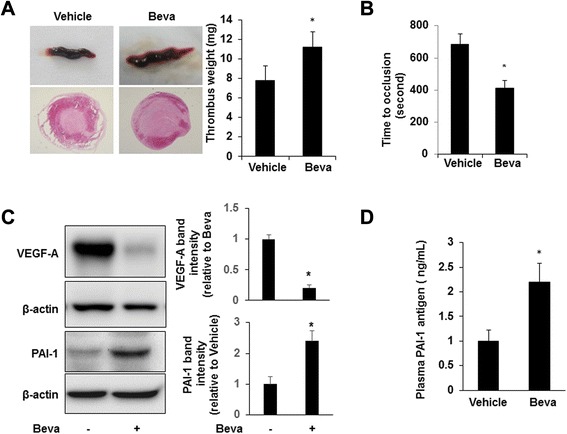
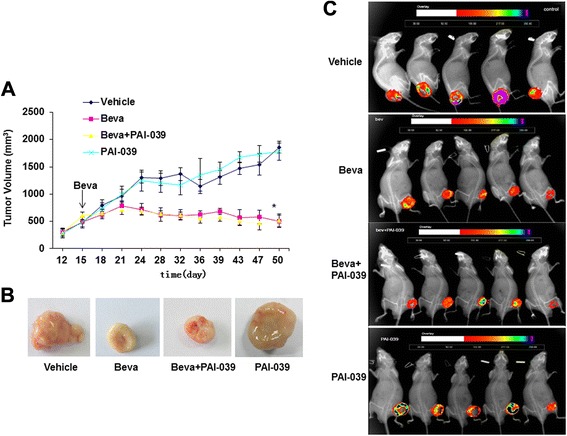
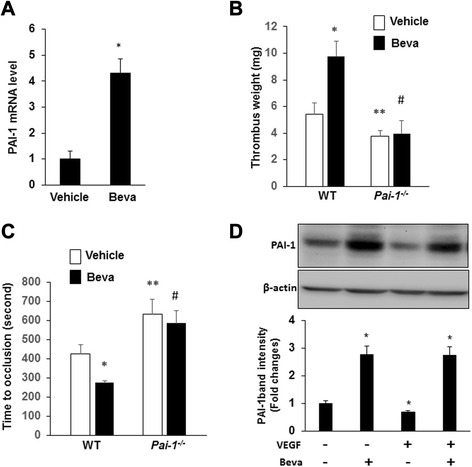
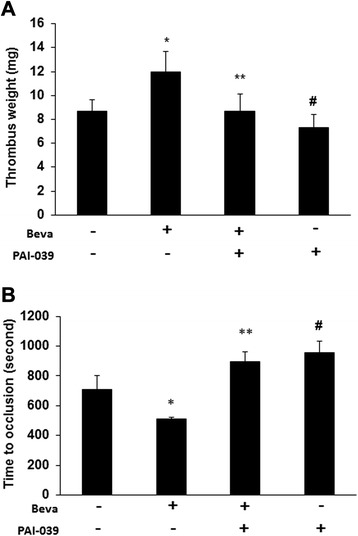
We found that treatment with bevacizumab significantly increased the thrombotic response to inferior vena cava obstruction and femoral vein injury. Plasminogen activator inhibitor (PAI-1) expression in tumors, plasma, and thrombi was significantly increased by bevacizumab. However, bevacizumab did not enhance VTE in PAI-1-deficient mice, suggesting that PAI-1 is a major mediator of bevacizumab's prothrombotic effect. VEGF inhibited expression of PAI-1 by A549 cells, and this effect was neutralized by bevacizumab, suggesting that bevacizumab increases PAI-1 expression in vivo by blocking the inhibitory effect of VEGF on PAI-1 expression by tumor cells. Pharmacological inhibition of PAI-1 with PAI-039 blocked bevacizumab-induced venous thrombosis.
Collectively, these findings indicate that PAI-1 plays a role in VTE associated with antiangiogenic therapy and the inhibition of PAI-1 shows efficacy as a therapeutic strategy for the prevention of bevacizumab-associated VTE.
静脉血栓栓塞症(VTE)发病率的增加与癌症抗血管内皮生长因子(VEGF)治疗相关。然而,这种效应背后的机制仍不清楚。在本研究中,我们在小鼠异种移植A549细胞肿瘤模型中研究了抗VEGF-A人源化单克隆抗体贝伐单抗对VTE的影响。
在人肺腺癌小鼠异种移植模型中进行下腔静脉狭窄模型和FeCl3诱导的隐静脉血栓形成模型。
我们发现,贝伐单抗治疗显著增加了对下腔静脉阻塞和股静脉损伤的血栓形成反应。贝伐单抗显著增加了肿瘤、血浆和血栓中纤溶酶原激活物抑制剂(PAI-1)的表达。然而,贝伐单抗在PAI-1缺陷小鼠中并未增强VTE,这表明PAI-1是贝伐单抗促血栓形成作用的主要介质。VEGF抑制A549细胞中PAI-1的表达,而贝伐单抗可中和这种作用,这表明贝伐单抗通过阻断VEGF对肿瘤细胞PAI-1表达的抑制作用来增加体内PAI-1的表达。用PAI-039对PAI-1进行药理抑制可阻断贝伐单抗诱导的静脉血栓形成。
总体而言,这些发现表明PAI-1在与抗血管生成治疗相关的VTE中起作用,抑制PAI-1作为预防贝伐单抗相关VTE的治疗策略显示出疗效。