Carles Misericòrdia, Brosa Max, Souto Juan Carlos, Garcia-Alamino Josep Maria, Guyatt Gordon, Alonso-Coello Pablo
Departament d'Economia and CREIP, Universitat Rovira i Virgili, Avinguda de la Universitat 1, 43204, Reus, Spain.
Oblikue Consulting, Barcelona, SL, Spain.
BMC Health Serv Res. 2015 Jul 28;15:289. doi: 10.1186/s12913-015-0934-9.
Vitamin K antagonists are commonly used for the prevention of thromboembolic events. Patient self-monitoring of vitamin K antagonists has proved superior to usual care. Dabigatran has been shown, relative to warfarin, to reduce thromboembolic events without increasing bleeding.
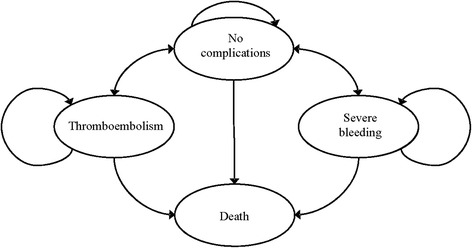
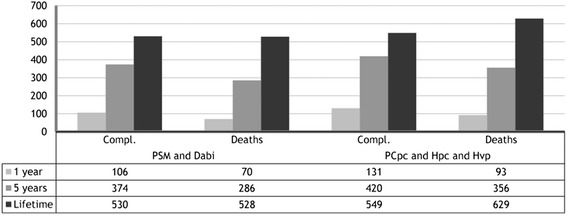
We constructed a Markov model to compare vitamin K self-monitoring strategies to dabigatran including effectiveness and costs of monitoring and complications (thromboembolism and major bleeding). The model was used to project the incidence of these complications, life years, quality-adjusted life years, and health system costs with anticoagulant treatment throughout life. The analysis was conducted from the health system perspective and from the societal perspective.
Low quality evidence suggests that self-monitoring is at least as effective as dabigatran for the outcomes of thrombosis, bleeding and death. Moderate quality evidence that patient self-monitoring is more effective than other forms of monitoring degree of anticoagulation with vitamin K antagonists, reducing the relative risk of thromboembolism by 41% and death by 34%. The cost per quality adjusted year gained relative to other warfarin monitoring strategies is well below 30,000 € in the short term, and is a dominant alternative from the fourth year. In comparison with dabigatran, the lower annual cost and its equivalence in terms of effectiveness made self-monitoring the dominant option. These results were confirmed in the probabilistic sensitivity analysis.
We have moderate quality evidence that self-monitoring of vitamin K antagonists is a cost-effective alternative compared with hospital and primary care monitoring, and low quality evidence, compared with dabigatran. Our analyses contrast with the available cost analysis of dabigatran and usual care of anticoagulated patients.
维生素K拮抗剂常用于预防血栓栓塞事件。患者自我监测维生素K拮抗剂已被证明优于常规护理。与华法林相比,达比加群已显示可减少血栓栓塞事件且不增加出血风险。
我们构建了一个马尔可夫模型,以比较维生素K自我监测策略与达比加群,包括监测的有效性和成本以及并发症(血栓栓塞和大出血)。该模型用于预测这些并发症的发生率、生命年、质量调整生命年以及终身抗凝治疗的卫生系统成本。分析是从卫生系统角度和社会角度进行的。
低质量证据表明,自我监测在血栓形成、出血和死亡结局方面至少与达比加群一样有效。中等质量证据表明,患者自我监测比其他形式的维生素K拮抗剂抗凝监测更有效,可将血栓栓塞的相对风险降低41%,死亡风险降低34%。相对于其他华法林监测策略,每获得一个质量调整年的成本在短期内远低于30,000欧元,从第四年起成为主要替代方案。与达比加群相比,较低的年度成本及其在有效性方面的等效性使自我监测成为主要选择。这些结果在概率敏感性分析中得到了证实。
我们有中等质量证据表明,与医院和初级保健监测相比,维生素K拮抗剂的自我监测是一种具有成本效益的替代方案;与达比加群相比,证据质量较低。我们的分析与现有的达比加群成本分析以及抗凝患者的常规护理形成对比。