Yu Fujun, Lu Zhongqiu, Chen Bicheng, Dong Peihong, Zheng Jianjian
Department of Infectious Diseases, The First Affiliated Hospital of Wenzhou Medical University, No.2 FuXue lane, Wenzhou, 325000, Zhejiang, People's Republic of China.
Emergency Department, The First Affiliated Hospital of Wenzhou Medical University, No.2 FuXue lane, Wenzhou, 325000, Zhejiang, People's Republic of China.
Diagn Pathol. 2015 Jul 28;10:129. doi: 10.1186/s13000-015-0369-y.
Chronic hepatitis B virus (HBV) infection is a known major etiological factor for hepatocellular carcinoma (HCC) development. Alpha-fetoprotein (AFP) is widely used to detect primary HCC, whereas its sensitivity and specificity are not satisfying. Recently, circulating microRNAs (miRNAs) have been reported to be promising biomarkers for diagnosing and monitoring cancers. This study was conducted to detect the application of serum miR-150 in the diagnosis and prognosis of HBV-related HCC.
The expression of miR-150 was evaluated using a real-time quantitative RT-PCR in 350 serum samples (120 samples from controls, 110 from chronic hepatitis B (CHB) patients and 120 samples from HCC patients.
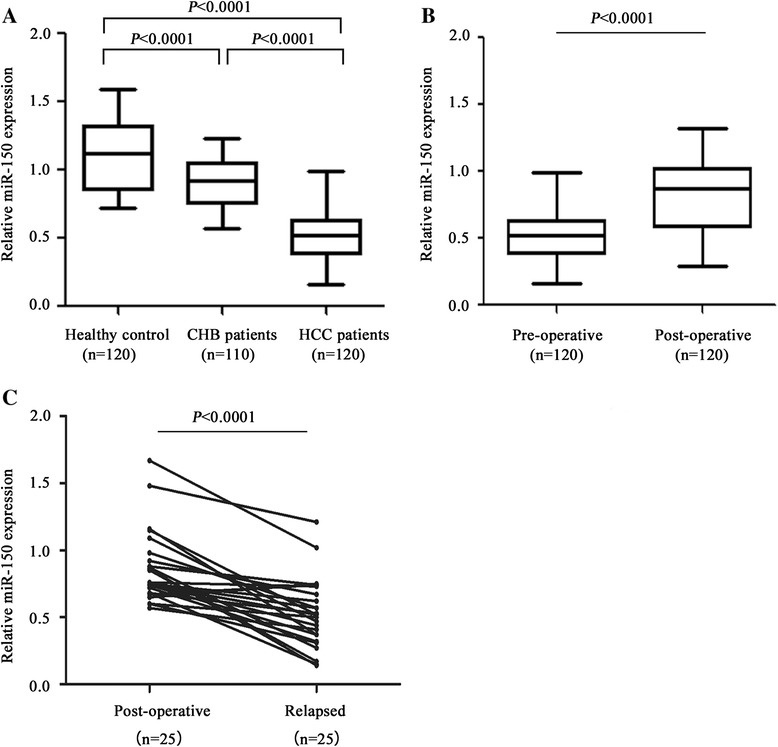
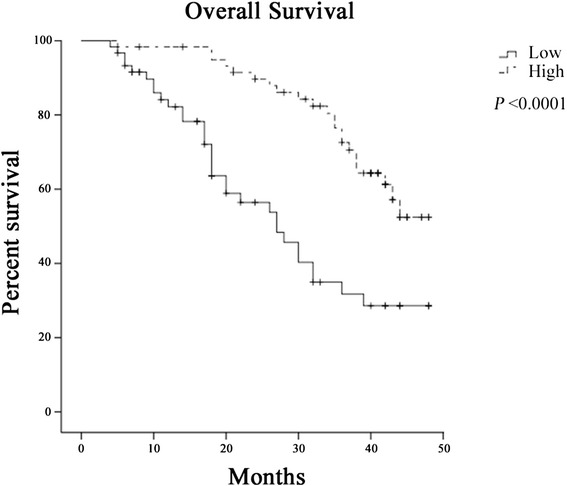
Serum miR-150 levels were significantly reduced in HCC patients, compared with healthy controls (P < 0.0001) and CHB patients (P < 0.0001). Serum miR-150 levels were increased after surgical operation (P < 0.0001) and decreased after tumor recurrence (P < 0.0001). Receiver operating characteristic curve (ROC) analyses suggested that serum miR-150 had significant diagnostic value for HBV-related HCC. It yielded an area under the curve (AUC) of ROC of 0.931 with 82.5% sensitivity and 83.7% specificity in discriminating HCC from healthy controls, and an AUC of ROC of 0.881 with 79.1% sensitivity and 76.5% specificity in discriminating HCC from CHB patients. Moreover, Kaplan-Meier curve analysis revealed that HCC patients with lower serum miR-150 had a significantly shortened overall survival (P < 0.0001). Univariate and Multivariable Cox regression analysis indicated that serum miR-150 level was an independent risk factor for overall survival (P < 0.0001 and P = 0.015, respectively).
Serum miR-150 can serve as a non-invasive biomarker for the diagnosis and prognosis of HCC patients.
慢性乙型肝炎病毒(HBV)感染是肝细胞癌(HCC)发生的已知主要病因。甲胎蛋白(AFP)被广泛用于检测原发性肝癌,但其敏感性和特异性并不令人满意。最近,循环微小RNA(miRNA)已被报道为诊断和监测癌症的有前景的生物标志物。本研究旨在检测血清miR-150在HBV相关肝癌诊断和预后中的应用。
使用实时定量逆转录聚合酶链反应(RT-PCR)评估350份血清样本(120份来自对照组,110份来自慢性乙型肝炎(CHB)患者,120份来自肝癌患者)中miR-150的表达。
与健康对照组(P < 0.0001)和CHB患者(P < 0.0001)相比,肝癌患者血清miR-150水平显著降低。手术后血清miR-150水平升高(P < 0.0001),肿瘤复发后降低(P < 0.0001)。受试者工作特征曲线(ROC)分析表明,血清miR-150对HBV相关肝癌具有显著诊断价值。在区分肝癌与健康对照组时,其ROC曲线下面积(AUC)为0.931,敏感性为82.5%,特异性为83.7%;在区分肝癌与CHB患者时,ROC的AUC为0.881,敏感性为79.1%,特异性为76.5%。此外,Kaplan-Meier曲线分析显示,血清miR-150水平较低的肝癌患者总生存期显著缩短(P < 0.0001)。单因素和多因素Cox回归分析表明,血清miR-150水平是总生存期的独立危险因素(分别为P < 0.0001和P = 0.015)。
血清miR-150可作为肝癌患者诊断和预后的非侵入性生物标志物。