Weber David R, Haynes Kevin, Leonard Mary B, Willi Steven M, Denburg Michelle R
Golisano Children's Hospital, University of Rochester School of Medicine and Dentistry, Rochester, NY
Perelman School of Medicine at the University of Pennsylvania, Philadelphia, PA.
Diabetes Care. 2015 Oct;38(10):1913-20. doi: 10.2337/dc15-0783. Epub 2015 Jul 27.
This study was conducted to determine if type 1 diabetes is associated with an increased risk of fracture across the life span.
This population-based cohort study used data from The Health Improvement Network (THIN) in the U.K. (data from 1994 to 2012), in which 30,394 participants aged 0-89 years with type 1 diabetes were compared with 303,872 randomly selected age-, sex-, and practice-matched participants without diabetes. Cox regression analysis was used to determine hazard ratios (HRs) for incident fracture in participants with type 1 diabetes.
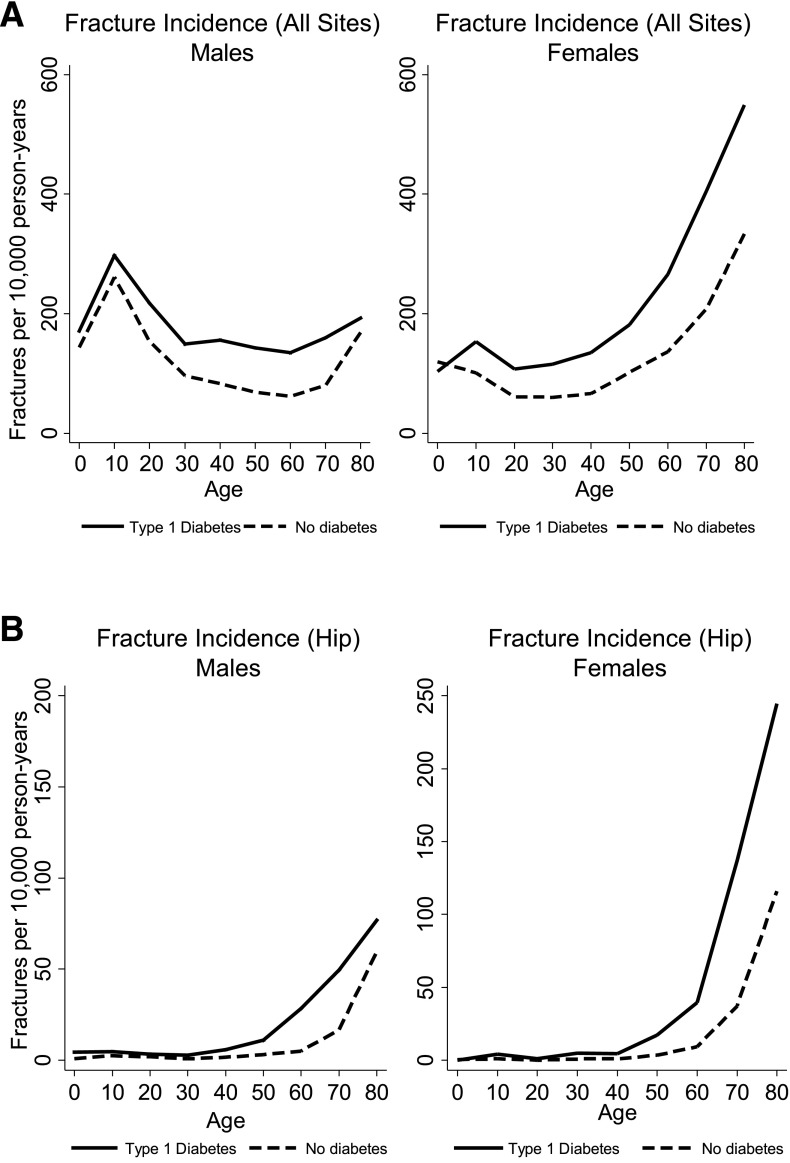
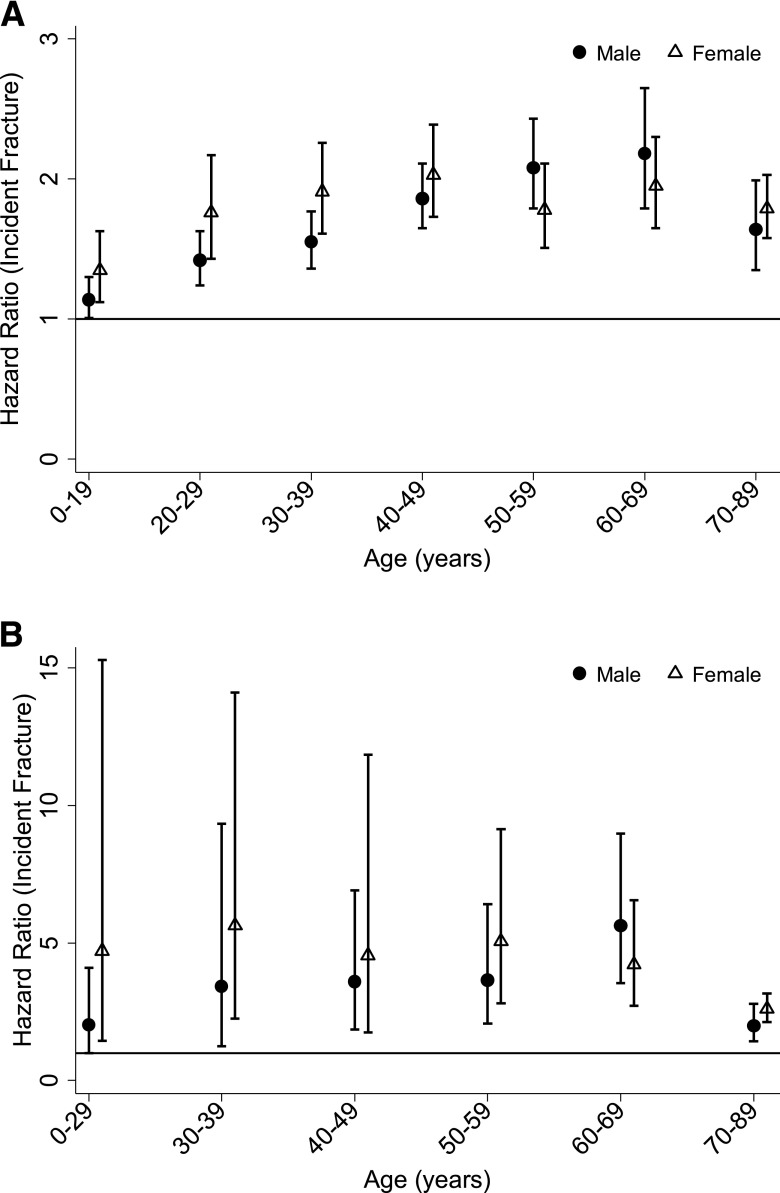
A total of 334,266 participants, median age 34 years, were monitored for 1.9 million person-years. HR were lowest in males and females age <20 years, with HR 1.14 (95% CI 1.01-1.29) and 1.35 (95% CI 1.12-1.63), respectively. Risk was highest in men 60-69 years (HR 2.18 [95% CI 1.79-2.65]), and in women 40-49 years (HR 2.03 [95% CI 1.73-2.39]). Lower extremity fractures comprised a higher proportion of incident fractures in participants with versus those without type 1 diabetes (31.1% vs. 25.1% in males, 39.3% vs. 32% in females; P < 0.001). Secondary analyses for incident hip fractures identified the highest HR of 5.64 (95% CI 3.55-8.97) in men 60-69 years and the highest HR of 5.63 (95% CI 2.25-14.11) in women 30-39 years.
Type 1 diabetes was associated with increased risk of incident fracture that began in childhood and extended across the life span. Participants with type 1 diabetes sustained a disproportionately greater number of lower extremity fractures. These findings have important public health implications, given the increasing prevalence of type 1 diabetes and the morbidity and mortality associated with hip fractures.
本研究旨在确定1型糖尿病是否与全生命周期骨折风险增加相关。
这项基于人群的队列研究使用了英国健康改善网络(THIN)的数据(1994年至2012年),将30394名0至89岁的1型糖尿病患者与303872名随机选择的年龄、性别和医疗机构匹配的非糖尿病患者进行比较。采用Cox回归分析确定1型糖尿病患者发生骨折的风险比(HR)。
总共334266名参与者,中位年龄34岁,接受了190万人年的监测。年龄<20岁的男性和女性HR最低,分别为1.14(95%CI 1.01 - 1.29)和1.35(95%CI 1.12 - 1.63)。60 - 69岁男性的风险最高(HR 2.18 [95%CI 1.79 - 2.65]),40 - 49岁女性的风险最高(HR 2.03 [95%CI 1.73 - 2.39])。与非1型糖尿病患者相比,1型糖尿病患者下肢骨折在新发骨折中所占比例更高(男性为31.1%对25.1%,女性为39.3%对32%;P < 0.001)。对新发髋部骨折的二次分析发现,60 - 69岁男性的HR最高,为5.64(95%CI 3.55 - 8.97),30 - 39岁女性的HR最高,为5.63(95%CI 2.25 - 14.11)。
1型糖尿病与始于儿童期并贯穿全生命周期的新发骨折风险增加相关。1型糖尿病患者下肢骨折的数量不成比例地更多。鉴于1型糖尿病患病率的上升以及髋部骨折相关的发病率和死亡率,这些发现具有重要的公共卫生意义。