Schnorfeil Frauke M, Lichtenegger Felix S, Emmerig Katharina, Schlueter Miriam, Neitz Julia S, Draenert Rika, Hiddemann Wolfgang, Subklewe Marion
Department of Internal Medicine III, Klinikum der Universität München, Munich, Germany.
Clinical Cooperation Group Immunotherapy, Helmholtz Institute Munich, Munich, Germany.
J Hematol Oncol. 2015 Jul 30;8:93. doi: 10.1186/s13045-015-0189-2.
T cell function is crucial for the success of several novel immunotherapeutic strategies for the treatment of acute myeloid leukemia (AML). However, changes in phenotype and function of T cells have been described in various hematologic malignancies, mimicking T cell exhaustion known from chronic viral infections. Detailed knowledge about phenotype and function of T cells in AML patients at different stages of the disease is indispensable for optimal development and application of immunotherapeutic strategies for this disease.
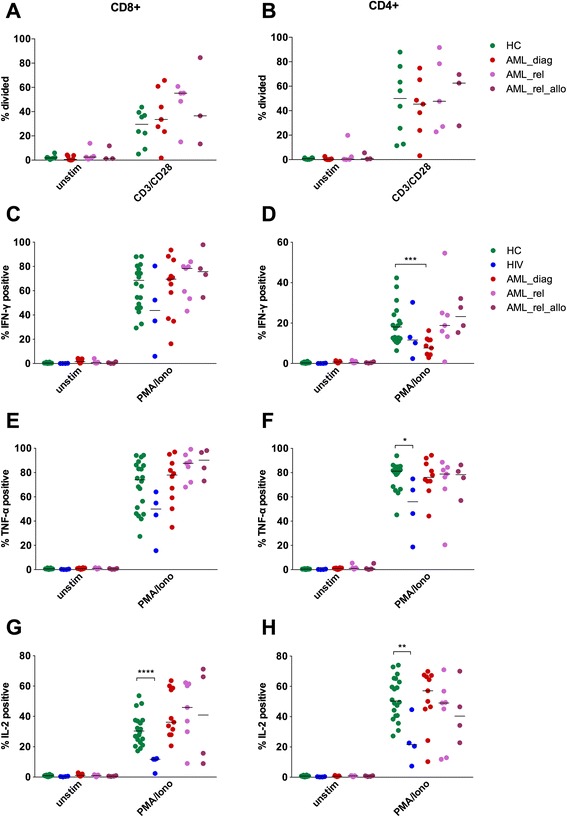
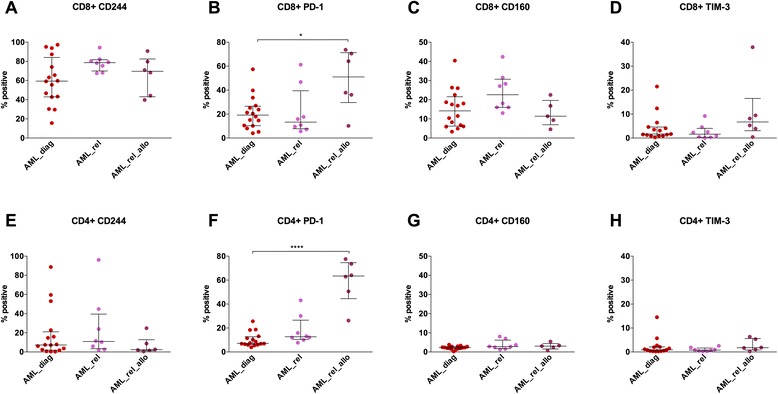
We used flow cytometry-based assays to characterize T cell phenotype and function in peripheral blood and bone marrow of AML patients at diagnosis, at relapse after intensive chemotherapy, and at relapse after allogeneic stem cell transplantation (SCT). Surface expression of CD244, PD-1, CD160, and TIM-3 was determined, and proliferation and production of IFN-γ, TNF-α, and IL-2 were measured.
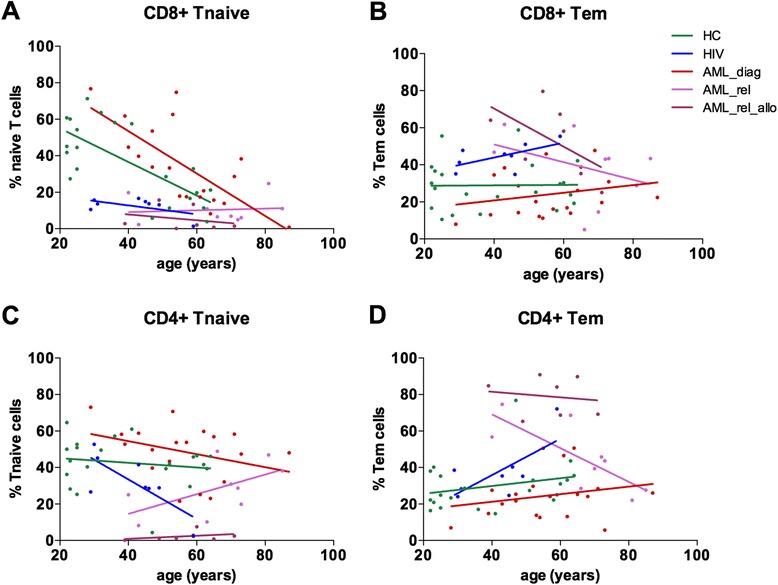
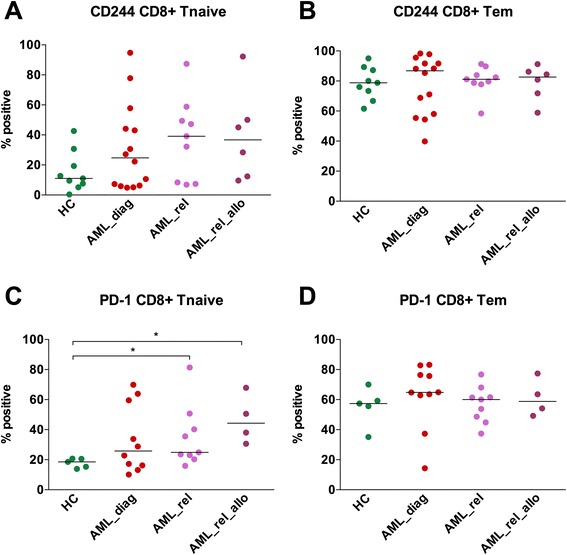
We detected similar expression of inhibitory molecules on T cells from patients at diagnosis and from age-matched healthy controls. At relapse after SCT, however, PD-1 expression was significantly increased compared to diagnosis, both on CD4(+) and CD8(+) T cells. This pattern was not associated with age and cytomegalovirus (CMV) status but with a shift towards effector memory cells in relapsed AML patients. Proliferation and cytokine production assays did not reveal functional defects in T cells of AML patients, neither at diagnosis nor at relapse.
We thus conclude that T cell exhaustion does not play a major role in AML. Immunotherapeutic strategies targeting autologous T cells thus have particularly good prospects in the setting of AML.
T细胞功能对于几种治疗急性髓系白血病(AML)的新型免疫治疗策略的成功至关重要。然而,在各种血液系统恶性肿瘤中均已描述了T细胞表型和功能的变化,类似于慢性病毒感染中已知的T细胞耗竭。对于AML患者在疾病不同阶段T细胞的表型和功能的详细了解,对于该疾病免疫治疗策略的优化开发和应用必不可少。
我们使用基于流式细胞术的检测方法来表征AML患者在诊断时、强化化疗后复发时以及异基因干细胞移植(SCT)后复发时外周血和骨髓中T细胞的表型和功能。测定CD244、PD-1、CD160和TIM-3的表面表达,并测量IFN-γ、TNF-α和IL-2的增殖和产生。
我们检测到诊断时患者的T细胞与年龄匹配的健康对照者的T细胞上抑制性分子的表达相似。然而,在SCT后复发时,与诊断时相比,CD4(+)和CD8(+) T细胞上的PD-1表达均显著增加。这种模式与年龄和巨细胞病毒(CMV)状态无关,而是与复发的AML患者向效应记忆细胞的转变有关。增殖和细胞因子产生检测未发现AML患者T细胞在诊断时或复发时存在功能缺陷。
因此,我们得出结论,T细胞耗竭在AML中不发挥主要作用。因此,针对自体T细胞的免疫治疗策略在AML的治疗中具有特别好的前景。