Noordmans Gerda A, Hillebrands Jan-Luuk, van Goor Harry, Korstanje Ron
Department of Pathology and Medical Biology, University of Groningen, University Medical Center Groningen, Groningen, the Netherlands.
The Jackson Laboratory, Bar Harbor, ME, USA.
Aging Cell. 2015 Oct;14(5):725-33. doi: 10.1111/acel.12378. Epub 2015 Jul 29.
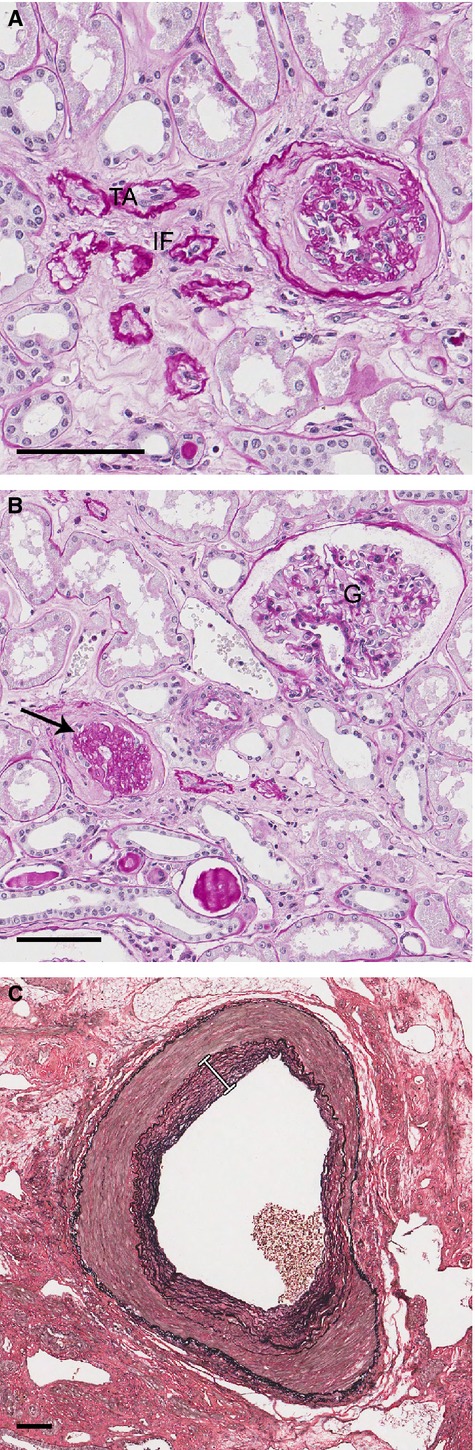
Several studies show evidence for the genetic basis of renal disease, which renders some individuals more prone than others to accelerated renal aging. Studying the genetics of renal aging can help us to identify genes involved in this process and to unravel the underlying pathways. First, this opinion article will give an overview of the phenotypes that can be observed in age-related kidney disease. Accurate phenotyping is essential in performing genetic analysis. For kidney aging, this could include both functional and structural changes. Subsequently, this article reviews the studies that report on candidate genes associated with renal aging in humans and mice. Several loci or candidate genes have been found associated with kidney disease, but identification of the specific genetic variants involved has proven to be difficult. CUBN, UMOD, and SHROOM3 were identified by human GWAS as being associated with albuminuria, kidney function, and chronic kidney disease (CKD). These are promising examples of genes that could be involved in renal aging, and were further mechanistically evaluated in animal models. Eventually, we will provide approaches for performing genetic analysis. We should leverage the power of mouse models, as testing in humans is limited. Mouse and other animal models can be used to explain the underlying biological mechanisms of genes and loci identified by human GWAS. Furthermore, mouse models can be used to identify genetic variants associated with age-associated histological changes, of which Far2, Wisp2, and Esrrg are examples. A new outbred mouse population with high genetic diversity will facilitate the identification of genes associated with renal aging by enabling high-resolution genetic mapping while also allowing the control of environmental factors, and by enabling access to renal tissues at specific time points for histology, proteomics, and gene expression.
多项研究显示了肾脏疾病的遗传基础证据,这使得一些个体比其他个体更容易出现肾脏加速衰老。研究肾脏衰老的遗传学有助于我们识别参与这一过程的基因,并揭示其潜在途径。首先,这篇观点文章将概述在与年龄相关的肾脏疾病中可观察到的表型。准确的表型分析对于进行遗传分析至关重要。对于肾脏衰老而言,这可能包括功能和结构变化。随后,本文回顾了有关人类和小鼠中与肾脏衰老相关的候选基因的研究。已经发现了几个与肾脏疾病相关的基因座或候选基因,但事实证明,识别其中涉及的特定基因变异很困难。CUBN、UMOD和SHROOM3通过全基因组关联研究(GWAS)被确定与蛋白尿、肾功能和慢性肾脏病(CKD)相关。这些是可能参与肾脏衰老的基因的有前景的例子,并在动物模型中进行了进一步的机制评估。最后,我们将提供进行遗传分析的方法。我们应该利用小鼠模型的优势,因为在人类中的测试是有限的。小鼠和其他动物模型可用于解释通过人类GWAS鉴定的基因和基因座的潜在生物学机制。此外,小鼠模型可用于识别与年龄相关的组织学变化相关的基因变异,Far2、Wisp2和Esrrg就是其中的例子。一个具有高遗传多样性的新的远交小鼠群体将有助于通过进行高分辨率遗传图谱绘制来识别与肾脏衰老相关的基因,同时还能控制环境因素,并能够在特定时间点获取肾脏组织用于组织学、蛋白质组学和基因表达研究。