de Groot Jeanny Ja, Maessen José Mc, Slangen Brigitte Fm, Winkens Bjorn, Dirksen Carmen D, van der Weijden Trudy
Department of Family Medicine, CAPHRI, School for Public Health and Primary Care, Maastricht University, P.O. Box 616, 6200 MD, Maastricht, the Netherlands.
Department of Obstetrics and Gynaecology, Maastricht University Medical Centre, P.O. Box 5800, 6202 AZ, Maastricht, the Netherlands.
Implement Sci. 2015 Jul 30;10:106. doi: 10.1186/s13012-015-0298-x.
Enhanced Recovery After Surgery (ERAS) programmes aim at an early recovery after surgical trauma and consequently at a reduced length of hospitalisation. This paper presents the protocol for a study that focuses on large-scale implementation of the ERAS programme in major gynaecological surgery in the Netherlands. The trial will evaluate effectiveness and costs of a stepped implementation approach that is characterised by tailoring the intensity of implementation activities to the needs of organisations and local barriers for change, in comparison with the generic breakthrough strategy that is usually applied in large-scale improvement projects in the Netherlands.
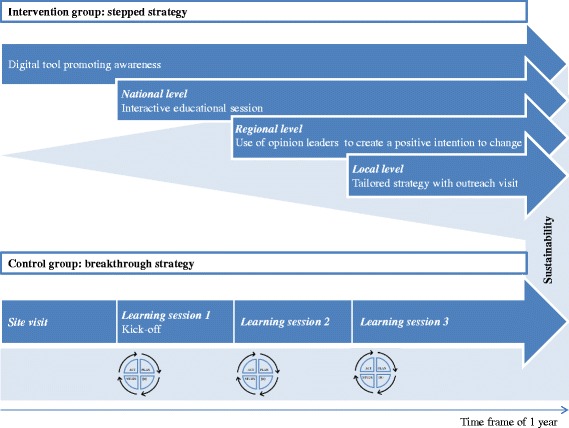
All Dutch hospitals authorised to perform major abdominal surgery in gynaecological oncology patients are eligible for inclusion in this cluster randomised controlled trial. The hospitals that already fully implemented the ERAS programme in their local perioperative management or those who predominantly admit gynaecological surgery patients to an external hospital replacement care facility will be excluded. Cluster randomisation will be applied at the hospital level and will be stratified based on tertiary status. Hospitals will be randomly assigned to the stepped implementation strategy or the breakthrough strategy. The control group will receive the traditional breakthrough strategy with three educational sessions and the use of plan-do-study-act cycles for planning and executing local improvement activities. The intervention group will receive an innovative stepped strategy comprising four levels of intensity of support. Implementation starts with generic low-cost activities and may build up to the highest level of tailored and labour-intensive activities. The decision for a stepwise increase in intensive support will be based on the success of implementation so far. Both implementation strategies will be completed within 1 year and evaluated on effect, process, and cost-effectiveness. The primary outcome is length of postoperative hospital stay. Additional outcome measures are length of recovery, guideline adherence, and mean implementation costs per patient.
This study takes up the challenge to evaluate an efficient strategy for large-scale implementation. Comparing effectiveness and costs of two different approaches, this study will help to define a preferred strategy for nationwide dissemination of best practices.
Dutch Trial Register NTR4058.
术后加速康复(ERAS)方案旨在实现手术创伤后的早期康复,从而缩短住院时间。本文介绍了一项研究方案,该研究聚焦于在荷兰的大型妇科手术中大规模实施ERAS方案。该试验将评估一种逐步实施方法的有效性和成本,该方法的特点是根据组织需求和当地变革障碍调整实施活动的强度,与荷兰大规模改进项目中通常采用的通用突破性策略进行比较。
所有被授权为妇科肿瘤患者进行大型腹部手术的荷兰医院均有资格纳入本集群随机对照试验。在当地围手术期管理中已全面实施ERAS方案的医院,或主要将妇科手术患者送往外部医院替代护理机构的医院将被排除。集群随机化将在医院层面进行,并根据三级医院地位进行分层。医院将被随机分配到逐步实施策略或突破性策略。对照组将接受传统的突破性策略,包括三次教育课程,并使用计划-执行-研究-行动循环来规划和执行当地的改进活动。干预组将接受一种创新的逐步策略,包括四个支持强度级别。实施从通用的低成本活动开始,可能逐步升级到最高级别的定制化和劳动密集型活动。强化支持逐步增加的决定将基于迄今为止的实施成功情况。两种实施策略都将在1年内完成,并对效果、过程和成本效益进行评估。主要结局是术后住院时间。其他结局指标包括康复时间、指南依从性和每位患者的平均实施成本。
本研究接受了评估大规模实施有效策略的挑战。通过比较两种不同方法的有效性和成本,本研究将有助于确定在全国范围内推广最佳实践的首选策略。
荷兰试验注册NTR4058。