Toyota Teruaki, Hanafusa Tadashi, Oda Takashi, Koumura Iwane, Sasaki Takanori, Matsuura Eiji, Kumon Hiromi, Yano Tsuneo, Ono Toshiro
Department of Radiation Research, Advanced Science Research Center, Okayama University, 2-5-1 Shikata-cho, Kita-ku, Okayama, 700-8558 Japan ; Graduate School of Health Sciences, Okayama University, 2-5-1 Shikata-cho, Kita-ku, Okayama, 700-8558 Japan.
Department of Radiation Research, Advanced Science Research Center, Okayama University, 2-5-1 Shikata-cho, Kita-ku, Okayama, 700-8558 Japan.
J Radioanal Nucl Chem. 2013;298(1):295-300. doi: 10.1007/s10967-012-2340-7. Epub 2012 Dec 6.
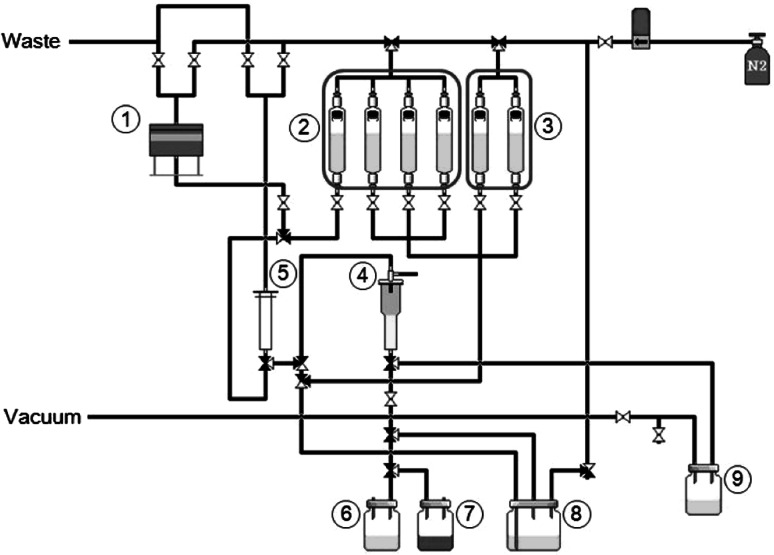
Ion exchange is a simple and efficient method for separating no-carrier-added Cu from an irradiated Ni target. We developed a semi-automated two-round Cu separation system equipped with a strong-base anion exchange resin column. We first verified the efficiency of the system using a non-radioactive substitute consisting of 25 mg of Ni and 127 ng of Cu, and confirmed that Cu was completely eluted at the second round of the separation step. After the bombardment, separation of Cu from the Ni target was achieved with high radiochemical purity. Cu produced and separated in this study had an extremely low level of Ni impurity. It could be used for labeling monoclonal antibodies for antibody positron emission tomography imaging and synthesizing radiopharmaceuticals.
离子交换是一种从辐照镍靶中分离无载体添加铜的简单有效方法。我们开发了一种配备强碱阴离子交换树脂柱的半自动两轮铜分离系统。我们首先使用由25毫克镍和127纳克铜组成的非放射性替代物验证了该系统的效率,并确认铜在分离步骤的第二轮中被完全洗脱。轰击后,从镍靶中分离出的铜具有高放射化学纯度。本研究中产生并分离的铜镍杂质含量极低。它可用于标记单克隆抗体以进行抗体正电子发射断层显像,并用于合成放射性药物。