Sampath Umesh, Kim Hyunjin, Kim Dae-gil, Kim Young-Chon, Song Minho
Division of Electronics and Information Engineering, Chonbuk National University, Jeonju 561-756, Korea.
Sensors (Basel). 2015 Jul 27;15(8):18229-38. doi: 10.3390/s150818229.
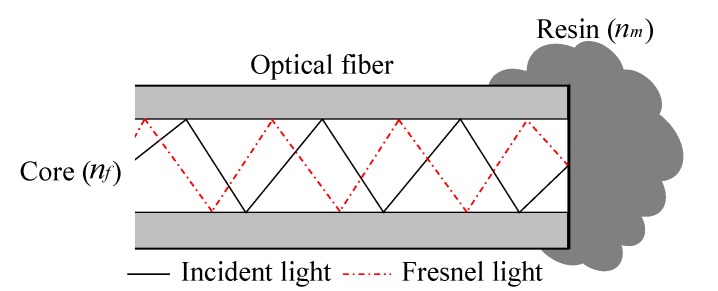
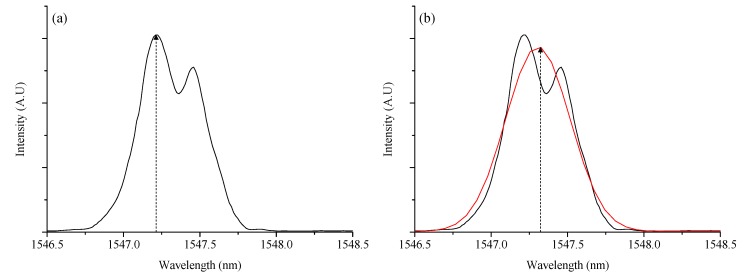
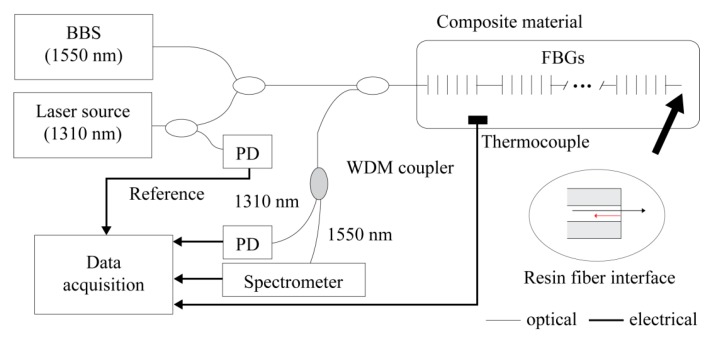
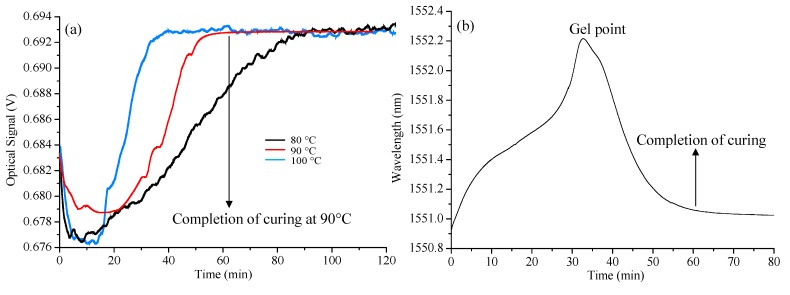
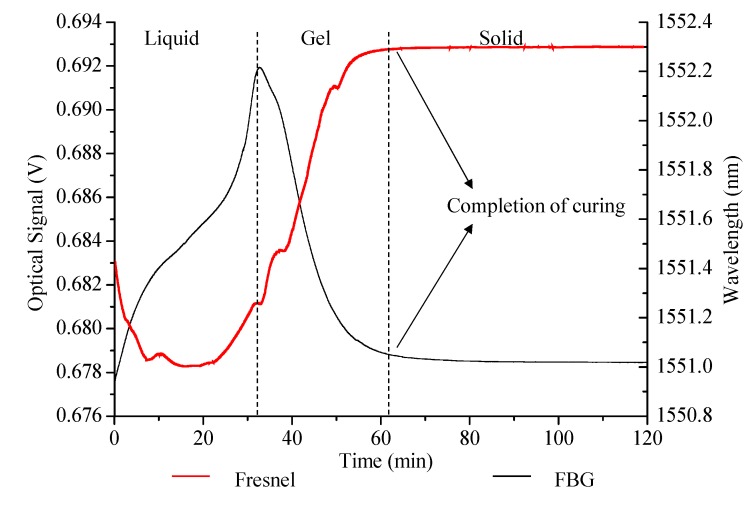
A fiber-optic cure monitoring system is proposed to measure curing status of composite structure such as a large scale wind turbine blade. The monitoring is based on the measurement of Fresnel reflectivity at the optical fiber/epoxy resin interface. The refractive index of epoxy resin varies throughout curing stages, changing the Fresnel reflectivity. The curing status is decided by monitoring the reflected intensity variation. The usage of fiber Bragg grating (FBG) sensor helps to separate the temperature-induced cross effects. A Gaussian curve fitting algorithm was applied to FBG spectra which were distorted in curing procedure. The substantial measurement errors could be minimized by locating the centroids of the Gaussian curve-fitted spectra. From the experiments performed in various isothermal conditions, the proposed system successfully identified the onset of gelation and the completion of curing of epoxy resins.
提出了一种光纤固化监测系统,用于测量大型风力涡轮机叶片等复合材料结构的固化状态。该监测基于对光纤/环氧树脂界面处菲涅尔反射率的测量。环氧树脂的折射率在整个固化阶段都会变化,从而改变菲涅尔反射率。通过监测反射强度的变化来确定固化状态。光纤布拉格光栅(FBG)传感器的使用有助于分离温度引起的交叉效应。将高斯曲线拟合算法应用于在固化过程中发生畸变的FBG光谱。通过定位高斯曲线拟合光谱的质心,可以将大量测量误差降至最低。从在各种等温条件下进行的实验来看,所提出的系统成功地识别出了环氧树脂的凝胶化起始点和固化完成点。