Herwartz Christine, Castillo-Juárez Paola, Schröder Linda, Barron Blanca L, Steger Gertrud
Institute of Virology, University of Cologne, Fürst-Pückler-Strasse 56, 50935 Cologne, Germany.
Escuela Nacional de Ciencias Biológicas, Instituto Politécnico Nacional, 11340 Ciudad de México, DF, Mexico.
Mediators Inflamm. 2015;2015:804264. doi: 10.1155/2015/804264. Epub 2015 Jul 1.
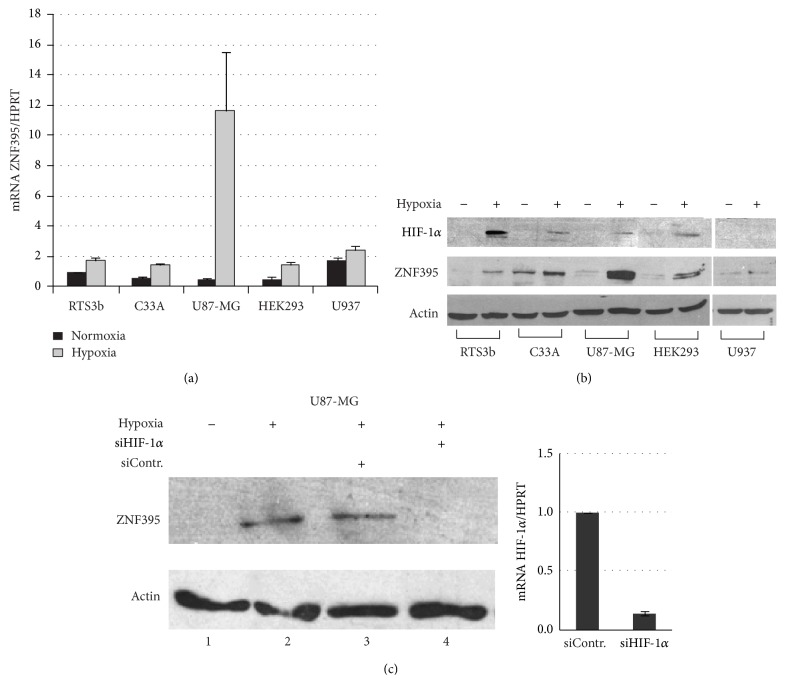
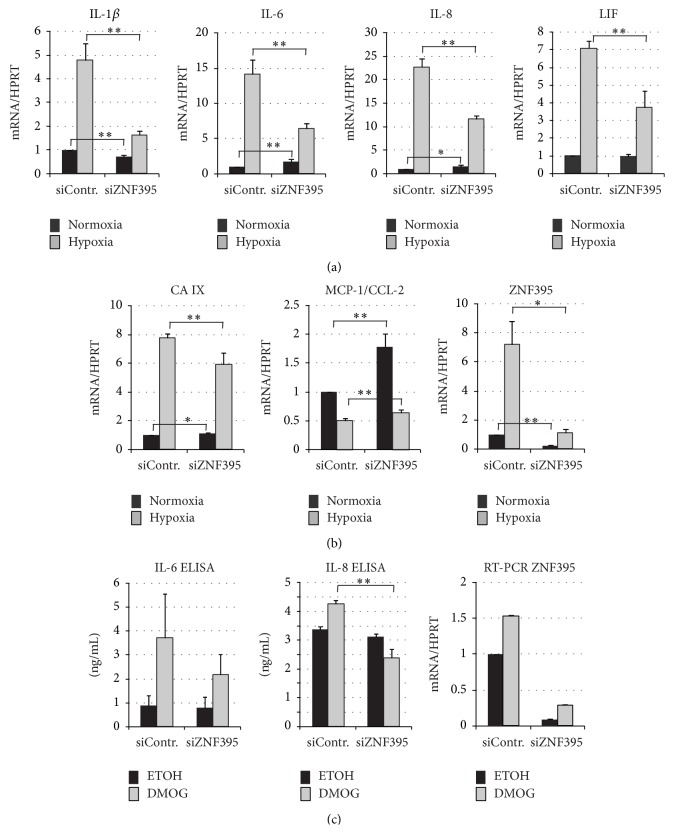
Hypoxia activates the expression of proangiogenic and survival promoting factors as well as proinflammatory cytokines that support tissue inflammation. Hypoxia and inflammation are associated with tumor progression. The identification of the factors participating in the hypoxia associated inflammation is essential to develop strategies to control tumor hypoxia. The transcription factor ZNF395 was found to be overexpressed in various tumors including glioblastomas particularly in the network of a hypoxic response pointing to a functional role of ZNF395. On the other hand, ZNF395 was suggested to have tumor suppressor activities which may rely on its repression of proinflammatory factors. To address these conflictive observations, we investigated the role of ZNF395 in the expression of proinflammatory cytokines in the astrocytoma cell line U87-MG under hypoxia. We show that ZNF395 is a target gene of the hypoxia inducible factor HIF-1α. By gene expression analysis, RT-PCR and ELISA, we demonstrated that the siRNA-mediated suppression of ZNF395 impairs the hypoxic induction of IL-1β, IL-6, IL-8, and LIF in U87-MG cells. At ambient oxygen concentrations, ZNF395 had no enhancing effect, indicating that this transcriptional activation by ZNF395 is restricted to hypoxic conditions. Our results suggest that ZNF395 contributes to hypoxia associated inflammation by superactivating proinflammatory cytokines.
缺氧会激活促血管生成和促进存活的因子以及支持组织炎症的促炎细胞因子的表达。缺氧和炎症与肿瘤进展相关。确定参与缺氧相关炎症的因子对于制定控制肿瘤缺氧的策略至关重要。转录因子ZNF395在包括胶质母细胞瘤在内的各种肿瘤中被发现过表达,尤其是在缺氧反应网络中,这表明ZNF395具有功能性作用。另一方面,有人提出ZNF395具有肿瘤抑制活性,这可能依赖于其对促炎因子的抑制作用。为了解决这些相互矛盾的观察结果,我们研究了ZNF395在缺氧条件下对星形细胞瘤细胞系U87-MG中促炎细胞因子表达的作用。我们发现ZNF395是缺氧诱导因子HIF-1α的靶基因。通过基因表达分析、RT-PCR和ELISA,我们证明siRNA介导的ZNF395抑制会损害U87-MG细胞中IL-1β、IL-6、IL-8和LIF的缺氧诱导。在正常氧浓度下,ZNF395没有增强作用,这表明ZNF395的这种转录激活仅限于缺氧条件。我们的结果表明,ZNF395通过超激活促炎细胞因子促进缺氧相关炎症。