Sapkaroski Daniel, Osborne Catherine, Knight Kellie A
Department of Medical Imaging & Radiation Sciences, Faculty of Medicine, Nursing & Health Sciences, School of Biomedical Sciences, Monash University Clayton, Vic., Australia.
J Med Radiat Sci. 2015 Jun;62(2):142-51. doi: 10.1002/jmrs.108. Epub 2015 May 25.
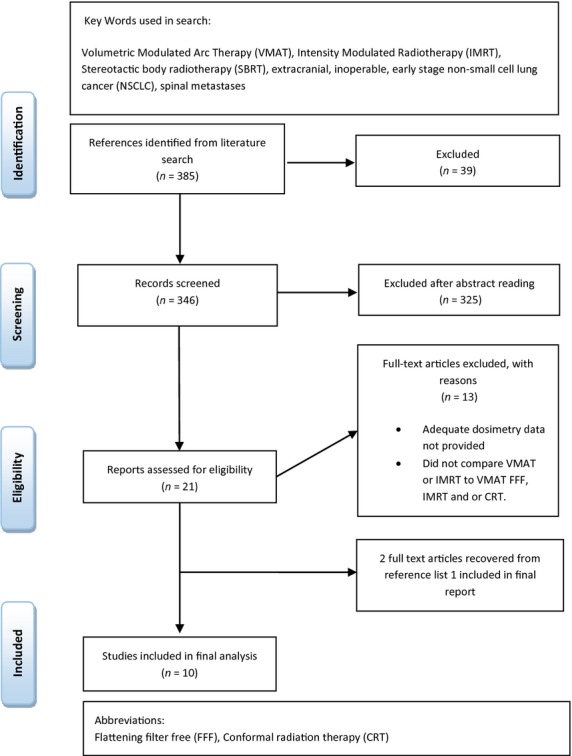
Stereotactic body radiotherapy (SBRT) is a high precision radiotherapy technique used for the treatment of small to moderate extra-cranial tumours. Early studies utilising SBRT have shown favourable outcomes. However, major disadvantages of static field SBRT include long treatment times and toxicity complications. Volumetric modulated arc therapy (VMAT) and intensity modulated radiotherapy (IMRT) may potentially mitigate these disadvantages. This review aims to assess the feasibility of emerging VMAT and IMRT-based SBRT treatment techniques and qualify which offers the best outcome for patients, whilst identifying any emerging and advantageous SBRT planning trends. A review and synthesis of data from current literature up to September 2013 was conducted on EMBASE, Medline, PubMed, Science Direct, Proquest central, Google Scholar and the Cochrane Database of Systematic reviews. Only full text papers comparing VMAT and or IMRT and or Static SBRT were included. Ten papers were identified that evaluated the results of VMAT/IMRT SBRT. Five related to medically inoperable stage 1 and 2 non-small-cell lung cancer (NSCLC), three to spinal metastasis, one related to abdominal lymph node malignancies, with the final one looking at pancreatic adenocarcinoma. Overall treatment times with VMAT were reduced by 66-70% for lung, 46-58% for spine, 42% and 21% for lymph node and pancreatic metastasis respectively, planning constraints were met with several studies showing improved organs at risk sparing with IMRT/VMAT to static SBRT. Both IMRT and VMAT were able to meet all planning constraints in the studies reviewed, with VMAT offering the greatest treatment efficiency. Early clinical outcomes with VMAT and IMRT SBRT have demonstrated excellent local control and favourable survival outcomes.
立体定向体部放射治疗(SBRT)是一种用于治疗中小尺寸颅外肿瘤的高精度放射治疗技术。早期利用SBRT的研究已显示出良好的疗效。然而,静态野SBRT的主要缺点包括治疗时间长和毒性并发症。容积调强弧形治疗(VMAT)和调强放射治疗(IMRT)可能会减轻这些缺点。本综述旨在评估基于VMAT和IMRT的新兴SBRT治疗技术的可行性,并确定哪种技术为患者提供最佳疗效,同时识别任何新兴且有利的SBRT计划趋势。对截至2013年9月的当前文献数据进行了综述和综合分析,检索了EMBASE、Medline、PubMed、Science Direct、Proquest central、Google Scholar和Cochrane系统评价数据库。仅纳入了比较VMAT和/或IMRT和/或静态SBRT的全文论文。共识别出10篇评估VMAT/IMRT SBRT结果的论文。其中5篇与医学上无法手术的1期和2期非小细胞肺癌(NSCLC)相关,3篇与脊柱转移相关,1篇与腹部淋巴结恶性肿瘤相关,最后1篇关注胰腺腺癌。VMAT的总体治疗时间在肺部减少了66 - 70%,在脊柱减少了46 - 58%,在淋巴结和胰腺转移中分别减少了42%和21%,多项研究表明IMRT/VMAT在保护危及器官方面优于静态SBRT,满足了计划限制条件。在综述的研究中,IMRT和VMAT都能够满足所有计划限制条件,VMAT的治疗效率最高。VMAT和IMRT SBRT的早期临床结果显示出出色的局部控制和良好的生存结果。