Fransson Anette, de Medina Philippe, Paillasse Michaël R, Silvente-Poirot Sandrine, Poirot Marc, Ulfendahl Mats
Department of Neuroscience, Karolinska Institutet Stockholm, Sweden.
Affichem SA Toulouse, France.
Front Aging Neurosci. 2015 Jul 24;7:145. doi: 10.3389/fnagi.2015.00145. eCollection 2015.
To investigate the therapeutic potential for treating inner ear damage of two new steroidal alkaloid compounds, Dendrogenin A and Dendrogenin B, previously shown to be potent inductors of cell differentiation.
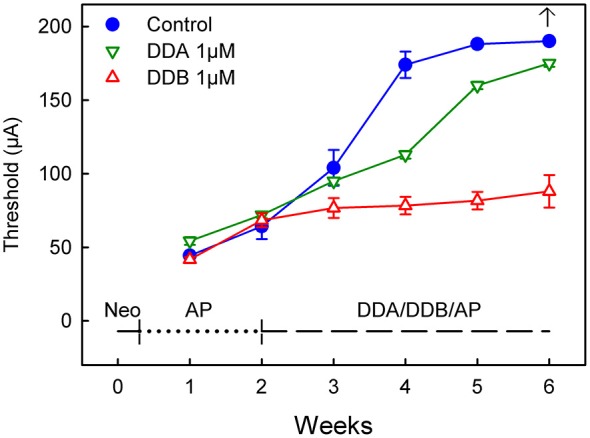
Guinea pigs, unilaterally deafened by neomycin infusion, received a cochlear implant followed by immediate or a 2-week delayed treatment with Dendrogenin A, Dendrogenin B, and, as comparison artificial perilymph and glial cell-line derived neurotrophic factor. After a 4-week treatment period the animals were sacrificed and the cochleae processed for morphological analysis. Electrically-evoked auditory brainstem responses (eABRs) were measured weekly throughout the experiment.
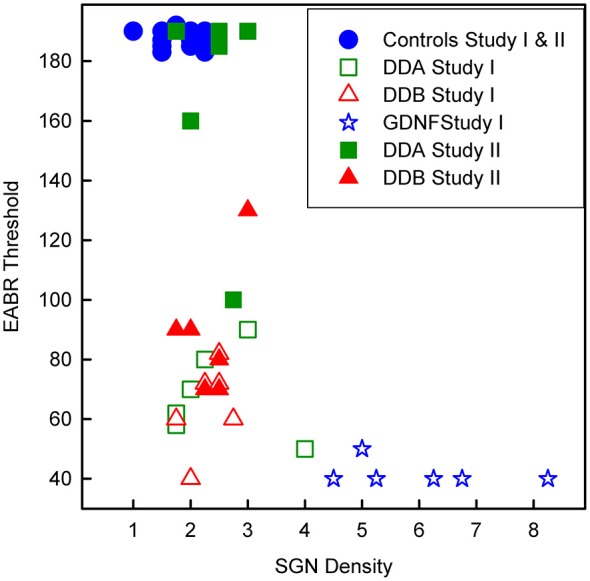
Following immediate or delayed Dendrogenin treatment the electrical responsiveness was significantly maintained, in a similar extent as has been shown using neurotrophic factors. Histological analysis showed that the spiral ganglion neurons density was only slightly higher than the untreated group.
Our results suggest that Dendrogenins constitute a new class of drugs with strong potential to improve cochlear implant efficacy and to treat neuropathy/synaptopathy related hearing loss. That electrical responsiveness was maintained despite a significantly reduced neural population suggests that the efficacy of cochlear implants is more related to the functional state of the spiral ganglion neurons than merely their number.
研究两种新的甾体生物碱化合物A(树状多环碱A)和B(树状多环碱B)治疗内耳损伤的潜力,此前已证明这两种化合物是细胞分化的有效诱导剂。
通过新霉素灌注使豚鼠单侧耳聋,随后植入人工耳蜗,之后立即或延迟2周用树状多环碱A、树状多环碱B进行治疗,作为对照的是人工外淋巴液和胶质细胞系源性神经营养因子。经过4周的治疗期后,处死动物并对耳蜗进行形态学分析。在整个实验过程中每周测量电诱发听性脑干反应(eABR)。
立即或延迟使用树状多环碱治疗后,电反应性得到显著维持,其程度与使用神经营养因子时相似。组织学分析表明,螺旋神经节神经元密度仅略高于未治疗组。
我们的结果表明,树状多环碱构成了一类新的药物,具有提高人工耳蜗疗效和治疗与神经病变/突触病变相关听力损失的强大潜力。尽管神经数量显著减少但电反应性仍得以维持,这表明人工耳蜗的疗效更多地与螺旋神经节神经元的功能状态有关,而不仅仅取决于其数量。