An W, Rainbow M J, Cheung R T H
Department of Rehabilitation Sciences, The Hong Kong Polytechnic University, Kowloon, Hong Kong.
Department of Mechanical and Materials Engineering, Queen's University, Kingston, ON, Canada K7L 3N6.
Biomed Res Int. 2015;2015:240153. doi: 10.1155/2015/240153. Epub 2015 Jul 15.
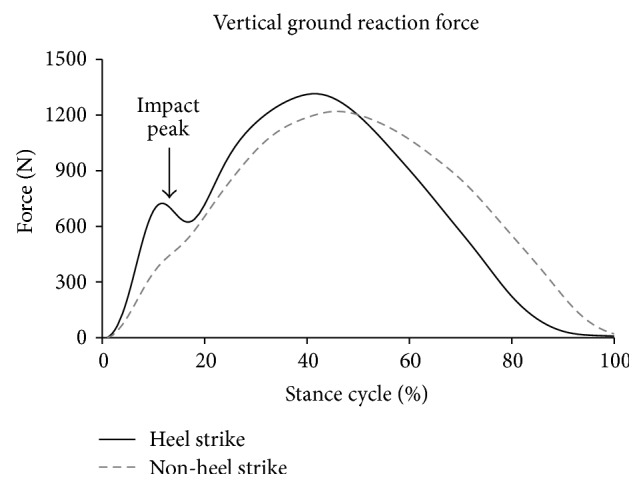
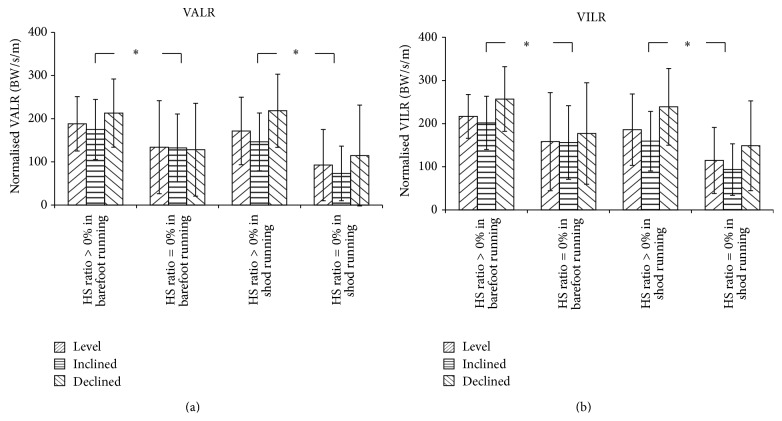
Barefoot running has been proposed to reduce vertical loading rates, which is a risk factor of running injuries. Most of the previous studies evaluated runners on level surfaces. This study examined the effect of surface inclination on vertical loading rates and landing pattern during the first attempt of barefoot running among habitual shod runners. Twenty habitual shod runners were asked to run on treadmill at 8.0 km/h at three inclination angles (0°; +10°; -10°) with and without their usual running shoes. Vertical average rate (VALR) and instantaneous loading rate (VILR) were obtained by established methods. Landing pattern was decided using high-speed camera. VALR and VILR in shod condition were significantly higher (p < 0.001) in declined than in level or inclined treadmill running, but not in barefoot condition (p > 0.382). There was no difference (p > 0.413) in the landing pattern among all surface inclinations. Only one runner demonstrated complete transition to non-heel strike landing in all slope conditions. Reducing heel strike ratio in barefoot running did not ensure a decrease in loading rates (p > 0.15). Conversely, non-heel strike landing, regardless of footwear condition, would result in a softer landing (p < 0.011).
有人提出赤足跑步可以降低垂直负荷率,而垂直负荷率是跑步受伤的一个风险因素。之前的大多数研究都是在水平面上评估跑步者。本研究调查了在习惯穿跑鞋的跑步者首次尝试赤足跑步时,路面倾斜度对垂直负荷率和着地方式的影响。20名习惯穿跑鞋的跑步者被要求在跑步机上以8.0公里/小时的速度,在三个倾斜角度(0°;+10°;-10°)下跑步,且分别穿着和不穿他们常用的跑鞋。通过既定方法获得垂直平均率(VALR)和瞬时负荷率(VILR)。使用高速摄像机确定着地方式。在穿跑鞋的情况下,下坡时的VALR和VILR显著高于水平或上坡跑步机跑步时(p<0.001),但在赤足情况下并非如此(p>0.382)。在所有路面倾斜度下,着地方式没有差异(p>0.413)。只有一名跑步者在所有坡度条件下都完全转变为非脚跟先着地的方式。在赤足跑步中降低脚跟先着地的比例并不能确保负荷率降低(p>0.15)。相反,无论穿鞋情况如何,非脚跟先着地的方式会导致着地更柔和(p<0.011)。