Cheung Roy T H, An Winko W, Au Ivan P H, Zhang Janet H, Chan Zoe Y S, Man Alfred, Lau Fannie O Y, Lam Melody K Y, Lau K K, Leung C Y, Tsang N W, Sze Louis K Y, Lam Gilbert W K
Gait & Motion Analysis Laboratory, Department of Rehabilitation Sciences, The Hong Kong Polytechnic University, Hong Kong, China.
Persona Surgical Modelling, Hong Kong, China.
PLoS One. 2017 Jun 9;12(6):e0175724. doi: 10.1371/journal.pone.0175724. eCollection 2017.
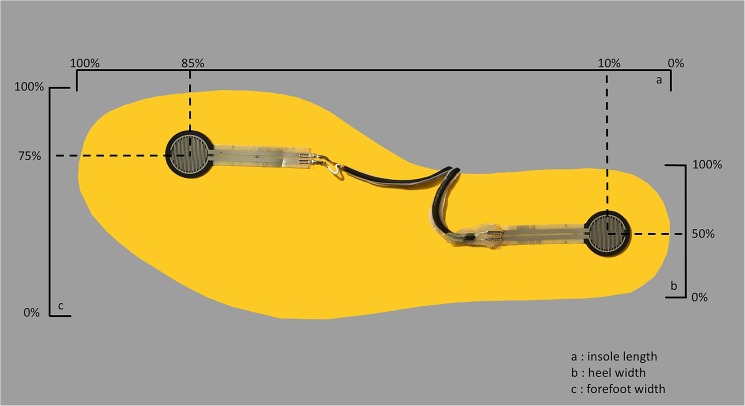
This study introduced a novel but simple method to continuously measure footstrike patterns in runners using inexpensive force sensors. Two force sensing resistors were firmly affixed at the heel and second toe of both insoles to collect the time signal of foot contact. A total of 109 healthy young adults (42 males and 67 females) were recruited in this study. They ran on an instrumented treadmill at 0°, +10°, and -10° inclinations and attempted rearfoot, midfoot, and forefoot landings using real time visual biofeedback. Intra-step strike index and onset time difference between two force sensors were measured and analyzed with univariate linear regression. We analyzed 25,655 footfalls and found that onset time difference between two sensors explained 80-84% of variation in the prediction model of strike index (R-squared = 0.799-0.836, p<0.001). However, the time windows to detect footstrike patterns on different surface inclinations were not consistent. These findings may allow laboratory-based gait retraining to be implemented in natural running environments to aid in both injury prevention and performance enhancement.
本研究介绍了一种新颖但简单的方法,可使用廉价的力传感器连续测量跑步者的着地模式。两个力敏电阻被牢固地粘贴在两只鞋垫的脚跟和第二脚趾处,以收集足部接触的时间信号。本研究共招募了109名健康的年轻人(42名男性和67名女性)。他们在装有仪器的跑步机上以0°、+10°和-10°的坡度跑步,并利用实时视觉生物反馈尝试后脚、中脚和前脚着地。测量并通过单变量线性回归分析了步内着地指数和两个力传感器之间的起始时间差。我们分析了25655次落地情况,发现两个传感器之间的起始时间差在着地指数预测模型中解释了80-84%的变异(决定系数=0.799-0.836,p<0.001)。然而,在不同地面坡度上检测着地模式的时间窗口并不一致。这些发现可能使基于实验室的步态再训练能够在自然跑步环境中实施,以帮助预防损伤和提高运动表现。