Prasannavenkatesh Ramachandran, Andimuthu Ramachandran, Kandasamy Palanivelu, Rajadurai Geetha, Kumar Divya Subash, Radhapriya Parthasarathy, Ponnusamy Malini
Center for Climate Change and Adaptation Research, College of Engineering, Anna University, Guindy Campus, Chennai, Tamil Nadu 600 025, India.
ScientificWorldJournal. 2015;2015:643714. doi: 10.1155/2015/643714. Epub 2015 Jul 14.
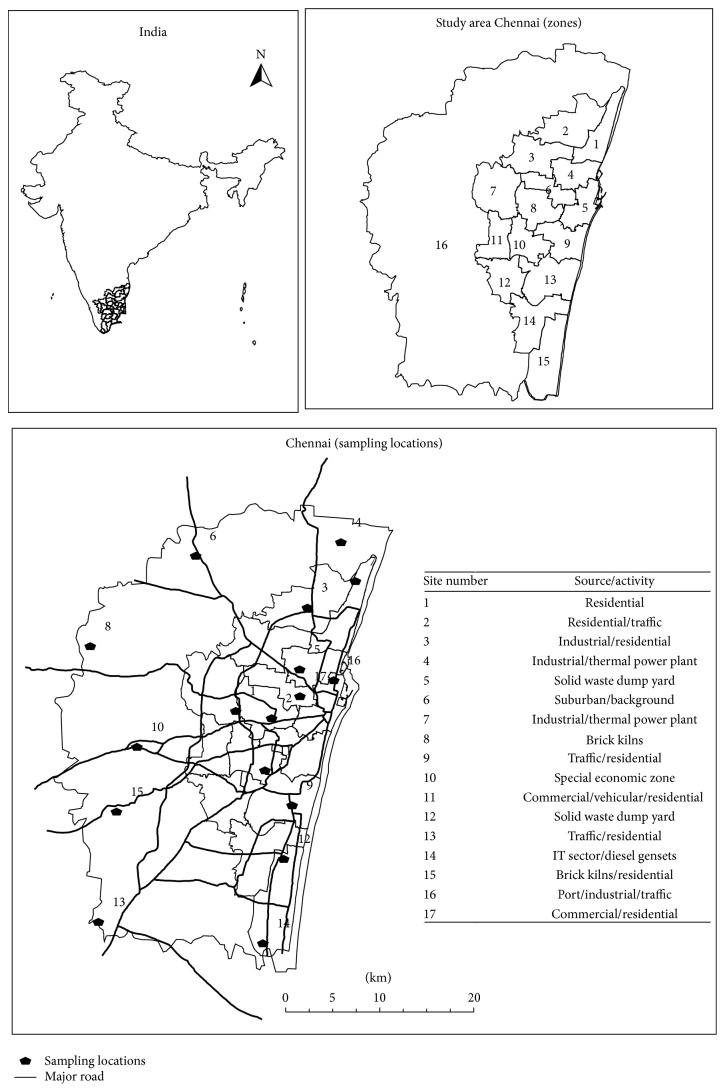
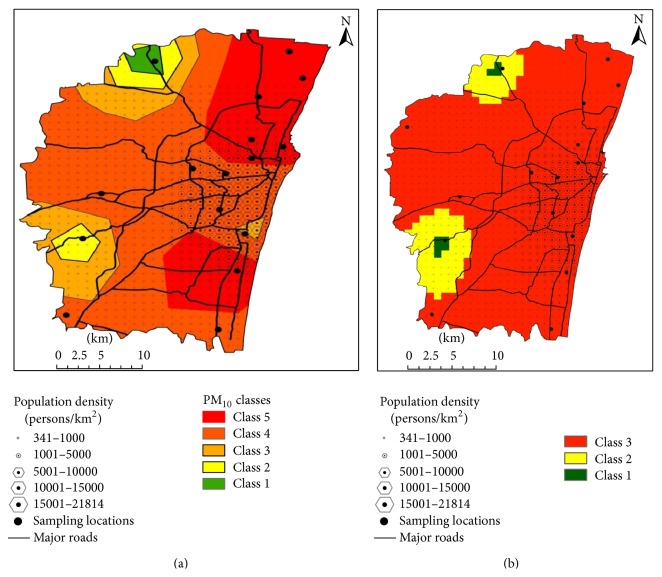
Research outcomes from the epidemiological studies have found that the course (PM10) and the fine particulate matter (PM2.5) are mainly responsible for various respiratory health effects for humans. The population-weighted exposure assessment is used as a vital decision-making tool to analyze the vulnerable areas where the population is exposed to critical concentrations of pollutants. Systemic sampling was carried out at strategic locations of Chennai to estimate the various concentration levels of particulate pollution during November 2013-January 2014. The concentration of the pollutants was classified based on the World Health Organization interim target (IT) guidelines. Using geospatial information systems the pollution and the high-resolution population data were interpolated to study the extent of the pollutants at the urban scale. The results show that approximately 28% of the population resides in vulnerable locations where the coarse particulate matter exceeds the prescribed standards. Alarmingly, the results of the analysis of fine particulates show that about 94% of the inhabitants live in critical areas where the concentration of the fine particulates exceeds the IT guidelines. Results based on human exposure analysis show the vulnerability is more towards the zones which are surrounded by prominent sources of pollution.
流行病学研究的结果发现,可吸入颗粒物(PM10)和细颗粒物(PM2.5)是造成人类各种呼吸健康影响的主要原因。人口加权暴露评估被用作一种重要的决策工具,以分析人群暴露于临界污染物浓度的脆弱区域。在金奈的战略地点进行了系统采样,以估算2013年11月至2014年1月期间颗粒物污染的各种浓度水平。污染物浓度是根据世界卫生组织临时目标(IT)指南进行分类的。利用地理信息系统对污染和高分辨率人口数据进行插值,以研究城市尺度上污染物的范围。结果表明,约28%的人口居住在粗颗粒物超过规定标准的脆弱地区。令人担忧的是,细颗粒物分析结果显示,约94%的居民生活在细颗粒物浓度超过IT指南的临界区域。基于人体暴露分析的结果表明,脆弱性更倾向于被突出污染源包围的区域。