Bertram Douglas F, Drever Mark C, McAllister Murdoch K, Schroeder Bernard K, Lindsay David J, Faust Deborah A
Environment Canada, Wildlife Research Division, Institute of Ocean Sciences, Sidney, British Columbia, Canada.
Environment Canada, Canadian Wildlife Service, Delta, British Columbia, Canada.
PLoS One. 2015 Aug 10;10(8):e0134891. doi: 10.1371/journal.pone.0134891. eCollection 2015.
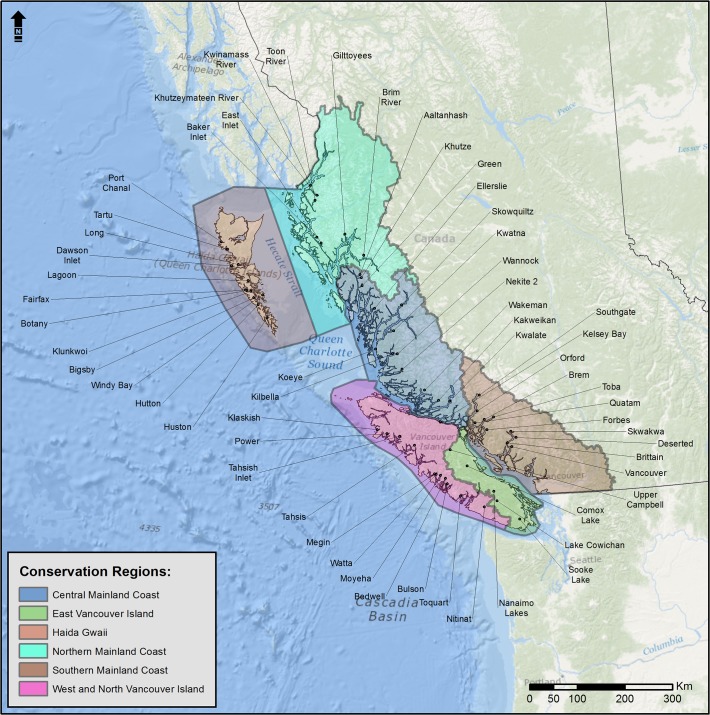
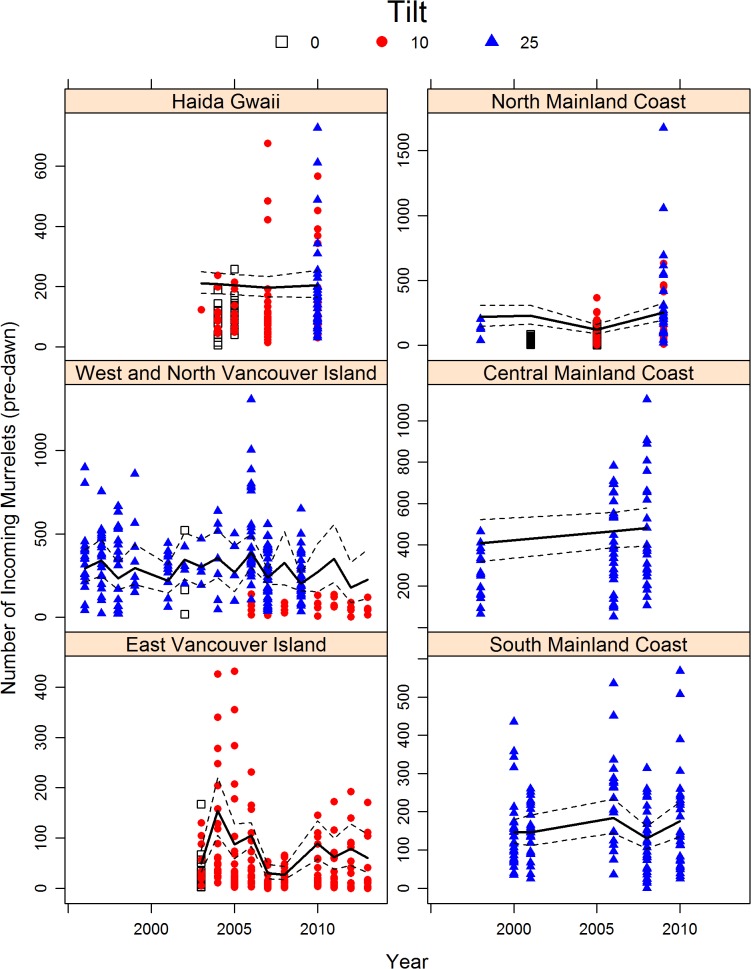
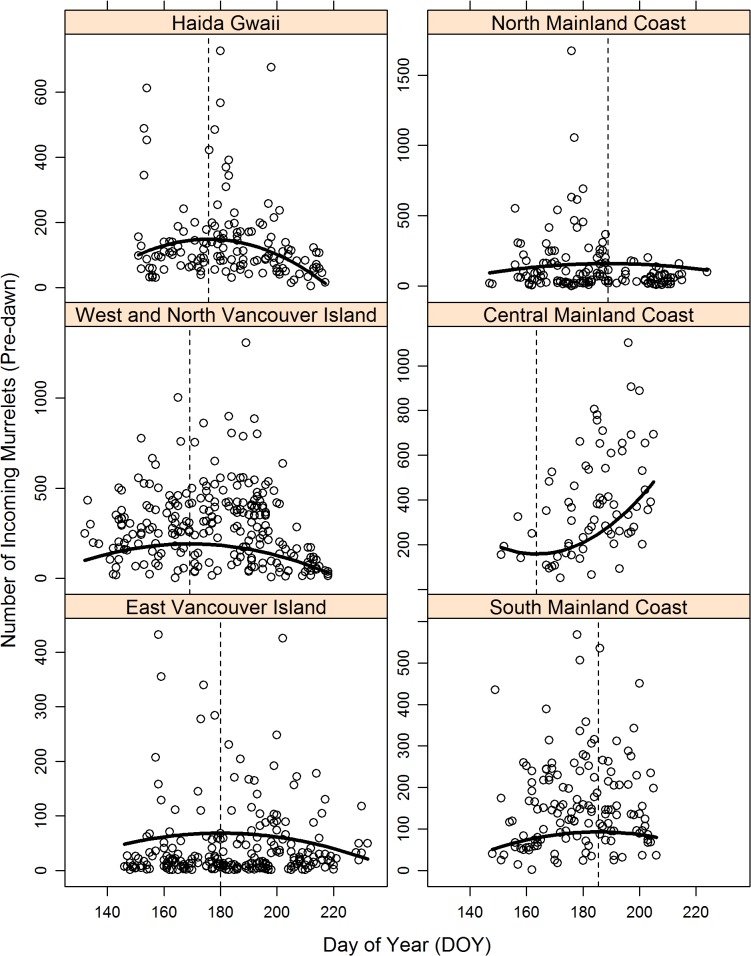
Species at risk with secretive breeding behaviours, low densities, and wide geographic range pose a significant challenge to conservation actions because population trends are difficult to detect. Such is the case with the Marbled Murrelet (Brachyramphus marmoratus), a seabird listed as 'Threatened' by the Species at Risk Act in Canada largely due to the loss of its old growth forest nesting habitat. We report the first estimates of population trend of Marbled Murrelets in Canada derived from a monitoring program that uses marine radar to detect birds as they enter forest watersheds during 923 dawn surveys at 58 radar monitoring stations within the six Marbled Murrelet Conservation Regions on coastal British Columbia, Canada, 1996-2013. Temporal trends in radar counts were analyzed with a hierarchical Bayesian multivariate modeling approach that controlled for variation in tilt of the radar unit and day of year, included year-specific deviations from the overall trend ('year effects'), and allowed for trends to be estimated at three spatial scales. A negative overall trend of -1.6%/yr (95% credibility interval: -3.2%, 0.01%) indicated moderate evidence for a coast-wide decline, although trends varied strongly among the six conservation regions. Negative annual trends were detected in East Vancouver Island (-9%/yr) and South Mainland Coast (-3%/yr) Conservation Regions. Over a quarter of the year effects were significantly different from zero, and the estimated standard deviation in common-shared year effects between sites within each region was about 50% per year. This large common-shared interannual variation in counts may have been caused by regional movements of birds related to changes in marine conditions that affect the availability of prey.
具有隐秘繁殖行为、低密度和广泛地理分布的濒危物种给保护行动带来了重大挑战,因为种群趋势难以察觉。大理石纹海雀(Brachyramphus marmoratus)就是这样一个例子,它是一种海鸟,在加拿大被《濒危物种法案》列为“受威胁物种”,主要原因是其原始森林筑巢栖息地的丧失。我们报告了加拿大大理石纹海雀种群趋势的首次估计,该估计来自一项监测计划,该计划利用海洋雷达在1996 - 2013年期间于加拿大不列颠哥伦比亚省沿海六个大理石纹海雀保护区内的58个雷达监测站进行的923次黎明调查中,在鸟类进入森林流域时检测它们。雷达计数的时间趋势采用分层贝叶斯多变量建模方法进行分析,该方法控制了雷达单元倾斜度和一年中的日期变化,包括与总体趋势的年度特定偏差(“年份效应”),并允许在三个空间尺度上估计趋势。-1.6%/年的总体负趋势(95%可信区间:-3.2%,0.01%)表明有中等证据支持全海岸范围的下降,尽管六个保护区的趋势差异很大。在东温哥华岛(-9%/年)和南大陆海岸(-3%/年)保护区检测到负年度趋势。超过四分之一的年份效应与零有显著差异,每个区域内各站点之间共同共享的年份效应估计标准差约为每年50%。计数中这种较大的共同共享年际变化可能是由与影响猎物可获得性的海洋条件变化相关的鸟类区域移动引起的。