Pinzón-Rondón Ángela María, Zárate-Ardila Carol, Hoyos-Martínez Alfonso, Ruiz-Sternberg Ángela María, Vélez-van-Meerbeke Alberto
Escuela de Medicina y Ciencias de la Salud, Universidad del Rosario, Bogotá, Colombia.
Facultad de Medicina, Universidad del Rosario sede Quinta de Mutis, Carrera 24 #63C-69, Bogotá, Colombia.
BMC Public Health. 2015 Aug 21;15:811. doi: 10.1186/s12889-015-2120-8.
Each year 2.5 billion cases of diarrheal disease are reported in children under five years, and over 1,000 die. Country characteristics could play a role on this situation. We explored associations between country characteristics and diarrheal disease in children under 5 years of age, adjusting by child, mother and household attributes in developing countries.
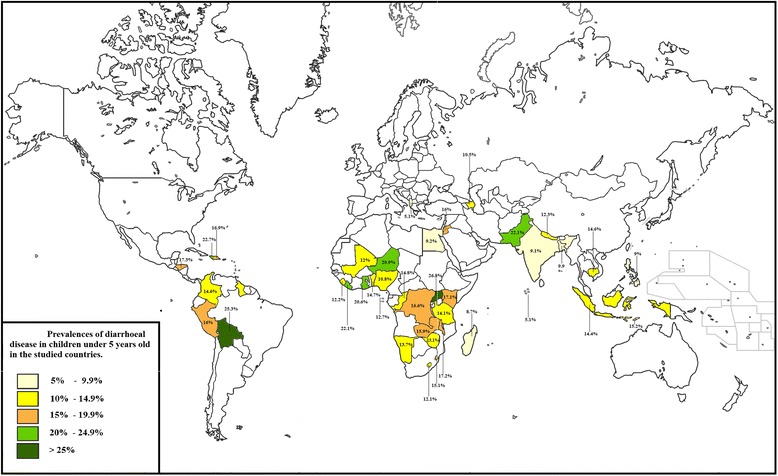
This study included 348,706 children from 40 nations. We conducted a multilevel analysis of data from the Demographic and Health Surveys and the World Bank.
The prevalence of acute diarrhea was 14 %. Country inequalities (OR = 1.335; 95 % CI 1.117-1.663) and country's low income (OR = 1.488; 95 % CI 1.024-2.163) were associated with diarrhea, and these country characteristics changed the associations of well-known determinants of diarrhea. Specifically, living in poor countries strengthens the association of poor household wealth and mother's lack of education with the disease. Other factors associated with diarrhea were female sex of the child (OR = 0.922; 95 % CI 0.900-0.944), age of the child (OR = 0.978; 95 % CI 0.978-0.979), immunization status (OR = 0.821; 95 % CI 0.799-0.843), normal birthweight (OR = 0.879; 95 % CI 0.834-0.926), maternal age (OR = 0.987; 95 % CI 0.985-0.989), lack of maternal education (OR = 1.416; 95 % CI 1.283-1.564), working status of the mother (OR = 1.136; 95 % CI 1.106-1.167), planned pregnancy (OR = 0.774; 95 % CI 0.753-0.795), a nuclear family structure (OR = 0.949; 95 % CI 0.923-0.975), and household wealth (OR = 0.948; 95 % CI 0.921-0.977).
Inequalities and lack of resources at the country level in developing countries -but not health expenditure- were associated with acute diarrhea, independently of child, family and household features. The broad environment considerably modifies well-known social determinants of acute diarrhea and public health campaigns designed to target diarrhea should consider macro characteristics of the country.
每年有25亿例五岁以下儿童腹泻病病例被报告,超过1000名儿童死亡。国家特征可能对这种情况产生影响。我们在发展中国家探讨了国家特征与五岁以下儿童腹泻病之间的关联,并对儿童、母亲和家庭属性进行了调整。
本研究纳入了来自40个国家的348,706名儿童。我们对人口与健康调查和世界银行的数据进行了多层次分析。
急性腹泻的患病率为14%。国家不平等(比值比=1.335;95%置信区间1.117 - 1.663)和国家低收入(比值比=1.488;95%置信区间1.024 - 2.163)与腹泻相关,并且这些国家特征改变了腹泻的已知决定因素之间的关联。具体而言,生活在贫穷国家会加强贫困家庭财富和母亲缺乏教育与该疾病之间的关联。与腹泻相关的其他因素包括儿童为女性(比值比=0.922;95%置信区间0.900 - 0.944)、儿童年龄(比值比=0.978;95%置信区间0.978 - 0.979)、免疫状况(比值比=0.821;95%置信区间0.799 - 0.843)、正常出生体重(比值比=0.879;95%置信区间0.834 - 0.926)、母亲年龄(比值比=0.987;95%置信区间0.985 - 0.989)、母亲缺乏教育(比值比=1.416;95%置信区间1.283 - 1.564)、母亲工作状况(比值比=1.136;95%置信区间1.106 - 1.167)、计划怀孕(比值比=0.774;95%置信区间0.753 - 0.795)、核心家庭结构(比值比=0.949;95%置信区间0.923 - 0.975)以及家庭财富(比值比=0.948;95%置信区间0.921 - 0.977)。
发展中国家国家层面的不平等和资源匮乏——而非卫生支出——与急性腹泻相关,独立于儿童、家庭和家庭特征。广泛的环境显著改变了急性腹泻的已知社会决定因素,旨在针对腹泻的公共卫生运动应考虑国家的宏观特征。