Gelagay Abebaw Addis, Koye Digsu Negese, Yeshita Hedija Yenus
Department of Reproductive Health, College of Medicine and Health Sciences, University of Gondar, Gondar, Ethiopia.
Department of Epidemiology and Biostatistics, College of Medicine and Health Sciences, University of Gondar, Gondar, Ethiopia.
Reprod Health. 2015 Aug 27;12:76. doi: 10.1186/s12978-015-0073-0.
The use of long acting contraceptive methods (LACMs) is one of the strategies for preventing mother-to-child transmission (MTCT) of HIV. Studies noted that significant proportion of unintended pregnancy among HIV positive women was due to contraceptive failure mainly of short term contraceptives. This highlights the need to use most effective types of modern contraception, long acting contraceptive. However, studies conducted on demand for long acting contraceptive methods in this particular group of people are scarce in Ethiopia. This study aimed to assess demand for long acting contraceptive methods and associated factors among married reproductive age women attending care at Antiretroviral treatment (ART) clinics in public health institutions at Bahir Dar City, Northwest Ethiopia.
Institution-based cross-sectional study was conducted among 654 systematically selected women attending care in ART clinics in public health facilities at Bahir Dar city from March to April, 2014. A structured and pretested interviewer administered questionnaire was used to collect data. Data were entered using EPI info version 3.5.3 and then exported to SPSS version 16 for analysis. Descriptive statistics were used to describe the socio-demographic and economic characteristics of the study participants. Logistic regression analyses were employed to identify factors associated with demand for long acting contraceptive methods. Odds ratios with 95 % CI were used to assess the presence and strength of association.
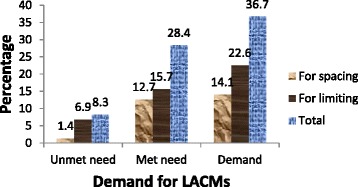
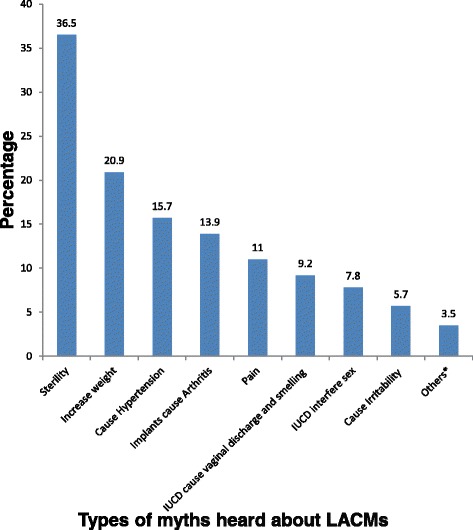
A total of 654 respondents have participated in the study (response rate 99. 09 %). The demand for long acting contraceptive methods was 36.7 % (95 % CI: 33.2 %, 40.6 %). The odds of demand for LACMs among HIV positive women who were living in urban were three times [AOR = 3.05, 95 % CI: 1.34, 6.89] higher than those who were living in rural. The odds of demand for LACMs among the respondents who were in elementary educational level were two times [AOR = 2.31, 95 % CI: 1.34, 3.99] more likely as compared to those who had no formal education. HIV positive women who had four or more alive children were almost four times [AOR = 3.86, 95 % CI: 1.62, 9.20] more likely to have demand for LACMs than those who had one child or had no child at all. Those who had desire to give birth after 2 years were nearly six times more likely [AOR = 5.68, 95 % CI: 3.05, 11.58] to have demand for LACMs and women who had no birth intension were eight times more likely [AOR = 7.78, 95 % CI: 4.15, 14.58] to have demand for LACMs as compared to those who had intention to have birth within 2 years. Women who had past experience on LACMs had six times more likely [AOR = 6.35, 95 % CI: 4.09, 9.87] to have demand for LACMs than those who hadn't any experience. The odds of demand for long acting contraceptive methods among HIV positive women who had heard myths about LACMs was 55 % less [AOR = 0.45, 95 % CI: 0.29, 0.68] than those women who hadn't heard myths.
Demand for long acting contraceptive methods in this study was low. There was high unmet need for LACMs. Myths about LACMs were common in the community and were the major barriers for the promotion and utilization of the methods. Demand creation on LACMs and bringing attitudinal change related to myths through provision of information, education and communication are recommended. Moreover, giving greater attention for rural residents is important.
使用长效避孕方法是预防艾滋病毒母婴传播(MTCT)的策略之一。研究指出,艾滋病毒阳性女性中相当一部分意外怀孕是由于避孕失败,主要是短效避孕药的失败。这凸显了使用最有效的现代避孕方法——长效避孕药的必要性。然而,在埃塞俄比亚,针对这一特定人群对长效避孕方法的需求所开展的研究很少。本研究旨在评估埃塞俄比亚西北部巴赫达尔市公共卫生机构接受抗逆转录病毒治疗(ART)门诊护理的已婚育龄妇女对长效避孕方法的需求及相关因素。
2014年3月至4月,在巴赫达尔市公共卫生设施的ART门诊对654名系统选取的接受护理的妇女进行了基于机构的横断面研究。使用经过结构化和预测试的访谈员管理的问卷收集数据。数据使用EPI info 3.5.3版本录入,然后导出到SPSS 16版本进行分析。描述性统计用于描述研究参与者的社会人口学和经济特征。采用逻辑回归分析来确定与长效避孕方法需求相关的因素。使用95%置信区间的比值比来评估关联的存在和强度。
共有654名受访者参与了研究(回复率99.09%)。对长效避孕方法的需求为36.7%(95%置信区间:33.2%,40.6%)。居住在城市的艾滋病毒阳性女性对长效避孕方法的需求几率是居住在农村女性的三倍[AOR = 3.05,95%置信区间:1.34,6.89]。小学教育水平的受访者对长效避孕方法的需求几率是未接受正规教育者的两倍[AOR = 2.31,95%置信区间:1.34,3.99]。有四个或更多存活子女的艾滋病毒阳性女性对长效避孕方法的需求几率几乎是只有一个孩子或没有孩子的女性的四倍[AOR = 3.86,95%置信区间:1.62,9.20]。那些希望在两年后生育的女性对长效避孕方法的需求几率几乎是那些打算在两年内生育女性的六倍[AOR = 5.68,95%置信区间:3.05,11.58],而没有生育意愿的女性对长效避孕方法的需求几率是打算在两年内生育女性的八倍[AOR = 7.78,95%置信区间:4.15,14.58]。有长效避孕方法使用经验的女性对长效避孕方法的需求几率是没有任何经验女性的六倍[AOR = 6.35,95%置信区间:4.09,9.87]。听说过关于长效避孕方法谣言的艾滋病毒阳性女性对长效避孕方法的需求几率比没有听说过谣言的女性低55%[AOR = 0.45,95%置信区间:0.29,0.68]。
本研究中对长效避孕方法的需求较低。对长效避孕方法存在高度未满足的需求。关于长效避孕方法的谣言在社区中很常见,是推广和使用这些方法的主要障碍。建议开展关于长效避孕方法的需求创造,并通过提供信息、教育和宣传来改变与谣言相关的态度。此外,更加关注农村居民很重要。