Bixby Center for Population, Health and Sustainability, School of Public Health, University of California, Berkeley, California, USA.
PLoS One. 2013 May 20;8(5):e64032. doi: 10.1371/journal.pone.0064032. Print 2013.
To investigate factors associated with a woman's willingness to pay (WTP) for injectable contraceptives in Tigray, Ethiopia.
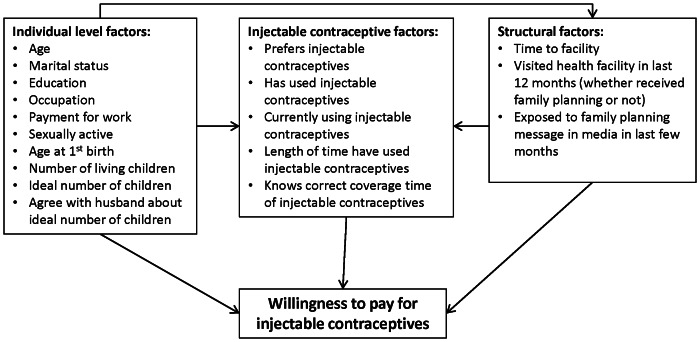
We used a multistage random sampling design to generate a representative sample of reproductive age women from the Central Zone of Tigray, Ethiopia to participate in a survey (N = 1490). Respondents who had ever used injectable contraceptives or who were interested in using them were asked whether they would be willing to pay, and if so, how much. Logistic regression odds ratios (ORs) with 95% confidence intervals (CIs) and p-values were used to assess which factors were associated with WTP in our final model.
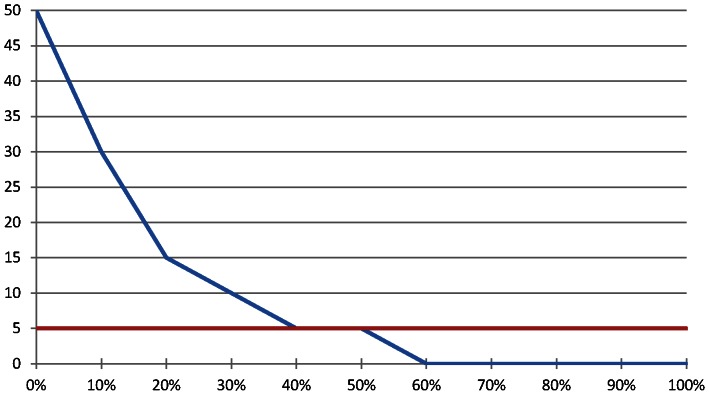
On average, respondents were willing to pay 11 birr ($0.65 USD) per injection. Being married, completing any amount of education, having given birth, and having visited a health facility in the last 12 months (whether received family planning information or not) were associated with statistically significantly increased odds of WTP. Having initiated sexual activity and having 1-2 children (compared to 0 children) were associated with statistically significantly decreased odds of WTP. We also detected two significant interactions. Among women who prefer injectable contraceptives, their odds of WTP for injectable contraceptives vary across length of time they have used them. And among women who work for pay, their odds of WTP for injectable contraceptives vary by whether they agree with their husband/partner about the ideal number of children.
In a sector that continually struggles with funding, cost recovery for contraceptive services may offer a means of improved financial sustainability while increasing rural access to injectable contraceptives. Results indicate there are opportunities for cost recovery in rural Tigray, Ethiopia and highlight factors that could be leveraged to increase WTP for injectable contraceptives.
调查与埃塞俄比亚提格雷地区妇女对注射型避孕药具的支付意愿(WTP)相关的因素。
我们采用多阶段随机抽样设计,从提格雷地区中心地带抽取了具有代表性的育龄期妇女样本(n=1490),参与调查。曾使用过注射型避孕药具或有意使用的受访者被问到是否愿意支付费用,如果愿意,愿意支付多少。使用逻辑回归比值比(OR)及其 95%置信区间(CI)和 p 值评估哪些因素与我们最终模型中的 WTP 相关。
受访者平均愿意为每支注射剂支付 11 比尔(0.65 美元)。已婚、接受过任何程度的教育、已生育、在过去 12 个月内曾去过医疗机构(无论是否接受过计划生育信息)与 WTP 的可能性呈统计学显著增加相关。已开始性行为和有 1-2 个孩子(与没有孩子相比)与 WTP 的可能性呈统计学显著降低相关。我们还检测到两个显著的交互作用。在更喜欢注射型避孕药具的女性中,她们对注射型避孕药具的 WTP 意愿随使用时间的长短而变化。在为薪酬工作的女性中,她们对注射型避孕药具的 WTP 意愿因是否同意丈夫/伴侣对理想子女数量的看法而异。
在一个持续面临资金短缺的部门中,为避孕服务收取费用可能是提高财务可持续性的一种手段,同时增加农村地区获得注射型避孕药具的机会。结果表明,在埃塞俄比亚提格雷农村地区有收取费用的机会,并强调了可以利用哪些因素来提高对注射型避孕药具的支付意愿。