Sabokdast Manijheh, Habibi-Rezaei Mehran, Moosavi-Movahedi Ali Akbar, Ferdousi Maryam, Azimzadeh-Irani Effat, Poursasan Najmeh
School of Biology, College of Science, University of Tehran, Tehran, Iran.
Present address: Department of agronomy, and plant breeding, College of Agriculture & Natural Resources, University of Tehran, Karaj, Iran.
Daru. 2015 Aug 27;23(1):42. doi: 10.1186/s40199-015-0126-5.
Diabetes mellitus is characterized jointly by hyperglycemia and hyperinsulinemia that make insulin more prone to be glycated and evolve insulin advanced glycation end products (Insulin- AGE). Here, we report the effect of beta-hydroxy butyrate (BHB) (the predominant ketone body) on the formation of insulin-AGE, insulin glycation derived liposomal lipid peroxidation and insulin-AGE toxicity in microglial cells.
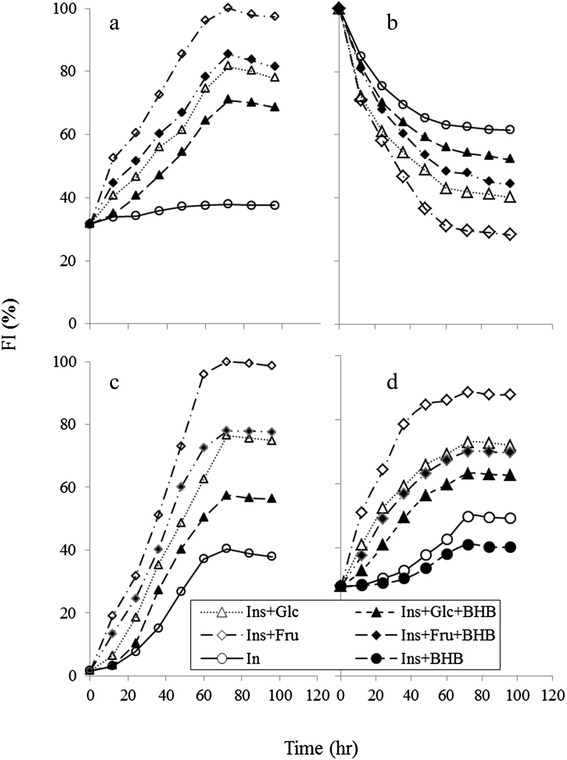
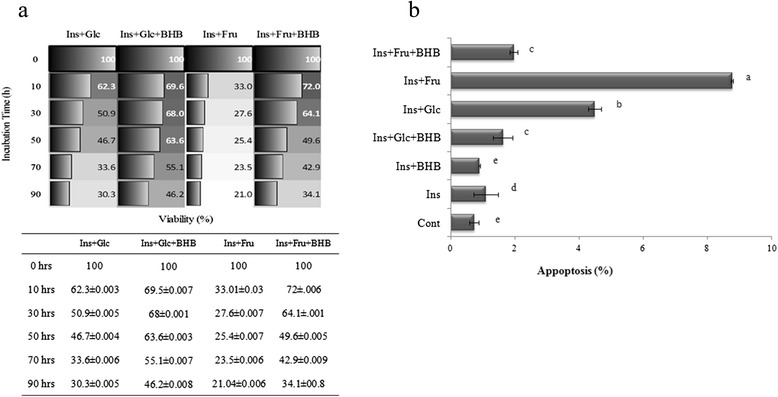
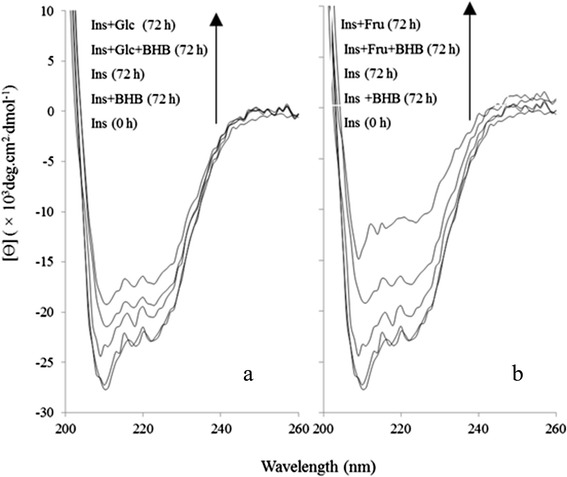
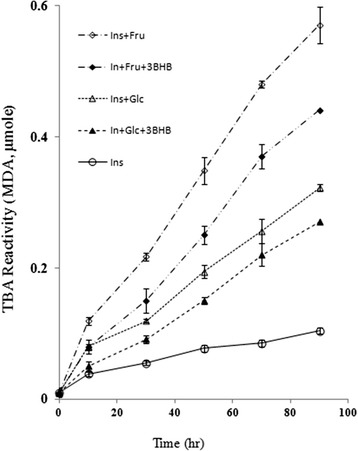
The inhibitory effect of BHB was monitored as a result of insulin incubation in the presence of glucose or fructose using AGE-dependent fluorescence, Tyr fluorescence as well as anilinonaphthalenesulfonate (ANS) andthioflavin T (ThT) binding, and circular dichroism (CD) investigations. To study lipid peroxidation induced by insulin glycation, thiobarbituric acid (TBA) assay and thiobarbituric acid reactive substance (TBARS) monitoring were used. The effect of insulin-AGE on microglial viability was investigated by 3-(4, 5 dimethylthiazol-2-yl)-2, 5-diphenyltetrazoliumbromide (MTT) cell assay and Annexin V/propidium iodide (PI) staining.
Here we are reporting the inhibitory effect of BHB on insulin glycation and generation of insulin-AGE as a possible explanation for insulin resistance. Moreover, the protective effect of BHB on consequential glycation derived liposomal lipid peroxidation as a causative event in microglial apoptosis is reported.
The reduced insulin fibril formation, structural inertia to glycation involved conformational changes, anti-lipid peroxidation effect, and increasing microglia viability indicated the protective effect of BHB that disclose insight on the possible preventive effect of BHB on Alzheimer's disease.
糖尿病的特征是高血糖和高胰岛素血症,这使得胰岛素更容易发生糖基化,并形成胰岛素晚期糖基化终产物(胰岛素-AGE)。在此,我们报告β-羟基丁酸(BHB)(主要的酮体)对胰岛素-AGE形成、胰岛素糖基化衍生的脂质体脂质过氧化以及小胶质细胞中胰岛素-AGE毒性的影响。
使用AGE依赖性荧光、酪氨酸荧光以及苯胺萘磺酸盐(ANS)和硫黄素T(ThT)结合,以及圆二色性(CD)研究,监测BHB在葡萄糖或果糖存在下胰岛素孵育的抑制作用。为了研究胰岛素糖基化诱导的脂质过氧化,使用了硫代巴比妥酸(TBA)测定和硫代巴比妥酸反应性物质(TBARS)监测。通过3-(4,5-二甲基噻唑-2-基)-2,5-二苯基四氮唑溴盐(MTT)细胞测定和膜联蛋白V/碘化丙啶(PI)染色,研究胰岛素-AGE对小胶质细胞活力的影响。
在此我们报告BHB对胰岛素糖基化和胰岛素-AGE生成的抑制作用,这可能是胰岛素抵抗的一种解释。此外,还报告了BHB对随之而来的糖基化衍生的脂质体脂质过氧化的保护作用,这是小胶质细胞凋亡中的一个致病事件。
胰岛素原纤维形成减少、对糖基化的结构惰性涉及构象变化、抗脂质过氧化作用以及小胶质细胞活力增加,表明BHB具有保护作用,这揭示了BHB对阿尔茨海默病可能的预防作用的见解。