Roskin Krishna M, Simchoni Noa, Liu Yi, Lee Ji-Yeun, Seo Katie, Hoh Ramona A, Pham Tho, Park Joon H, Furman David, Dekker Cornelia L, Davis Mark M, James Judith A, Nadeau Kari C, Cunningham-Rundles Charlotte, Boyd Scott D
Department of Pathology, Stanford University, Stanford, CA 94305, USA.
Departments of Medicine and Pediatrics, Icahn School of Medicine at Mount Sinai, New York, NY 10029, USA.
Sci Transl Med. 2015 Aug 26;7(302):302ra135. doi: 10.1126/scitranslmed.aab1216.
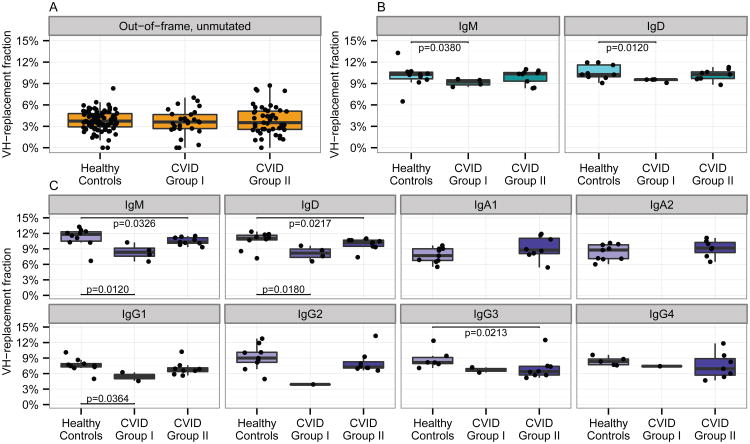
Common variable immune deficiency (CVID) is the most common symptomatic primary immune deficiency, affecting ~1 in 25,000 persons. These patients suffer from impaired antibody responses, autoimmunity, and susceptibility to lymphoid cancers. To explore the cellular basis for these clinical phenotypes, we conducted high-throughput DNA sequencing of immunoglobulin heavy chain gene rearrangements from 93 CVID patients and 105 control subjects and sorted naïve and memory B cells from 13 of the CVID patients and 10 of the control subjects. The CVID patients showed abnormal VDJ rearrangement and abnormal formation of complementarity-determining region 3 (CDR3). We observed a decreased selection against antibodies with long CDR3s in memory repertoires and decreased variable gene replacement, offering possible mechanisms for increased patient autoreactivity. Our data indicate that patient immunodeficiency might derive from both decreased diversity of the naïve B cell pool and decreased somatic hypermutation in memory repertoires. The CVID patients also exhibited an abnormal clonal expansion of unmutated B cells relative to the controls. Although impaired B cell germinal center activation is commonly viewed as causative in CVID, these data indicate that CVID B cells diverge from controls as early as the pro-B stage, cell and suggest possible explanations for the increased incidence of autoimmunity, immunodeficiency, and lymphoma CVID patients.
常见变异型免疫缺陷(CVID)是最常见的有症状的原发性免疫缺陷,每25000人中约有1人受其影响。这些患者存在抗体应答受损、自身免疫以及易患淋巴癌的问题。为了探究这些临床表型的细胞基础,我们对93例CVID患者和105例对照者的免疫球蛋白重链基因重排进行了高通量DNA测序,并对13例CVID患者和10例对照者的初始B细胞和记忆B细胞进行了分选。CVID患者表现出异常的VDJ重排和互补决定区3(CDR3)的异常形成。我们观察到在记忆库中针对长CDR3抗体的选择减少以及可变基因替换减少,这为患者自身反应性增加提供了可能的机制。我们的数据表明,患者的免疫缺陷可能源于初始B细胞库多样性的降低以及记忆库中体细胞高频突变的减少。与对照组相比,CVID患者还表现出未突变B细胞的异常克隆扩增。尽管B细胞生发中心激活受损通常被认为是CVID的病因,但这些数据表明CVID B细胞早在前B细胞阶段就与对照组不同,并为CVID患者自身免疫、免疫缺陷和淋巴瘤发病率增加提供了可能的解释。