Duan Shanzhou, Tsai Ying, Keng Peter, Chen Yongbing, Lee Soo Ok, Chen Yuhchyau
Department of Radiation Oncology, University of Rochester School of Medicine and Dentistry, Rochester, NY 14642, USA.
Department of Cardiothoracic Surgery, The Second Affiliated Hospital of Soochow University, Suzhou, Jiangsu 215004, P.R. China.
Oncotarget. 2015 Sep 29;6(29):27651-60. doi: 10.18632/oncotarget.4753.
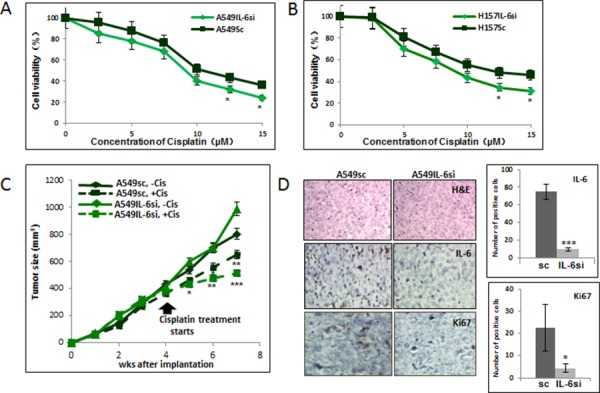
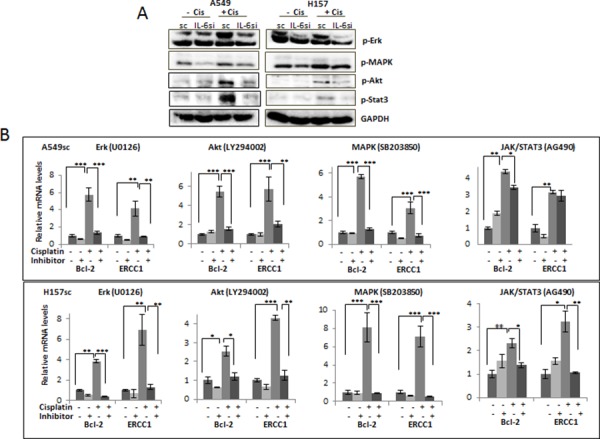
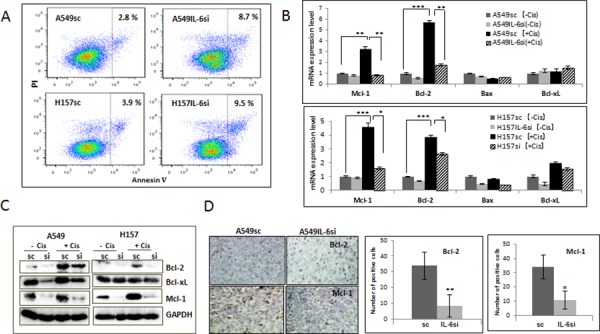
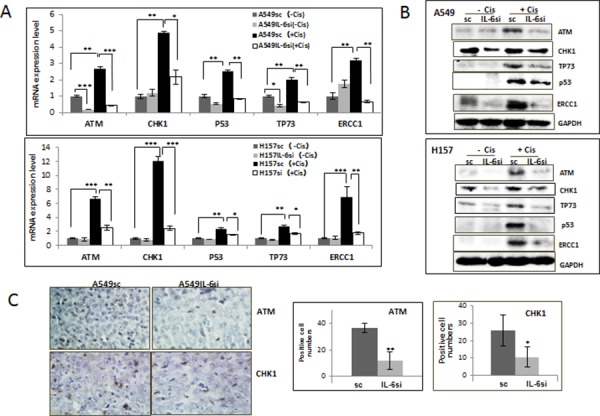
Cisplatin-based chemotherapy is currently the most effective treatment regimen for non-small cell lung cancer (NSCLC), but eventually tumor resistance develops which limits its success. The potential implication of IL-6 signaling in the cisplatin resistance of NSCLC was explored by testing whether NSCLC cells with different levels of intracellular IL-6 show different responses to the cytotoxic treatment of cisplatin. When the cisplatin cytotoxicity of the IL-6 knocked down human NSCLC cells (A549IL-6si and H157IL-6si) were compared with their corresponding scramble control cells (A549sc and H157sc), higher cisplatin cytotoxicity was found in IL-6 si cells than sc cells. Subcutaneous xenograft mouse models were developed using a pair of A549sc and A549IL-6si cells. When the tumor grew to about 400 mm2, mice were treated with cisplatin and tumor regression was monitored. Higher tumor regression was detected in the A549IL-6si xenografts compared to A549sc xenografts following cisplatin treatment. Immunostaining study results from tumor tissues also supported this finding. Expression of anti-apoptotic proteins Bcl-2 and Mcl-1 and DNA repair associated molecules ATM, CHK1, TP73, p53, and ERCC1 were significantly up regulated in cisplatin-treated A549sc and H157sc cells, but no increase was detected in A549IL-6si and H157IL-6si cells. Further inhibitor studies revealed that up regulation of these molecules by IL-6 may be through activation of IL-6 downstream signaling pathways like Akt, MAPK, Stat3, and Erk. These results provide potential for combining cisplatin and inhibitors of IL-6 signaling or its downstream signaling pathway as a future therapeutic approach in preventing development of cisplatin resistant NSCLC tumors.
基于顺铂的化疗是目前治疗非小细胞肺癌(NSCLC)最有效的治疗方案,但最终会出现肿瘤耐药性,这限制了其治疗效果。通过检测细胞内白细胞介素-6(IL-6)水平不同的NSCLC细胞对顺铂细胞毒性治疗的反应是否不同,探讨了IL-6信号传导在NSCLC顺铂耐药中的潜在影响。将白细胞介素-6敲低的人NSCLC细胞(A549IL-6si和H157IL-6si)与其相应的对照细胞(A549sc和H157sc)的顺铂细胞毒性进行比较,发现IL-6 si细胞中的顺铂细胞毒性高于对照细胞。使用一对A549sc和A549IL-6si细胞建立皮下异种移植小鼠模型。当肿瘤长到约400平方毫米时,用顺铂治疗小鼠并监测肿瘤消退情况。顺铂治疗后,与A549sc异种移植瘤相比,A549IL-6si异种移植瘤中检测到更高的肿瘤消退率。肿瘤组织的免疫染色研究结果也支持这一发现。在顺铂处理的A549sc和H157sc细胞中,抗凋亡蛋白Bcl-2和Mcl-1以及与DNA修复相关的分子ATM、CHK1、TP73、p53和ERCC1的表达显著上调,但在A549IL-6si和H157IL-6si细胞中未检测到增加。进一步的抑制剂研究表明,IL-6对这些分子的上调可能是通过激活IL-6下游信号通路如Akt、MAPK、Stat3和Erk实现的。这些结果为将顺铂与IL-6信号传导或其下游信号通路的抑制剂联合使用作为预防顺铂耐药NSCLC肿瘤发生的未来治疗方法提供了可能性。