Schmidt Lars Henning, Kümmel Andreas, Görlich Dennis, Mohr Michael, Bröckling Sebastian, Mikesch Jan Henrik, Grünewald Inga, Marra Alessandro, Schultheis Anne M, Wardelmann Eva, Müller-Tidow Carsten, Spieker Tilmann, Schliemann Christoph, Berdel Wolfgang E, Wiewrodt Rainer, Hartmann Wolfgang
Department of Medicine A, Hematology, Oncology and Pneumology, University Hospital Muenster, 48149 Muenster, Germany.
Pulmonary Division, Department of Medicine III, Johannes Gutenberg University Medical Center, 55101 Mainz, Germany.
PLoS One. 2015 Aug 27;10(8):e0136023. doi: 10.1371/journal.pone.0136023. eCollection 2015.
Immunotherapy can become a crucial therapeutic option to improve prognosis for lung cancer patients. First clinical trials with therapies targeting the programmed cell death receptor PD-1 and its ligand PD-L1 have shown promising results in several solid tumors. However, in lung cancer the diagnostic, prognostic and predictive value of these immunologic factors remains unclear.
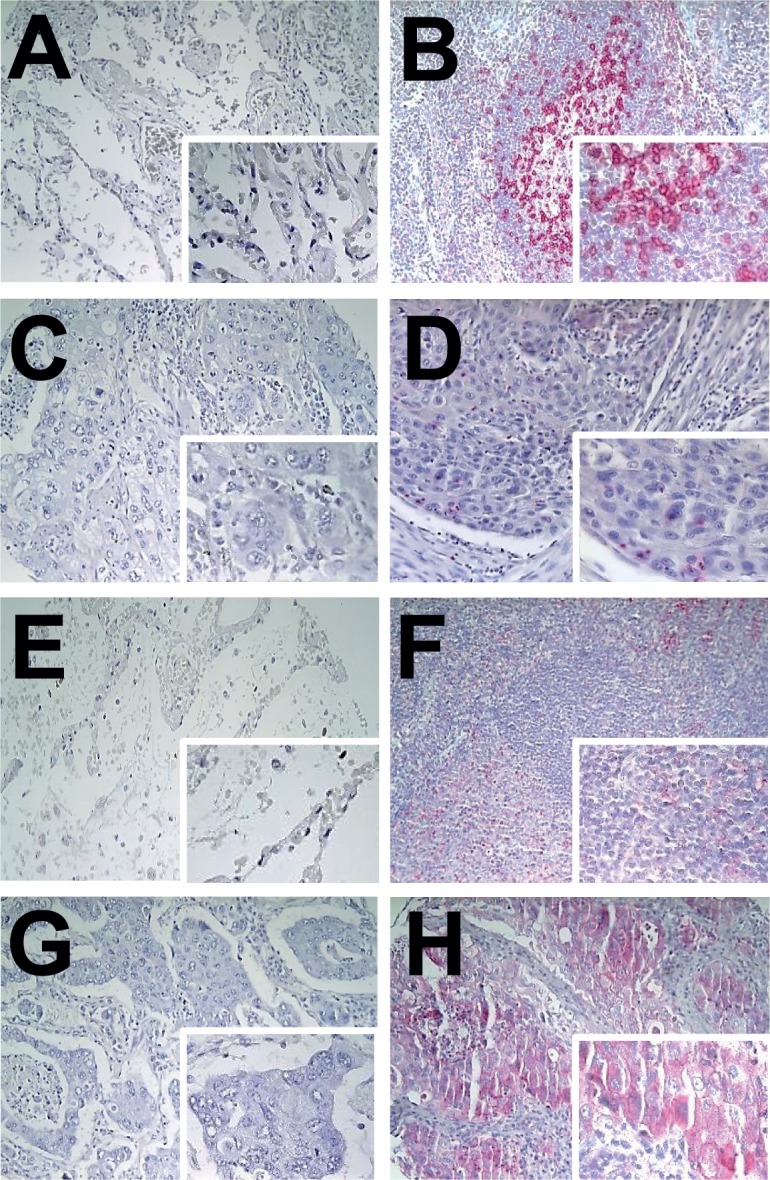
The impact of both factors was evaluated in a study collective of 321 clinically well-annotated patients with non-small lung cancer (NSCLC) using immunohistochemistry.
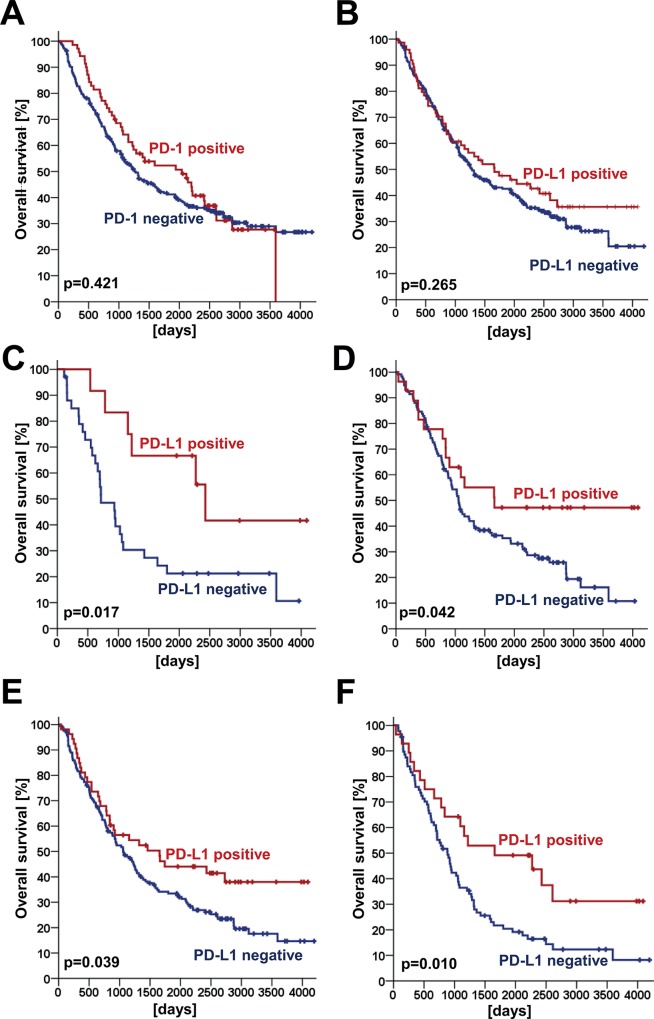
PD-1 expression by tumor infiltrating lymphocytes (TILs) was found in 22%, whereas tumor cell associated PD-L1 expression was observed in 24% of the NSCLC tumors. In Fisher's exact test a positive correlation was found for PD-L1 and Bcl-xl protein expression (p = 0.013). Interestingly, PD-L1 expression on tumor cells was associated with improved overall survival in pulmonary squamous cell carcinomas (SCC, p = 0.042, log rank test), with adjuvant therapy (p = 0.017), with increased tumor size (pT2-4, p = 0.039) and with positive lymph node status (pN1-3, p = 0.010). These observations were confirmed by multivariate cox regression models.
One major finding of our study is the identification of a prognostic implication of PD-L1 in subsets of NSCLC patients with pulmonary SCC, with increased tumor size, with a positive lymph node status and NSCLC patients who received adjuvant therapies. This study provides first data for immune-context related risk stratification of NSCLC patients. Further studies are necessary both to confirm this observation and to evaluate the predictive value of PD-1 and PD-L1 in NSCLC in the context of PD-1 inhibition.
免疫疗法可能成为改善肺癌患者预后的关键治疗选择。针对程序性细胞死亡受体PD - 1及其配体PD - L1的疗法进行的首批临床试验已在多种实体瘤中显示出有前景的结果。然而,在肺癌中,这些免疫因素的诊断、预后和预测价值仍不明确。
使用免疫组织化学方法,在321例临床注释完善的非小细胞肺癌(NSCLC)患者的研究队列中评估了这两种因素的影响。
在22%的肿瘤浸润淋巴细胞(TILs)中发现了PD - 1表达,而在24%的NSCLC肿瘤中观察到肿瘤细胞相关的PD - L1表达。在Fisher精确检验中,发现PD - L1与Bcl - xl蛋白表达呈正相关(p = 0.013)。有趣的是,肿瘤细胞上的PD - L1表达与肺鳞状细胞癌(SCC)患者的总生存期改善相关(p = 0.042,对数秩检验),与辅助治疗相关(p = 0.017),与肿瘤大小增加相关(pT2 - 4,p = 0.039)以及与阳性淋巴结状态相关(pN1 - 3,p = 0.010)。多变量Cox回归模型证实了这些观察结果。
我们研究的一个主要发现是确定了PD - L1在具有肺SCC、肿瘤大小增加、阳性淋巴结状态的NSCLC患者亚组以及接受辅助治疗的NSCLC患者中的预后意义。本研究为NSCLC患者的免疫背景相关风险分层提供了首批数据。有必要进一步开展研究以证实这一观察结果,并在PD - 1抑制的背景下评估PD - 1和PD - L1在NSCLC中的预测价值。