Kennedy Institute of Rheumatology and University of Oxford, Oxford, UK.
Dyax Corporation, Burlington, Massachusetts.
Arthritis Rheumatol. 2016 Feb;68(2):521-31. doi: 10.1002/art.39414.
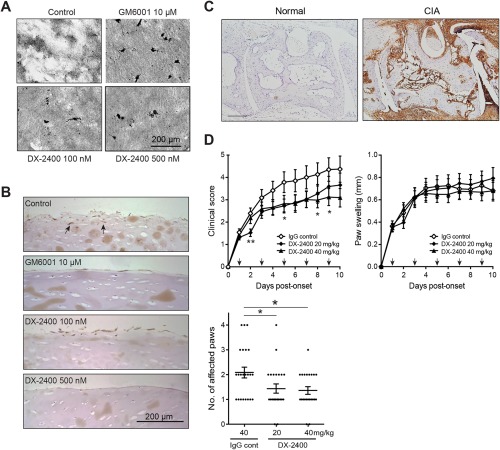
In rheumatoid arthritis (RA), destruction of articular cartilage by the inflamed synovium is considered to be driven by increased activities of proteolytic enzymes, including matrix metalloproteinases (MMPs). The purpose of this study was to investigate the therapeutic potential of selective inhibition of membrane type 1 MMP (MT1-MMP) and its combination with tumor necrosis factor (TNF) blockage in mice with collagen-induced arthritis (CIA).
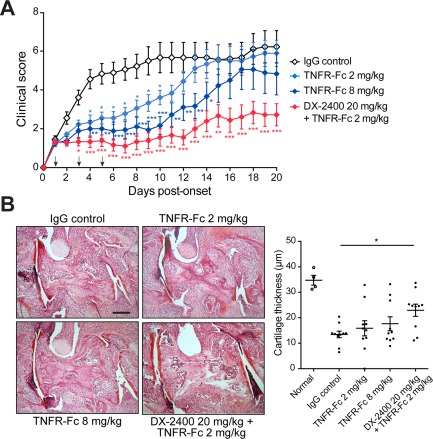
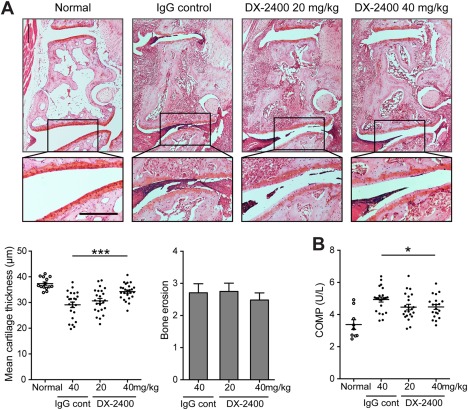
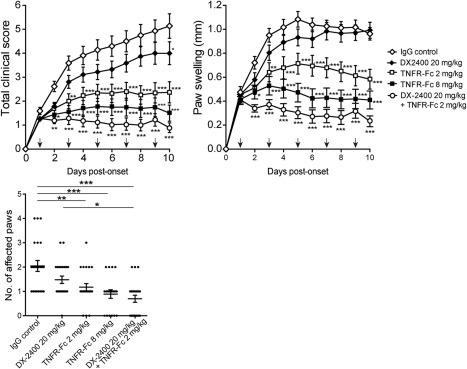
CIA was induced in DBA/1 mice by immunization with bovine type II collagen. From the onset of clinical arthritis, mice were treated with MT1-MMP selective inhibitory antibody DX-2400 and/or TNFR-Fc fusion protein. Disease progression was monitored daily, and serum, lymph nodes, and affected paws were collected at the end of the study for cytokine and histologic analyses. For in vitro analysis, bone marrow-derived macrophages were stimulated with lipopolysaccharide for 24 hours in the presence of DX-2400 and/or TNFR-Fc to analyze cytokine production and phenotype.
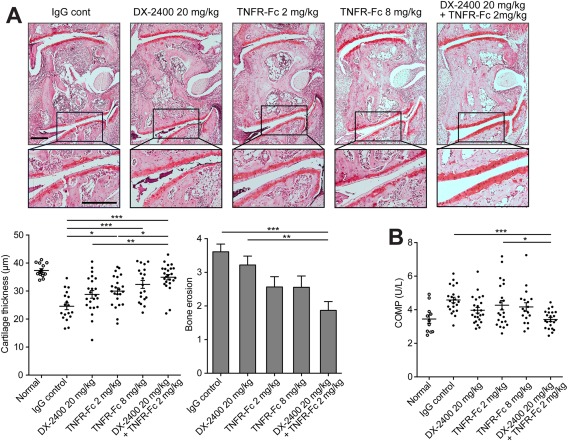
DX-2400 treatment significantly reduced cartilage degradation and disease progression in mice with CIA. Importantly, when combined with TNF blockade, DX-2400 acted synergistically, inducing long-term benefit. DX-2400 also inhibited the up-regulation of interleukin-12 (IL-12)/IL-23 p40 via polarization toward an M2 phenotype in bone marrow-derived macrophages. Increased production of IL-17 induced by anti-TNF, which correlated with an incomplete response to anti-TNF, was abrogated by combined treatment with DX-2400 in CIA.
Targeting MT1-MMP provides a potential strategy for joint protection, and its combination with TNF blockade may be particularly beneficial in RA patients with an inadequate response to anti-TNF therapy.
在类风湿关节炎(RA)中,炎症性滑膜对关节软骨的破坏被认为是由包括基质金属蛋白酶(MMPs)在内的蛋白水解酶活性增加所驱动的。本研究旨在探讨选择性抑制膜型 1 MMP(MT1-MMP)及其与肿瘤坏死因子(TNF)阻断联合治疗胶原诱导性关节炎(CIA)小鼠的治疗潜力。
通过用牛 II 型胶原免疫接种诱导 DBA/1 小鼠 CIA。从临床关节炎发病开始,用 MT1-MMP 选择性抑制抗体 DX-2400 和/或 TNFR-Fc 融合蛋白对小鼠进行治疗。每天监测疾病进展情况,并在研究结束时收集血清、淋巴结和受影响的爪子进行细胞因子和组织学分析。为了进行体外分析,用脂多糖刺激骨髓来源的巨噬细胞 24 小时,同时存在 DX-2400 和/或 TNFR-Fc,以分析细胞因子产生和表型。
DX-2400 治疗显著减少 CIA 小鼠的软骨降解和疾病进展。重要的是,当与 TNF 阻断联合使用时,DX-2400 表现出协同作用,诱导长期获益。DX-2400 还通过向骨髓来源的巨噬细胞的 M2 表型极化抑制白细胞介素-12(IL-12)/IL-23 p40 的上调。抗 TNF 诱导的 IL-17 产生增加与抗 TNF 反应不完全相关,这种增加被 DX-2400 联合治疗在 CIA 中消除。
靶向 MT1-MMP 为关节保护提供了一种潜在策略,其与 TNF 阻断联合治疗可能对抗 TNF 治疗反应不足的 RA 患者特别有益。