Division of Allergy, Immunology and Rheumatology, Taichung Veterans General Hospital, No, 160, Section 3, Taichung-Kang Road, Taichung, 407, Taiwan.
Arthritis Res Ther. 2011 Jul 30;13(4):R126. doi: 10.1186/ar3431.
The objective of this study was to investigate the effects of tumor necrosis factor (TNF)-α inhibitors on circulating T helper-type 17 (Th17) cells and Th17-related cytokines in patients with rheumatoid arthritis (RA).
The frequencies of circulating Th17 cells and serum levels of Th17-related cytokines were determined using flow cytometry analysis and ELISA, respectively, in 48 RA patients both before (baseline) and six months after anti-TNF-α therapy. Therapeutic response was evaluated using European League Against Rheumatism (EULAR) response criteria.
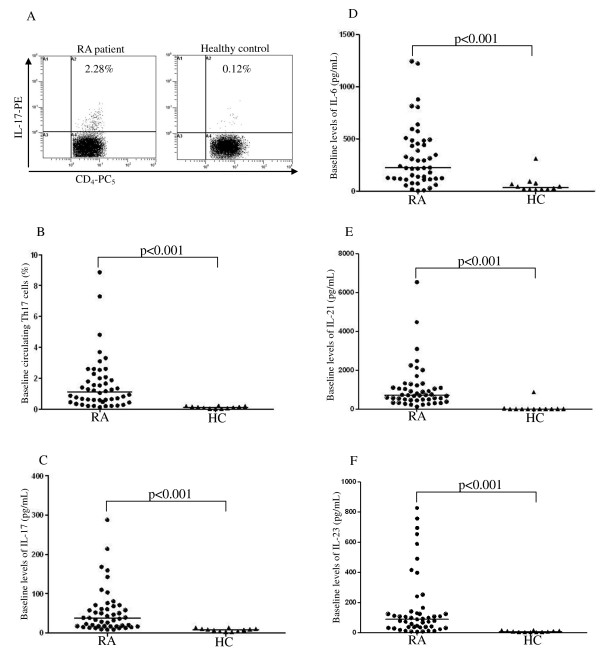
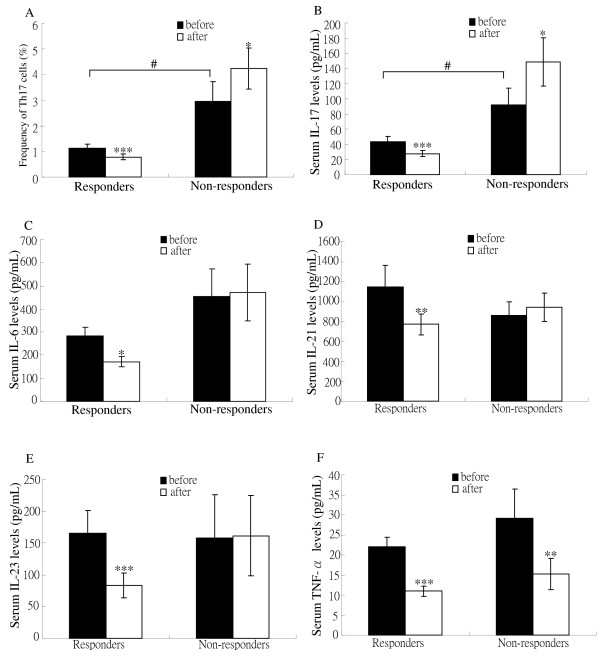
Significantly higher baseline frequencies of circulating Th17 cells and serum levels of interleukin (IL)-6, IL-17, IL-21, IL-23 and TNF-α were observed in active RA patients than in 12 healthy controls (all P < 0.001). After anti-TNF-α therapy, 36 patients (75%) were EULAR responders (20 good responders and 16 moderate responders) and 12 (25.0%) were non-responders. The mean levels of circulating Th17 cells and IL-17 significantly decreased (1.13% vs. 0.79%; 43.1 pg/ml vs. 27.8 pg/ml; respectively, both P < 0.001) in parallel with clinical remission in responders. Levels of IL-6, IL-21, IL-23 and TNF-α were significantly decreased after anti-TNF-α therapy in responders. In contrast, the mean levels of circulating Th17 cells and IL-17 significantly increased after anti-TNF-α therapy (2.94% vs. 4.23%; 92.1 pg/ml vs. 148.6 pg/ml; respectively, both P < 0.05) in non-responders. Logistic regression analysis identified a high baseline level of IL-17 as a significant predictor of poor therapeutic response.
The beneficial effect of anti-TNF-α therapy might involve a decrease in Th17-related cytokines in responders, whereas rising levels of circulating Th17-cells and IL-17 were observed in patients with an inadequate response to anti-TNF-α therapy.
本研究旨在探讨肿瘤坏死因子(TNF)-α 抑制剂对类风湿关节炎(RA)患者循环 T 辅助型 17(Th17)细胞和 Th17 相关细胞因子的影响。
采用流式细胞术分析和 ELISA 法分别检测 48 例 RA 患者治疗前(基线)和抗 TNF-α 治疗后 6 个月的循环 Th17 细胞频率和 Th17 相关细胞因子水平。采用欧洲抗风湿病联盟(EULAR)缓解标准评估治疗反应。
活动期 RA 患者循环 Th17 细胞频率和血清白细胞介素(IL)-6、IL-17、IL-21、IL-23 和 TNF-α水平明显高于 12 例健康对照者(均 P < 0.001)。抗 TNF-α 治疗后,36 例(75%)患者为 EULAR 缓解者(20 例为完全缓解者,16 例为部分缓解者),12 例(25.0%)为无缓解者。缓解者循环 Th17 细胞和 IL-17 水平分别显著下降(1.13%比 0.79%;43.1 pg/ml 比 27.8 pg/ml;均 P < 0.001),同时达到临床缓解。缓解者抗 TNF-α 治疗后 IL-6、IL-21、IL-23 和 TNF-α 水平均显著下降。相比之下,无缓解者抗 TNF-α 治疗后循环 Th17 细胞和 IL-17 水平明显升高(2.94%比 4.23%;92.1 pg/ml 比 148.6 pg/ml;均 P < 0.05)。Logistic 回归分析显示,IL-17 基线水平高是治疗反应不佳的显著预测因素。
抗 TNF-α 治疗的有益效果可能涉及缓解者 Th17 相关细胞因子水平降低,而抗 TNF-α 治疗反应不足的患者循环 Th17 细胞和 IL-17 水平升高。