Tsai Yung-Chieh, Lee Yen-Mei, Hsu Chih-Hsiung, Leu Sy-Ying, Chiang Hsiao-Yen, Yen Mao-Hsiung, Cheng Pao-Yun
Department of Obstetrics and Gynecology, Chi-Mei Medical Center, Tainan, Taiwan.
Department of Medicine, Taipei Medical University, Taipei, Taiwan.
Exp Mol Med. 2015 Aug 28;47(8):e180. doi: 10.1038/emm.2015.56.
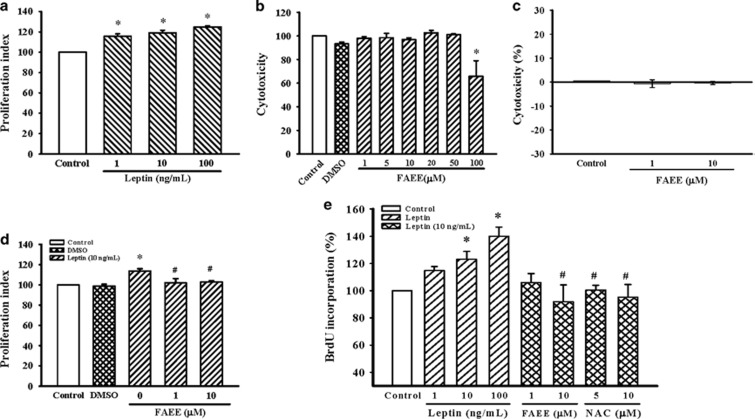
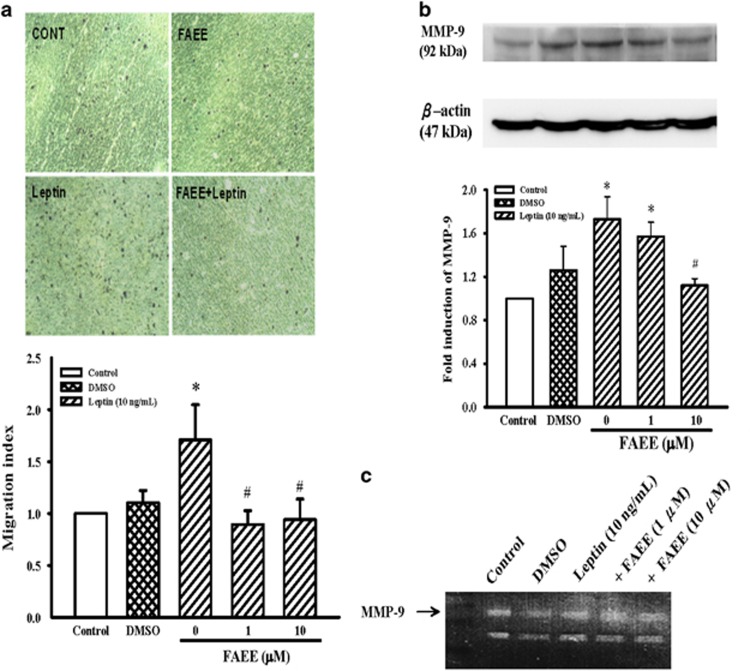
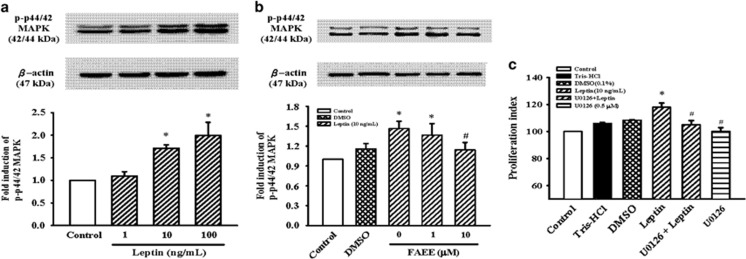
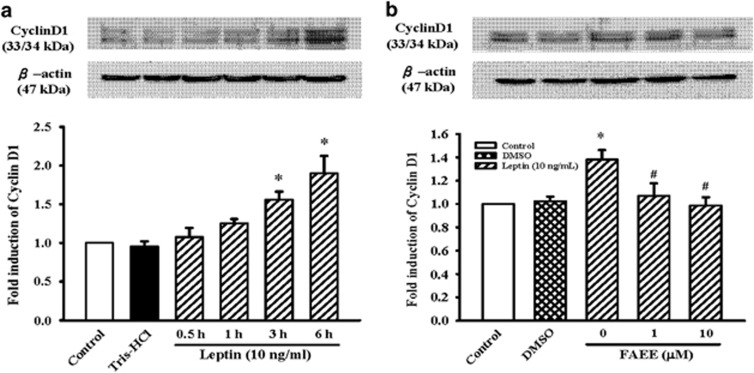
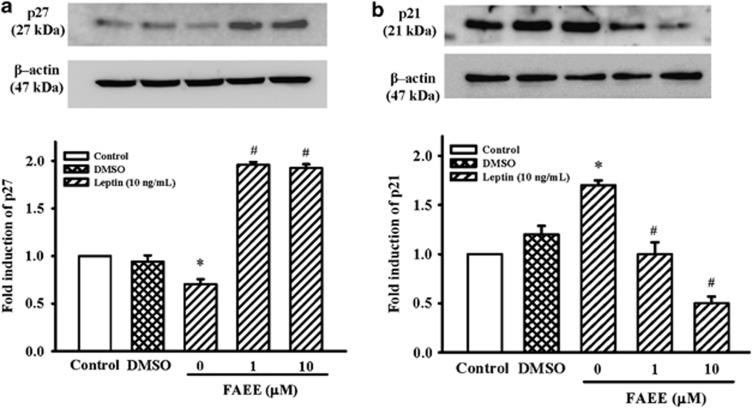
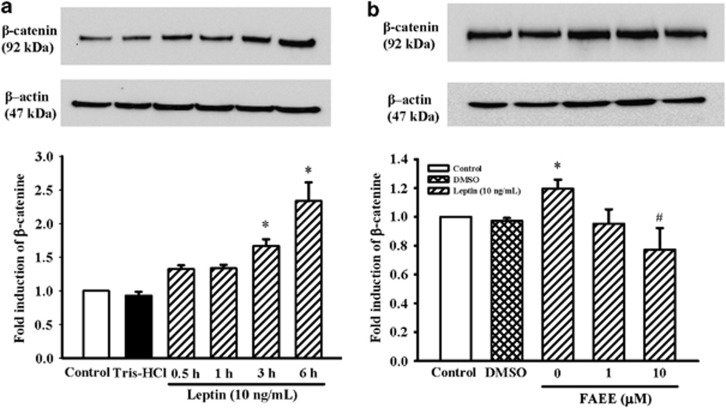
Leptin is a peptide hormone, which has a central role in the regulation of body weight; it also exerts many potentially atherogenic effects. Ferulic acid ethyl ester (FAEE) has been approved for antioxidant properties. The aim of this study was to investigate whether FAEE can inhibit the atherogenic effects of leptin and the possible molecular mechanism of its action. Both of cell proliferation and migration were measured when the aortic smooth muscle cell (A10 cell) treated with leptin and/or FAEE. Phosphorylated p44/42MAPK, cell cycle-regulatory protein (for example, cyclin D1, p21, p27), β-catenin and matrix metalloproteinase-9 (MMP-9) proteins levels were also measured. Results demonstrated that leptin (10, 100 ng ml(-1)) significantly increased the proliferation of cells and the phosphorylation of p44/42MAPK in A10 cells. The proliferative effect of leptin was significantly reduced by the pretreatment of U0126 (0.5 μM), a MEK inhibitor, in A10 cells. Meanwhile, leptin significantly increased the protein expression of cyclin D1, p21, β-catenin and decreased the expression of p27 in A10 cells. In addition, leptin (10 ng ml(-1)) significantly increased the migration of A10 cells and the expression of MMP-9 protein. Above effects of leptin were significantly reduced by the pretreatment of FAEE (1 and 10 μM) in A10 cells. In conclusion, FAEE exerts multiple effects on leptin-induced cell proliferation and migration, including the inhibition of p44/42MAPK phosphorylation, cell cycle-regulatory proteins and MMP-9, thereby suggesting that FAEE may be a possible therapeutic approach to the inhibition of obese vascular disease.
瘦素是一种肽类激素,在体重调节中起核心作用;它还具有许多潜在的致动脉粥样硬化作用。阿魏酸乙酯(FAEE)因其抗氧化特性已获认可。本研究的目的是探究FAEE是否能抑制瘦素的致动脉粥样硬化作用及其可能的作用分子机制。在用瘦素和/或FAEE处理主动脉平滑肌细胞(A10细胞)后,检测细胞增殖和迁移情况。还检测了磷酸化的p44/42MAPK、细胞周期调节蛋白(如细胞周期蛋白D1、p21、p27)、β-连环蛋白和基质金属蛋白酶-9(MMP-9)的蛋白水平。结果表明,瘦素(10、100 ng ml⁻¹)显著增加A10细胞的增殖及p44/42MAPK的磷酸化。MEK抑制剂U0126(0.5 μM)预处理A10细胞可显著降低瘦素的增殖作用。同时,瘦素显著增加A10细胞中细胞周期蛋白D1、p21、β-连环蛋白的蛋白表达,并降低p27的表达。此外,瘦素(10 ng ml⁻¹)显著增加A10细胞的迁移及MMP-9蛋白的表达。A10细胞经FAEE(1和10 μM)预处理后,上述瘦素的作用显著降低。总之,FAEE对瘦素诱导的细胞增殖和迁移具有多种作用,包括抑制p44/42MAPK磷酸化、细胞周期调节蛋白和MMP-9,从而提示FAEE可能是抑制肥胖相关血管疾病的一种潜在治疗方法。