Korkut Sabriye, Gökalp Emir, Özdemir Ahmet, Kurtoğlu Selim, Demirtaş Şafak, Gül Ülkü, Baştuğ Osman
Erciyes University Faculty of Medicine, Department of Neonatology, Kayseri, Turkey Phone:+90 352 207 66 66 E-mail:
J Clin Res Pediatr Endocrinol. 2015 Jun;7(2):155-8. doi: 10.4274/jcrpe.1740.
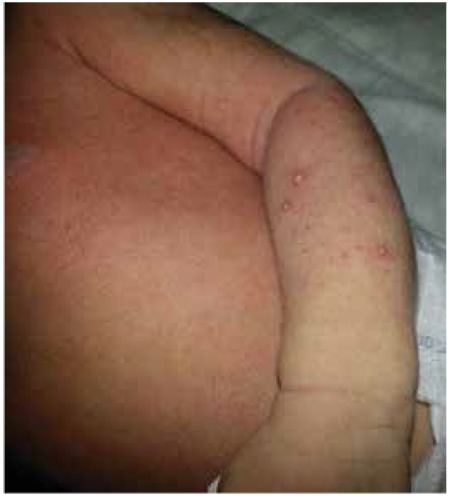
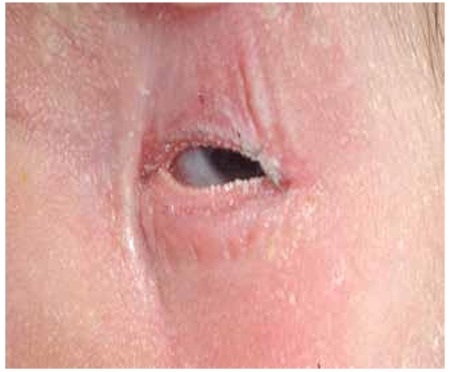
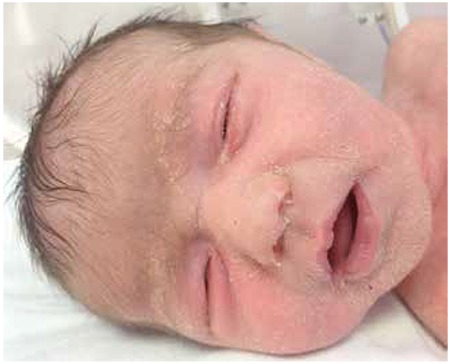
Pseudohypoaldosteronism (PHA) is defined as a state of resistance to aldosterone, a hormone crucial for electrolyte equilibrium. The genetically transmitted type of PHA is primary hypoaldosteronism. Secondary hypoaldosteronism develops as a result of hydronephrosis or hydroureter. PHA patients suffer from severe hyponatremia and a severe clinical condition due to severe loss of salt can be encountered in the neonatal period. Dermal findings in the form of miliaria rubra can also develop in these patients. With the loss of salt, abnormal accumulation of sebum in the eye due to a defect in the sodium channels can also occur. In this paper, a case of PHA in a newborn showing typical dermatological and ophthalmological findings is presented.
假性醛固酮减少症(PHA)被定义为对醛固酮产生抵抗的一种状态,醛固酮是一种对电解质平衡至关重要的激素。PHA的遗传传递类型为原发性醛固酮减少症。继发性醛固酮减少症是由肾积水或输尿管积水引起的。PHA患者会出现严重低钠血症,在新生儿期可能会因严重失盐而出现严重的临床状况。这些患者还可能出现粟粒疹形式的皮肤表现。由于钠通道缺陷,随着盐分流失,眼睛中也可能出现皮脂异常积聚。本文介绍了一例新生儿PHA病例,该病例表现出典型的皮肤病学和眼科表现。