Gao Ying, Gao Fei, Ma Jin-Lu, Zhang Xiao-Zhi, Li Yi, Song Li-Ping, Zhao Dong-Li
Department of Radiotherapy Oncology, First Affiliated Hospital of Xi'an Jiaotong University, Xi'an, People's Republic of China.
Department of Neurology, First Affiliated Hospital of Xi'an Medical University, Xi'an, People's Republic of China.
Patient Prefer Adherence. 2015 Aug 19;9:1189-94. doi: 10.2147/PPA.S87069. eCollection 2015.
Lung cancer is still the leading cause of cancer-related deaths worldwide. However, most elderly patients with advanced non-small-cell lung cancer (NSCLC) have been undertreated and the outcome related to age is controversial. A retrospective analysis was conducted for advanced NSCLC in order to investigate the characteristics and prognosis of older patients.
Medical records were collected from 165 patients with NSCLC (stages IIIA-IIIB) who had been treated with concurrent chemoradiotherapy (CRT) or radiotherapy from January 2009 to January 2011. The cases were divided into two age groups 1) patients ≥70 years old; 2) patients <70 years old. There were 73 patients in group I, 92 in group II. Patient characteristics, treatment toxicities, and prognosis were evaluated.
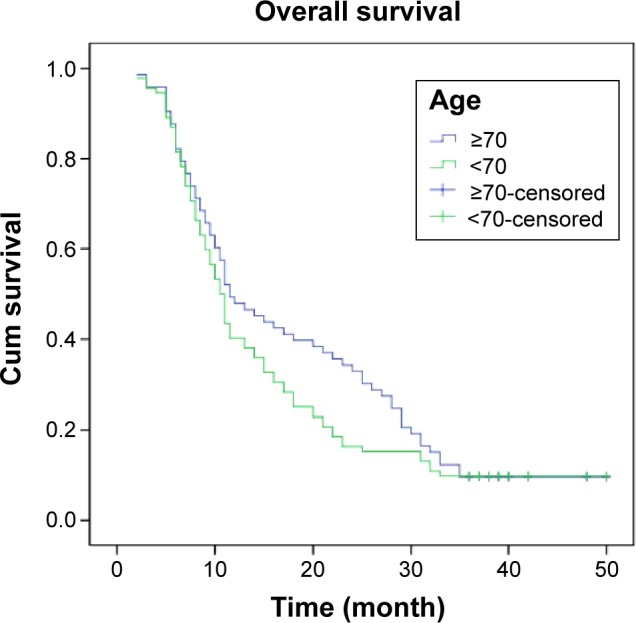
Of the 165 patients analyzed, 34 patients (34/73) in group I received concurrent CRT while 47 (47/92) in group II completed that treatment. No significant difference was observed in the reason for patients who discontinued CRT in two groups (P>0.05). In the patients with adenocarcinoma, more cases were found in group II than that in group I; the more squamous cell carcinoma and the more smokers with squamous cell carcinoma were seen in older group (P<0.05). With a median follow-up of 20.5 months, the 1-year survival for group I and II were 49.3% and 40.2% respectively (P=0.243). Two-year survival for the two groups was 20.5% and 16.3% (P=0.483); 3-year survival was 9.6% and 9.8% (P=0.967). There was no significant difference between two groups statistically in survival by univariate analysis (P>0.05). The therapy-related toxicities in group I seem to be similar to the group II (P>0.05).
More adenocarcinoma patients were found in youthful lung cancer and the more smokers with squamous cell carcinoma were seen in older group. Age is not the important factor for the selection and allocation of treatment in advanced NSCLC. The same prognosis and toxicities had been shown in older and young. Age may not be an independent increased risk of death in advanced NSCLC.
肺癌仍是全球癌症相关死亡的主要原因。然而,大多数老年晚期非小细胞肺癌(NSCLC)患者治疗不足,且年龄与预后的关系存在争议。对晚期NSCLC进行回顾性分析,以调查老年患者的特征和预后。
收集2009年1月至2011年1月期间接受同步放化疗(CRT)或放疗的165例NSCLC(IIIA-IIIB期)患者的病历。病例分为两个年龄组:1)≥70岁的患者;2)<70岁的患者。第一组有73例患者,第二组有92例。评估患者特征、治疗毒性和预后。
在分析的165例患者中,第一组34例(34/73)接受同步CRT,第二组47例(47/92)完成该治疗。两组中停止CRT的患者原因无显著差异(P>0.05)。腺癌患者中,第二组比第一组多;老年组鳞状细胞癌及鳞状细胞癌吸烟者更多(P<0.05)。中位随访20.5个月,第一组和第二组的1年生存率分别为49.3%和40.2%(P=0.243)。两组的2年生存率分别为20.5%和16.3%(P=0.483);3年生存率分别为9.6%和9.8%(P=0.967)。单因素分析两组生存率无统计学显著差异(P>0.05)。第一组的治疗相关毒性似乎与第二组相似(P>0.05)。
年轻肺癌患者中腺癌患者较多,老年组鳞状细胞癌吸烟者较多。年龄不是晚期NSCLC治疗选择和分配的重要因素。老年和年轻患者的预后和毒性相同。年龄可能不是晚期NSCLC死亡风险增加的独立因素。