Kamijo-Ikemori Atsuko, Hashimoto Nobuyuki, Sugaya Takeshi, Matsui Katsuomi, Hisamichi Mikako, Shibagaki Yugo, Miyake Fumihiko, Kimura Kenjiro
Department of Nephrology and Hypertension, St Marianna University School of Medicine, Kawasaki, Kanagawa, Japan ; Department of Anatomy, St Marianna University School of Medicine, Kawasaki, Kanagawa, Japan.
Department of Cardiology, St Marianna University School of Medicine, Kawasaki, Kanagawa, Japan.
Int J Nephrol Renovasc Dis. 2015 Aug 18;8:91-9. doi: 10.2147/IJNRD.S88467. eCollection 2015.
Contrast medium (CM) induces tubular hypoxia via endothelial damage due to direct cytotoxicity or viscosity. Urinary liver-type fatty acid binding protein (L-FABP) increases along with tubular hypoxia and may be a detector of systemic circulation injury. The aim of this study was to evaluate the clinical usefulness of detecting increases in urinary L-FABP levels due to administration of CM, as a prognostic biomarker for cardiovascular disease in patients without occurrence of CM-induced nephropathy undergoing cardiac catheterization procedure (CCP).
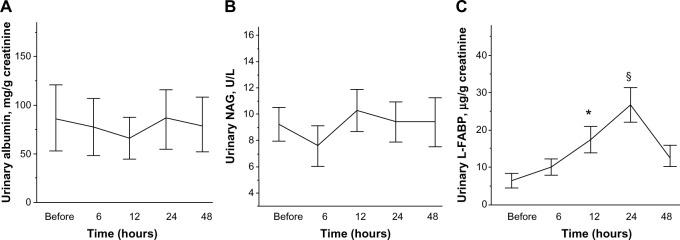
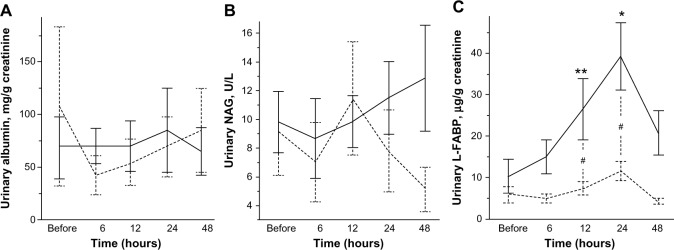
Retrospective longitudinal analyses of the relationship between urinary L-FABP levels and occurrence of cardiovascular events were performed (n=29). Urinary L-FABP was measured by ELISA before CCP, and at 6, 12, 24, and 48 hours after CCP.
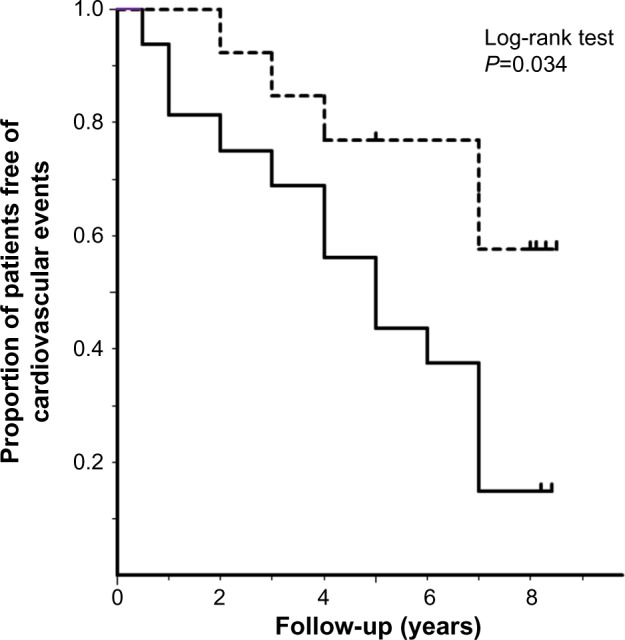
Urinary L-FABP levels were significantly higher at 12 hours (P<0.05) and 24 hours (P<0.005) after CCP compared with before CCP, only in the patients with occurrence of cardiovascular events (n=17), but not in those without cardiovascular events (n=12). The parameter with the largest area under the curve (0.816) for predicting the occurrence of cardiovascular events was the change in urinary L-FABP at 24 hours after CCP. The difference in urinary L-FABP levels (ΔL-FABP ≥11.0 μg/g creatinine) between before CCP and at 24 hours after CCP was a risk factor for the occurrence of cardiovascular events (hazard ratio, 4.93; 95% confidence interval, 1.27-19.13; P=0.021).
Measurement of urinary L-FABP before CCP and at 24 hours after CCP in patients with mild to moderate renal dysfunction may be an important indicator for risk stratification of onset of cardiovascular events.
造影剂(CM)可通过直接细胞毒性或粘度导致内皮损伤,进而引起肾小管缺氧。尿肝型脂肪酸结合蛋白(L-FABP)会随着肾小管缺氧而升高,可能是全身循环损伤的一个检测指标。本研究的目的是评估在接受心脏导管插入术(CCP)且未发生CM诱导的肾病的患者中,检测因CM给药导致的尿L-FABP水平升高作为心血管疾病预后生物标志物的临床实用性。
对尿L-FABP水平与心血管事件发生之间的关系进行回顾性纵向分析(n = 29)。在CCP前以及CCP后6、12、24和48小时通过酶联免疫吸附测定法(ELISA)测量尿L-FABP。
仅在发生心血管事件的患者(n = 17)中,CCP后12小时(P < 0.05)和24小时(P < 0.005)的尿L-FABP水平显著高于CCP前,而在未发生心血管事件的患者(n = 12)中则不然。预测心血管事件发生的曲线下面积最大的参数(0.816)是CCP后24小时尿L-FABP的变化。CCP前与CCP后24小时之间尿L-FABP水平的差异(ΔL-FABP≥11.0μg/g肌酐)是心血管事件发生的一个危险因素(风险比,4.93;95%置信区间,1.27 - 19.13;P = 0.021)。
在轻度至中度肾功能不全的患者中,CCP前和CCP后24小时测量尿L-FABP可能是心血管事件发病风险分层的一个重要指标。