Shi Fangfang, Len Yamei, Gong Yuping, Shi Rui, Yang Xi, Naren Duolan, Yan Tianyou
Department of Hematology, West China Hospital, Sichuan University, Chengdu, Sichuan, China.
PLoS One. 2015 Aug 28;10(8):e0136746. doi: 10.1371/journal.pone.0136746. eCollection 2015.
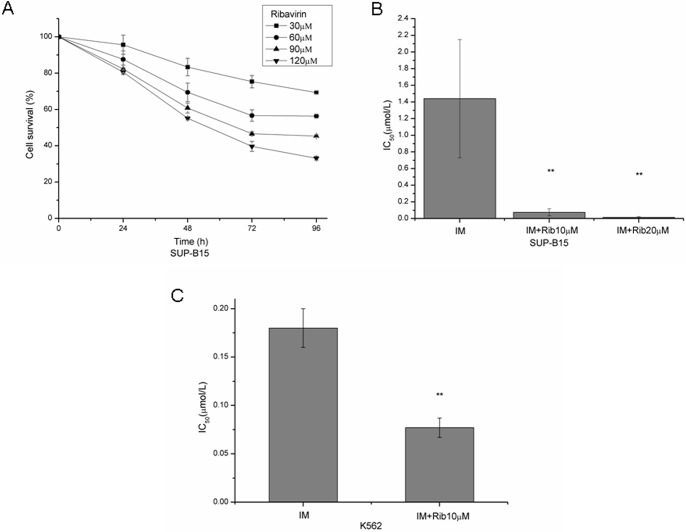
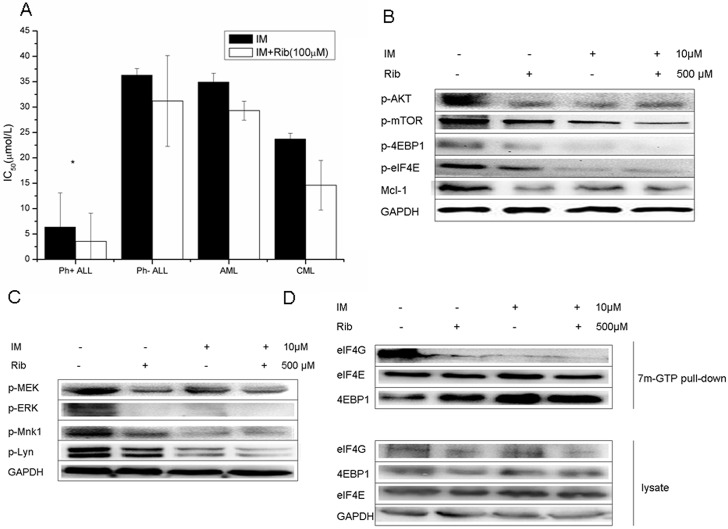
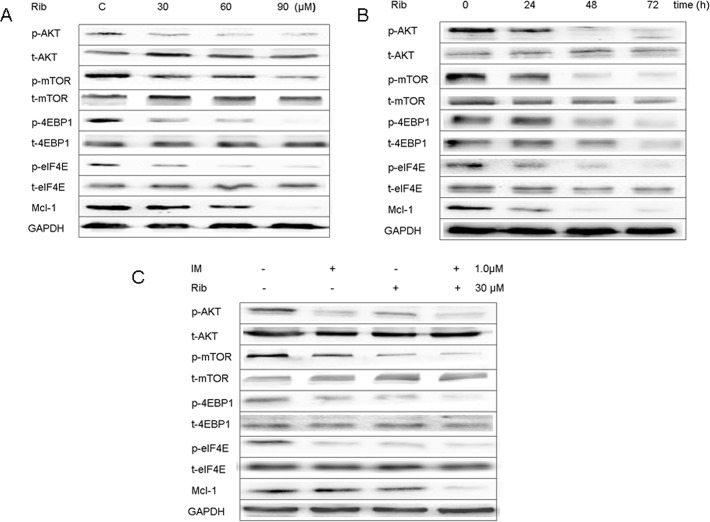
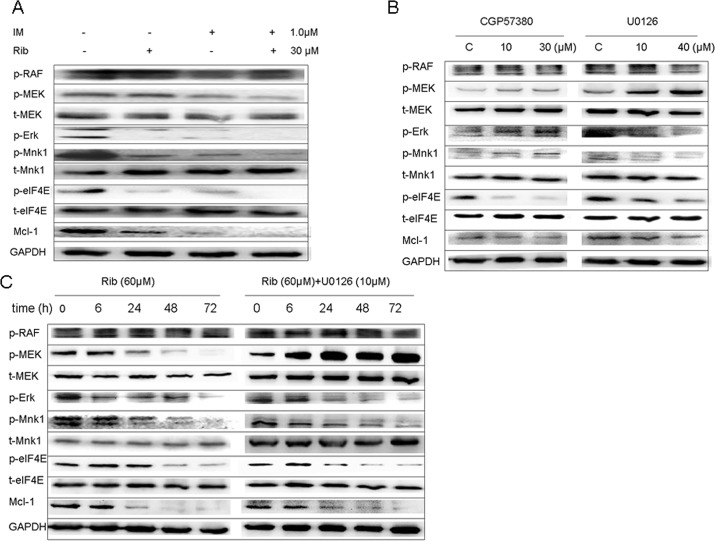
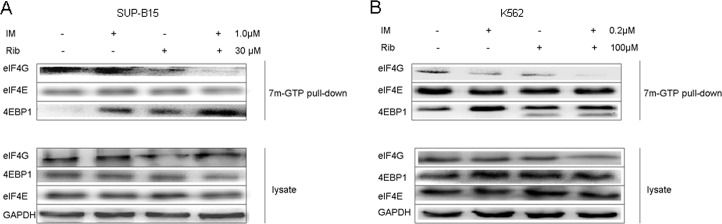
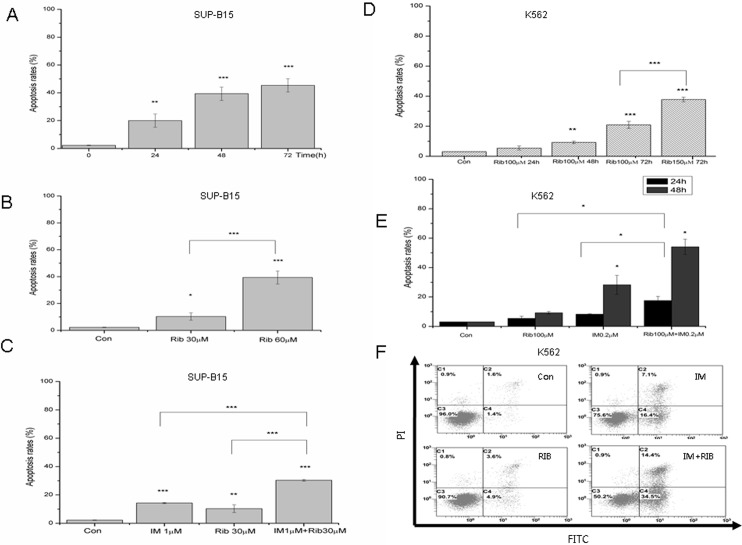
The eukaryotic translation initiation factor 4E (eIF4E), which is the main composition factor of eIF4F translation initiation complex, influences the growth of tumor through modulating cap-dependent protein translation. Previous studies reported that ribavirin could suppress eIF4E-controlled translation and reduce the synthesis of onco-proteins. Here, we investigated the anti-leukemic effects of ribavirin alone or in combination with tyrosine kinase inhibitor imatinib in Philadelphia chromosome positive (Ph+) leukemia cell lines SUP-B15 (Ph+ acute lymphoblastic leukemia cell line, Ph+ ALL) and K562 (chronic myelogenous leukemia cell line, CML). Our results showed that ribavirin had anti-proliferation effect; it down-regulated the phosphorylation levels of Akt, mTOR, 4EBP1, and eIF4E proteins in the mTOR/eIF4E signaling pathway, and MEK, ERK, Mnk1 and eIF4E proteins in ERK/Mnk1/eIF4E signaling pathway; reduced the expression of Mcl-1 (a translation substrates of eIF4F translation initiation complex) at protein synthesis level not mRNA transcriptional level; and induced cell apoptosis in both SUP-B15 and K562. 7-Methyl-guanosine cap affinity assay further demonstrated that ribavirin remarkably increased the eIF4E binding to 4EBP1 and decreased the combination of eIF4E with eIF4G, consequently resulting in a major inhibition of eIF4F complex assembly. The combination of ribavirin with imatinib enhanced antileukemic effects mentioned above, indicating that two drugs have synergistic anti-leukemic effect. Consistent with the cell lines, similar results were observed in Ph+ acute lymphoblastic primary leukemic blasts; however, the anti-proliferative role of ribavirin in other types of acute primary leukemic blasts was not obvious, which indicated that the anti-leukemic effect of ribavirin was different in cell lineages.
真核生物翻译起始因子4E(eIF4E)是eIF4F翻译起始复合物的主要组成因子,通过调节帽依赖性蛋白翻译影响肿瘤生长。以往研究报道,利巴韦林可抑制eIF4E控制的翻译并减少癌蛋白的合成。在此,我们研究了利巴韦林单独或与酪氨酸激酶抑制剂伊马替尼联合对费城染色体阳性(Ph +)白血病细胞系SUP - B15(Ph +急性淋巴细胞白血病细胞系,Ph + ALL)和K562(慢性粒细胞白血病细胞系,CML)的抗白血病作用。我们的结果表明,利巴韦林具有抗增殖作用;它下调了mTOR / eIF4E信号通路中Akt、mTOR、4EBP1和eIF4E蛋白的磷酸化水平,以及ERK / Mnk1 / eIF4E信号通路中MEK、ERK、Mnk1和eIF4E蛋白的磷酸化水平;在蛋白质合成水平而非mRNA转录水平降低了Mcl - 1(eIF4F翻译起始复合物的翻译底物)的表达;并诱导SUP - B15和K562细胞凋亡。7 - 甲基鸟苷帽亲和力测定进一步表明,利巴韦林显著增加了eIF4E与4EBP1的结合,并减少了eIF4E与eIF4G的结合,从而导致eIF4F复合物组装受到主要抑制。利巴韦林与伊马替尼联合增强了上述抗白血病作用,表明两种药物具有协同抗白血病作用。与细胞系一致,在Ph +急性淋巴细胞白血病原代白血病细胞中观察到类似结果;然而,利巴韦林在其他类型急性原代白血病细胞中的抗增殖作用不明显,这表明利巴韦林的抗白血病作用在细胞谱系中有所不同。