Haverinen-Shaughnessy Ulla, Shaughnessy Richard J
Indoor Air Program, the University of Tulsa, 600 S College Ave, Tulsa, OK, 74104, United States of America; National Institute for Health and Welfare, Department of Health Protection, P.O. Box 95, 70701, Kuopio, Finland.
Indoor Air Program, the University of Tulsa, 600 S College Ave, Tulsa, OK, 74104, United States of America.
PLoS One. 2015 Aug 28;10(8):e0136165. doi: 10.1371/journal.pone.0136165. eCollection 2015.
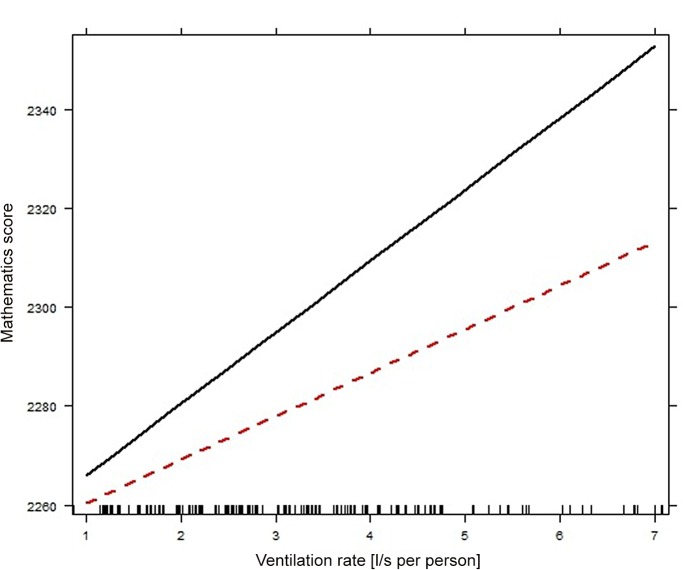
Using a multilevel approach, we estimated the effects of classroom ventilation rate and temperature on academic achievement. The analysis is based on measurement data from a 70 elementary school district (140 fifth grade classrooms) from Southwestern United States, and student level data (N = 3109) on socioeconomic variables and standardized test scores. There was a statistically significant association between ventilation rates and mathematics scores, and it was stronger when the six classrooms with high ventilation rates that were indicated as outliers were filtered (> 7.1 l/s per person). The association remained significant when prior year test scores were included in the model, resulting in less unexplained variability. Students' mean mathematics scores (average 2286 points) were increased by up to eleven points (0.5%) per each liter per second per person increase in ventilation rate within the range of 0.9-7.1 l/s per person (estimated effect size 74 points). There was an additional increase of 12-13 points per each 1°C decrease in temperature within the observed range of 20-25°C (estimated effect size 67 points). Effects of similar magnitude but higher variability were observed for reading and science scores. In conclusion, maintaining adequate ventilation and thermal comfort in classrooms could significantly improve academic achievement of students.
我们采用多层次方法,估计了教室通风率和温度对学业成绩的影响。该分析基于美国西南部一个拥有70所小学(140间五年级教室)的学区的测量数据,以及关于社会经济变量和标准化考试成绩的学生层面数据(N = 3109)。通风率与数学成绩之间存在统计学上的显著关联,当将被视为异常值的六间通风率高的教室(每人> 7.1升/秒)过滤掉后,这种关联更强。当模型中纳入上一年的考试成绩时,该关联仍然显著,从而减少了无法解释的变异性。在每人0.9 - 7.1升/秒的通风率范围内,每人每秒每增加一升通风率,学生的平均数学成绩(平均2286分)最多可提高11分(0.5%)(估计效应大小为74分)。在20 - 25°C的观测温度范围内,温度每降低1°C,成绩额外提高12 - 13分(估计效应大小为67分)。阅读和科学成绩也观察到了类似幅度但变异性更高的影响。总之,保持教室充足的通风和热舒适度可显著提高学生的学业成绩。