Sanfélix-Gimeno Gabriel, Hurtado Isabel, Sanfélix-Genovés José, Baixauli-Pérez Cristóbal, Rodríguez-Bernal Clara L, Peiró Salvador
Health Services Research Unit, Center for Public Health Research (FISABIO), Valencia, Spain; Red de Investigación en Servicios de Salud en Enfermedades Crónicas (REDISSEC), Valencia, Spain.
Health Services Research Unit, Center for Public Health Research (FISABIO), Valencia, Spain; Red de Investigación en Servicios de Salud en Enfermedades Crónicas (REDISSEC), Valencia, Spain; Fundación de Investigación del Hospital Clínico Universitario-Instituto de Investigación Sanitaria INCLIVA. Valencia, Spain.
PLoS One. 2015 Aug 28;10(8):e0135475. doi: 10.1371/journal.pone.0135475. eCollection 2015.
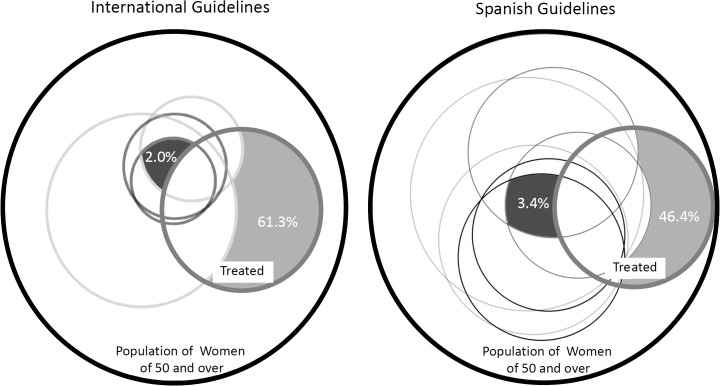
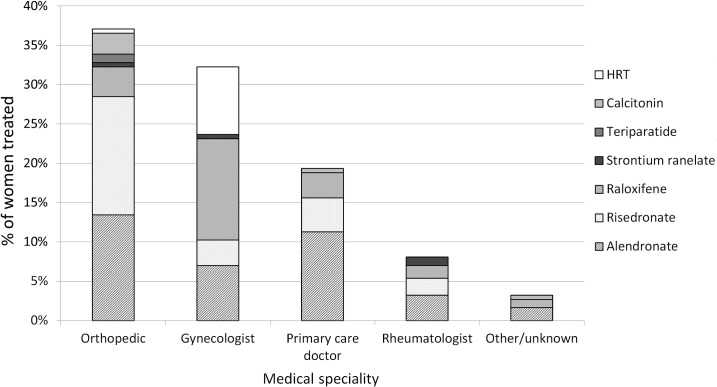
Inappropriate prescribing of antiosteoporotic medications has been observed; however, the joint study of both overuse and underuse has barely been attempted. Spain, with its high utilization rates, constitutes a good example to assess differences in over and under use according to diverse highly-influential osteoporosis guidelines (HIOG) worldwide. We used data of a population-based cross-sectional study including 824 post-menopausal women ≥50 years old living in the city of Valencia, Spain and aimed to estimate the percentage of women eligible for treatment, and the proportion of overuse and underuse of antiosteoporotic treatment according to HIOG. The prevalence of antiosteoporotic treatment in postmenopausal women ≥ 50 in Valencia was 20.9% (95%CI:17.6-24.4). The type of antiosteoporotic drugs prescribed varied greatly depending on the medical specialty responsible of the initial prescription. When applying the HIOG, the percentage of women 50 and over who should be treated varied from less than 9% to over 44%. In real terms, from the approximately eight million women of 50 years old and over in Spain, the number eligible for treatment would range from 0.7 to 3.8 million, depending on the guideline used. A huge proportion of inappropriate treatments was found when applying these guidelines to the Spanish population, combining a high overuse (42-78% depending on the guideline used) and underuse (7-41%). In conclusion, we found that the pharmacological management of osteoporosis in women of 50 and over in this population combines an important overuse and, to a lesser extent, underuse, although the level of inappropriateness varied strikingly depending on the CPG used. It seems urgent to reduce treatment overuse without neglecting underuse, as is urgent an attempt to reach wider agreement worldwide regarding osteoporosis management, in order to facilitate appropriate treatment and development of policies to reduce effectively treatment inappropriateness.
已观察到抗骨质疏松药物的不适当处方情况;然而,对用药过量和用药不足的联合研究几乎尚未尝试过。西班牙的利用率很高,是一个很好的例子,可以根据全球不同的高影响力骨质疏松症指南(HIOG)来评估用药过量和不足的差异。我们使用了一项基于人群的横断面研究数据,该研究包括824名居住在西班牙巴伦西亚市、年龄≥50岁的绝经后妇女,旨在估计符合治疗条件的妇女百分比,以及根据HIOG评估的抗骨质疏松治疗用药过量和不足的比例。巴伦西亚市年龄≥50岁的绝经后妇女中抗骨质疏松治疗的患病率为20.9%(95%CI:17.6 - 24.4)。所开抗骨质疏松药物的类型因负责初始处方的医学专科不同而有很大差异。应用HIOG时,50岁及以上应接受治疗的妇女百分比从不到9%到超过44%不等。实际上,在西班牙约800万50岁及以上的妇女中,符合治疗条件的人数根据所使用的指南在070万至380万之间。将这些指南应用于西班牙人群时,发现了很大比例的不适当治疗情况,用药过量比例较高(根据所使用的指南为42% - 78%),用药不足比例为(7% - 41%)。总之,我们发现该人群中50岁及以上妇女的骨质疏松症药物治疗存在重要的用药过量情况,在较小程度上也存在用药不足情况,尽管不适当程度因所使用的临床实践指南而异。在不忽视用药不足的情况下减少治疗用药过量似乎很紧迫,同样紧迫的是试图在全球范围内就骨质疏松症管理达成更广泛的共识,以便促进适当治疗并制定政策有效减少治疗不适当情况。