Choe Jung-Yoon, Prodanovic Nenad, Niebrzydowski Jaroslaw, Staykov Ivan, Dokoupilova Eva, Baranauskaite Asta, Yatsyshyn Roman, Mekic Mevludin, Porawska Wieskawa, Ciferska Hana, Jedrychowicz-Rosiak Krystyna, Zielinska Agnieszka, Choi Jasmine, Rho Young Hee, Smolen Josef S
Department of Internal Medicine, Catholic University of Daegu School of Medicine, Daegu, South Korea.
Clinical Center Banja Luka, Banja Luka, Bosnia and Herzegovina.
Ann Rheum Dis. 2017 Jan;76(1):58-64. doi: 10.1136/annrheumdis-2015-207764. Epub 2015 Aug 28.
To compare the efficacy, safety, immunogenicity and pharmacokinetics (PK) of SB2 to the infliximab reference product (INF) in patients with moderate to severe rheumatoid arthritis (RA) despite methotrexate therapy.
This is a phase III, randomised, double-blind, multinational, multicentre parallel group study. Patients with moderate to severe RA despite methotrexate therapy were randomised in a 1:1 ratio to receive either SB2 or INF of 3 mg/kg. The primary end point was the American College of Rheumatology 20% (ACR20) response at week 30. Inclusion of the 95% CI of the ACR20 response difference within a ±15% margin was required for equivalence.
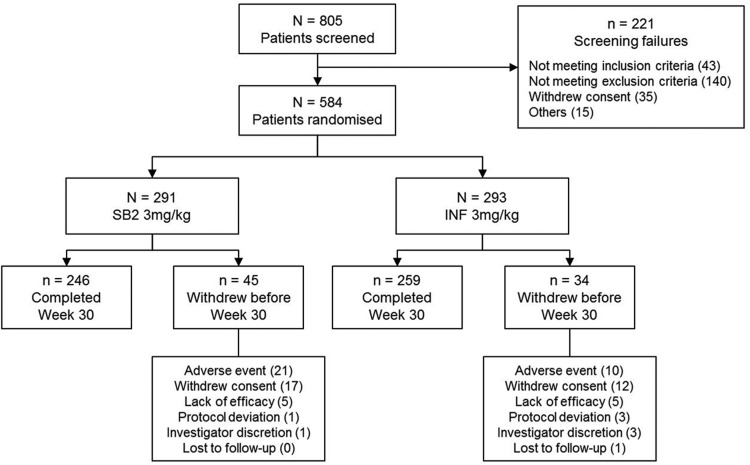
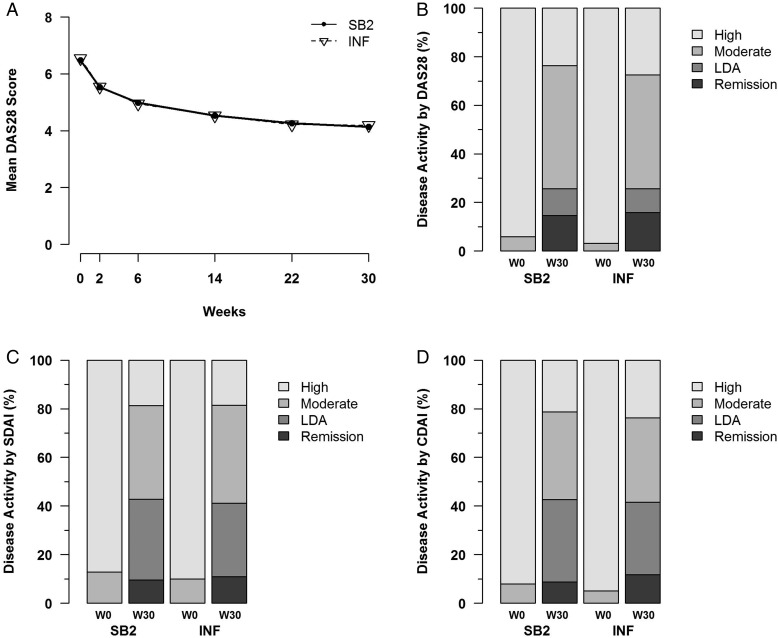
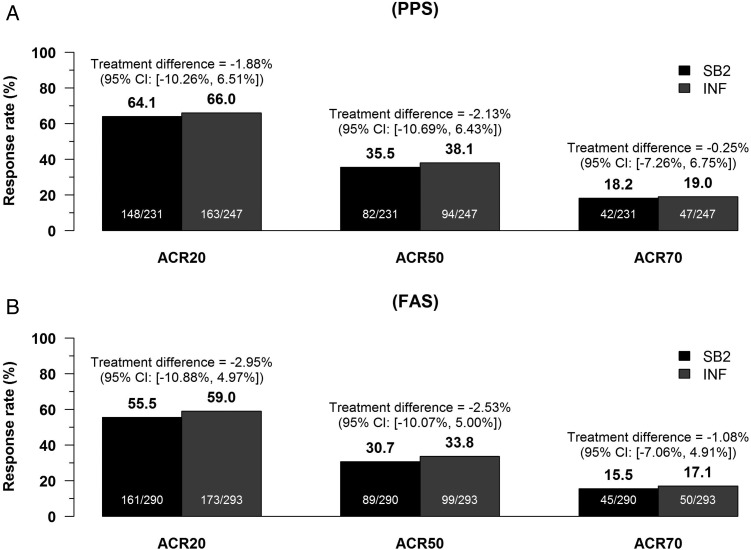
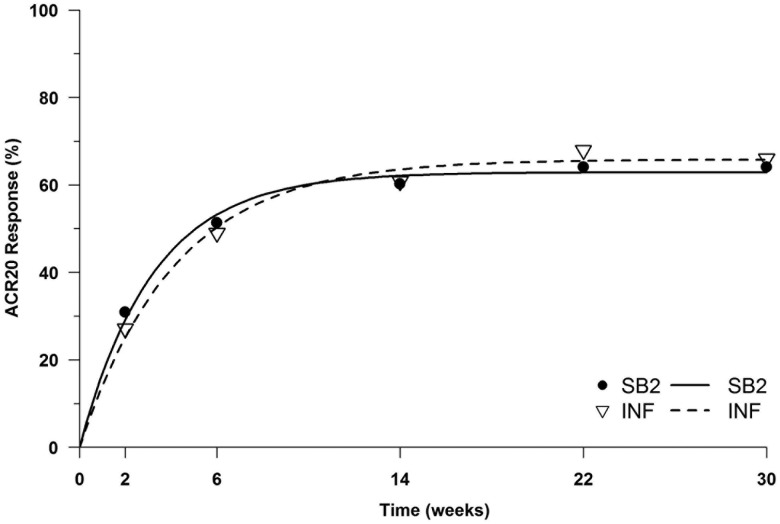
584 subjects were randomised into SB2 (N=291; 290 analysed) or INF (N=293). The ACR20 response at week 30 in the per-protocol set was 64.1% in SB2 versus 66.0% in INF. The adjusted rate difference was -1.88% (95% CI -10.26% to 6.51%), which was within the predefined equivalence margin. Other efficacy outcomes such as ACR50/70, disease activity score measured by 28 joints and European League against Rheumatism response were similar between SB2 and INF. The incidence of treatment-emergent adverse events was comparable (57.6% in SB2 vs 58.0% in INF) as well as the incidence of antidrug antibodies (ADA) to infliximab up to week 30 (55.1% in SB2 vs 49.7% in INF). The PK profile was similar between SB2 and INF. Efficacy, safety and PK by ADA subgroup were comparable between SB2 and INF.
SB2 was equivalent to INF in terms of ACR20 response at week 30. SB2 was well tolerated with a comparable safety profile, immunogenicity and PK to INF.
NCT01936181.
比较SB2与英夫利昔单抗对照产品(INF)在接受甲氨蝶呤治疗的中度至重度类风湿性关节炎(RA)患者中的疗效、安全性、免疫原性和药代动力学(PK)。
这是一项III期、随机、双盲、多国家、多中心平行组研究。尽管接受了甲氨蝶呤治疗,但中度至重度RA患者按1:1比例随机分组,接受3 mg/kg的SB2或INF。主要终点是第30周时美国风湿病学会20%(ACR20)反应。等效性要求ACR20反应差异的95%置信区间包含在±15%范围内。
584名受试者被随机分为SB2组(N = 291;分析290例)或INF组(N = 293)。在符合方案集的第30周时,SB2组的ACR20反应为64.1%,INF组为66.0%。调整后的率差为-1.88%(95%置信区间为-10.26%至6.51%),在预定义的等效范围内。SB2和INF之间的其他疗效结果,如ACR50/70、28个关节测量的疾病活动评分和欧洲抗风湿病联盟反应相似。治疗中出现的不良事件发生率相当(SB2组为57.6%,INF组为58.0%),至第30周时抗英夫利昔单抗抗体(ADA)的发生率也相当(SB2组为55.1%,INF组为49.7%)。SB2和INF之间的PK曲线相似。SB2和INF在ADA亚组中的疗效、安全性和PK相当。
在第30周时,SB2在ACR20反应方面与INF等效。SB2耐受性良好,安全性、免疫原性和PK与INF相当。
NCT01936181。