Stecklov Guy, Weinreb Alexander A, Sana Mariano
Department of Sociology and Anthropology, The Hebrew University of Jerusalem, Jerusalem, Israel.
Department of Sociology and Population Research Center, University of Texas at Austin, Austin, Texas, United States of America.
PLoS One. 2015 Aug 31;10(8):e0136972. doi: 10.1371/journal.pone.0136972. eCollection 2015.
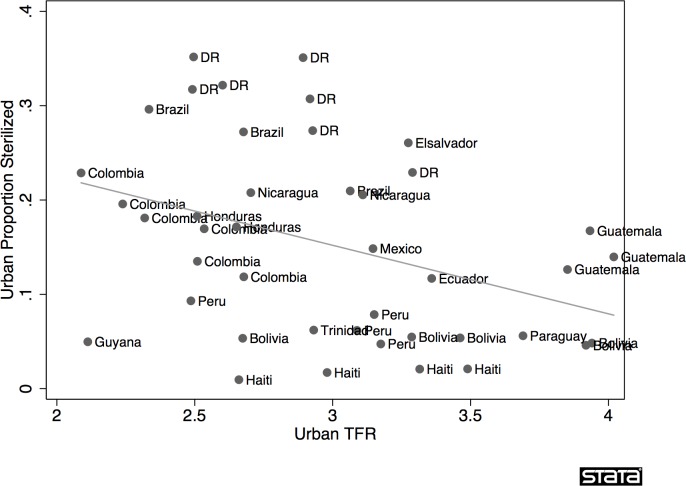
Sterilization levels reported in the Dominican Republic appear well above what we would normally expect given prevailing patterns in the region. We suspect that the use of strangers as interviewers--the normative approach in data collection in both developed and developing country settings--may be partly responsible for this result, and may underlie a long history of bias in family planning data. We present findings from a field experiment conducted in a Dominican town in 2010, where interviewer assignment was randomized by level of preexisting level of familiarity between interviewer and respondent. In our data, sterilization use is higher when the interviewer is an outsider, as opposed to someone known to the respondent or from the same community. In addition, high sterilization use is correlated with a propensity of respondents to present themselves in a positive light to interviewers. These results call into question the routine use of strangers and outsiders as interviewers in demographic and health surveys.
多米尼加共和国报告的绝育率似乎远高于根据该地区普遍模式我们通常所预期的水平。我们怀疑,使用陌生人作为访谈者(这在发达国家和发展中国家的数据收集工作中都是规范做法)可能是造成这一结果的部分原因,并且可能是计划生育数据长期存在偏差的根源。我们展示了2010年在多米尼加一个城镇进行的一项实地实验的结果,在该实验中,访谈者的分配是根据访谈者与受访者之间预先存在的熟悉程度随机进行的。在我们的数据中,当访谈者是局外人时,绝育的使用率更高,这与受访者认识或来自同一社区的人作为访谈者的情况相反。此外,高绝育使用率与受访者向访谈者展现积极形象的倾向相关。这些结果对在人口与健康调查中常规使用陌生人和局外人作为访谈者提出了质疑。