Park Sook Ryun, Ryu Min-Hee, Ryoo Baek-Yeol, Beck Mo Youl, Lee In Soon, Choi Mi Jung, Lee Mi Woo, Kang Yoon-Koo
Department of Oncology, Asan Medical Center, University of Ulsan College of Medicine, Seoul, Korea.
Department of Dermatology, Asan Medical Center, University of Ulsan College of Medicine, Seoul, Korea.
Cancer Res Treat. 2016 Jan;48(1):162-70. doi: 10.4143/crt.2015.017. Epub 2015 Sep 1.
This study evaluated the incidence of imatinib-associated skin rash, the interventional outcomes of severe rash, and impact of severe rash on the outcomes of imatinib treatment in gastrointestinal stromal tumor (GIST) patients.
A total of 620 patients were administered adjuvant or palliative imatinib for GIST at Asan Medical Center between January 2000 and July 2012. This analysis focused on a group of 42 patients who developed a severe rash requiring major interventions, defined as dose interruption or reduction of imatinib or systemic steroid use.
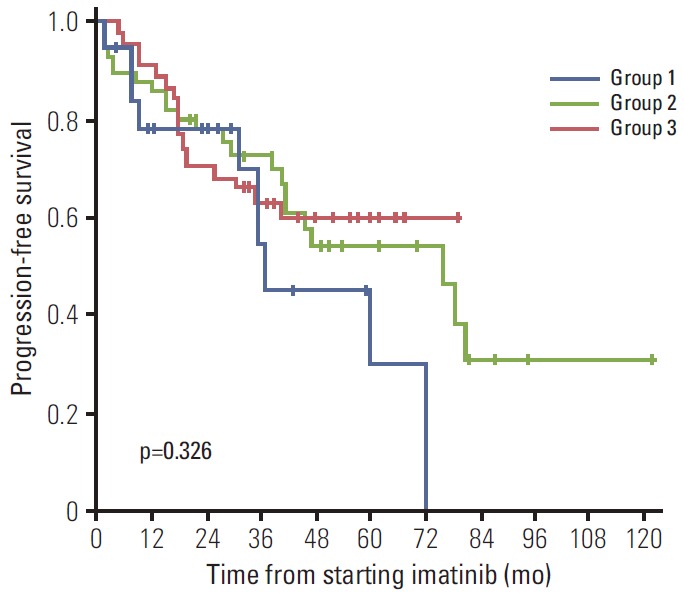
Of the 620 patients treated with imatinib, 148 patients (23.9%) developed an imatinib-associated skin rash; 42 patients (6.8%) developed a severe rash requiring major intervention. Of these, 28 patients (66.8%) successfully continued imatinib with interventions. Serial blood eosinophil levels during imatinib treatment were associated with skin rash and severity. A significant association was observed between successful intervention and blood eosinophil level at the time of intervention initiation. In metastatic settings, patients with severe rash requiring major interventions tended to show poorer progression-free survival than patients who did not require major intervention and patients with no rash, although this finding was not statistically significant (p=0.326).
By aggressive treatment of severe rash through modification of imatinib dose or use of systemic steroid, the majority of patients can continue on imatinib. In particular, imatinib dose intensity can be maintained with use of systemic steroid. Measuring the blood eosinophil levels may be helpful in guiding the management plan for skin rash regarding the intensity and duration of interventions.
本研究评估了伊马替尼相关皮疹的发生率、严重皮疹的干预结果以及严重皮疹对胃肠道间质瘤(GIST)患者伊马替尼治疗结果的影响。
2000年1月至2012年7月期间,共有620例患者在峨山医学中心接受伊马替尼辅助或姑息治疗GIST。本分析聚焦于一组42例出现严重皮疹且需要进行重大干预的患者,重大干预定义为伊马替尼剂量中断或减少或使用全身性类固醇。
在接受伊马替尼治疗的620例患者中,148例(23.9%)出现伊马替尼相关皮疹;42例(6.8%)出现需要重大干预的严重皮疹。其中,28例(66.8%)通过干预成功继续使用伊马替尼。伊马替尼治疗期间的系列血嗜酸性粒细胞水平与皮疹及严重程度相关。在开始干预时,成功干预与血嗜酸性粒细胞水平之间观察到显著关联。在转移性情况下,需要进行重大干预的严重皮疹患者的无进展生存期往往比不需要重大干预的患者和无皮疹患者更差,尽管这一发现无统计学意义(p=0.326)。
通过调整伊马替尼剂量或使用全身性类固醇积极治疗严重皮疹,大多数患者可以继续使用伊马替尼。特别是,使用全身性类固醇可维持伊马替尼剂量强度。测量血嗜酸性粒细胞水平可能有助于指导关于皮疹干预强度和持续时间的管理计划。