Yoon Hong In, Park Kyu Hyun, Lee Eun-Jung, Keum Ki Chang, Lee Chang Geol, Kim Chul Hoon, Kim Yong Bae
Department of Pharmacology, Brain Korea 21 PLUS Project for Medical Science, Yonsei University College of Medicine, Seoul, Korea.
Department of Radiation Oncology, Yonsei Cancer Center, Yonsei University College of Medicine, Seoul, Korea.
Cancer Res Treat. 2016 Apr;48(2):473-82. doi: 10.4143/crt.2015.116. Epub 2015 Aug 12.
The purpose of this study is to investigate the prognostic significance of SOX2 gene amplification and expression in patients with American Joint Committee on Cancer stage III lung squamous cell carcinoma (SCC) who underwent surgery followed by adjuvant radiotherapy.
Pathological specimens were obtained from 33 patients with stage III lung SCC treated with surgery followed by adjuvant radiotherapy between 1996 and 2008. SOX2 gene amplification and protein expression were analyzed using fluorescent in situ hybridization and immunohistochemistry, respectively. Patients were divided into two groups according to their SOX2 gene amplification and protein expression status. Kaplan-Meier estimates and a Cox proportional hazards model were used to identify the prognostic factors affecting patient survival.
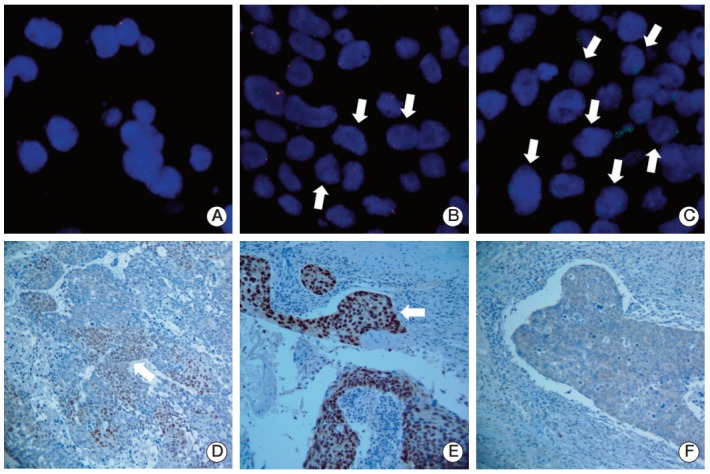
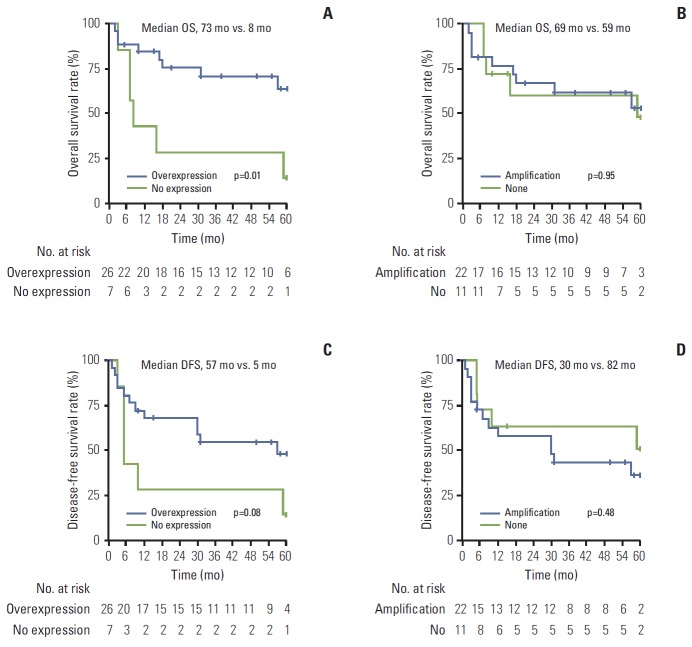
The median follow-up period for surviving patients was 58 months (range, 5 to 102 months). SOX2 gene amplification was observed in 22 patients and protein overexpression in 26 patients. SOX2 overexpression showed significant association with SOX2 gene amplification (p=0.002). In multivariate analysis, SOX2 overexpression was a significant prognostic factor for overall survival (OS) (hazard ratios [HR], 0.1; 95% confidence interval [CI], 0.002 to 0.5; p=0.005) and disease-free survival (DFS) (HR, 0.15; 95% CI, 0.04 to 0.65; p=0.01). Age (HR, 0.33; 95% CI, 0.11 to 0.98; p=0.046) and total radiation dose (HR, 0.13; 95% CI, 0.02 to 0.7; p=0.02) were the independent prognostic factors for OS and DFS. Patients with SOX2 amplification did not show a longer OS (p=0.95) and DFS (p=0.48).
Our data suggested that SOX2 overexpression could be used as a positive prognostic factor in patients with stage III lung SCC receiving adjuvant radiotherapy.
本研究旨在探讨SOX2基因扩增及表达在接受手术及辅助放疗的美国癌症联合委员会III期肺鳞状细胞癌(SCC)患者中的预后意义。
收集1996年至2008年间33例接受手术及辅助放疗的III期肺SCC患者的病理标本。分别采用荧光原位杂交和免疫组化分析SOX2基因扩增及蛋白表达情况。根据SOX2基因扩增及蛋白表达状态将患者分为两组。采用Kaplan-Meier法估计生存率并使用Cox比例风险模型确定影响患者生存的预后因素。
存活患者的中位随访期为58个月(范围5至102个月)。22例患者观察到SOX2基因扩增,26例患者出现蛋白过表达。SOX2过表达与SOX2基因扩增显著相关(p = 0.002)。多因素分析中,SOX2过表达是总生存期(OS)(风险比[HR],0.1;95%置信区间[CI],0.002至0.5;p = 0.005)和无病生存期(DFS)(HR,0.15;95%CI,0.04至0.65;p = 0.01)的显著预后因素。年龄(HR,0.33;95%CI,0.11至0.98;p = 0.046)和总放疗剂量(HR,0.13;95%CI,0.02至0.7;p = 0.02)是OS和DFS的独立预后因素。SOX2扩增患者的OS(p = 0.95)和DFS(p = 0.48)未延长。
我们的数据表明,SOX2过表达可作为接受辅助放疗的III期肺SCC患者的阳性预后因素。